 FotonMedix











news
Company News丨Industry News丨Products News
Search the whole station
Company News丨Industry News丨Products News
When discussing dog laser therapy for arthritis, we must first address the physiological reality: Is it possible for light to reverse structural bone changes or grade-IV cartilage loss?
The honest clinical answer is no. Once a joint has undergone significant remodeling or “bone-on-bone” attrition, no non-invasive modality can regrow that lost architecture. However, we then ask: Why, then, is it considered the gold standard for management?
It is because arthritis is not just a structural failure; it is a chronic inflammatory syndrome. While we cannot “fix” the bone, we can fundamentally reset the chemical environment of the joint capsule. Laser therapy shifts the joint from a pro-inflammatory state to a regenerative state.
In laser therapy in veterinary medicine, the primary goal is to trigger a biological response through a process called Photobiomodulation (PBM).
The target is the enzyme Cytochrome C Oxidase within the mitochondria. When Class IV laser energy (specifically in the 810nm-980nm range) hits this enzyme, it displaces Nitric Oxide, which typically inhibits cellular respiration during inflammation. This allows oxygen to bind, accelerating the production of Adenosine Triphosphate (ATP).
Chronic arthritis creates a “soup” of substance P, prostaglandins, and interleukins within the synovial fluid. High-intensity laser therapy stimulates lymph drainage and inhibits the synthesis of these inflammatory mediators. This provides an analgesic effect that, unlike drugs, does not require processing by the liver or kidneys.
For dog laser therapy for arthritis, power isn’t just about speed; it’s about depth.
Clinic: Highland Veterinary Rehabilitation Center
Patient: “Max,” a 12-year-old Neutered Male Labrador Retriever
Weight: 38.5 kg
Diagnosis: Severe Bilateral Coxofemoral Osteoarthritis (Secondary to Hip Dysplasia)
Max presented with a Grade 4/5 lameness in the hind limbs. His owners reported he was unable to stand on hardwood floors without assistance and had become aggressive when touched near his lower back. He was currently on a maximum dose of Grapiprant with diminishing returns.
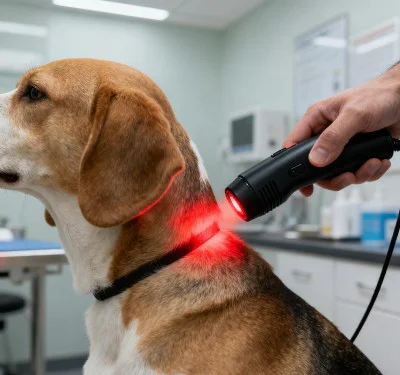
Is laser therapy superior to traditional pharmacology? In veterinary medicine, we view it as a partnership.
| Feature | NSAIDs (Drugs) | Laser Therapy (PBM) | PRP/Stem Cell |
| Systemic Impact | High (Liver/Kidney stress) | None | Low |
| Onset of Action | Fast (Hours) | Cumulative (Days) | Slow (Weeks) |
| Tissue Repair | None (Masks pain) | Active (Stimulates ATP) | High (Regenerative) |
| Invasiveness | Oral/Injectable | Non-invasive | Surgical/Sedation |
For aging dogs where organ function is compromised, laser therapy provides a safety profile that pharmaceutical interventions simply cannot match.
To achieve the best ranking for dog laser therapy for arthritis, clinics must focus on “The Three Ts”: Transparency, Technique, and Timing.
Pet owners are more likely to commit to a 6-session package if the clinic explains the cumulative nature of PBM. It is not a “one-and-done” treatment.
The “sweet spot” for treating arthritis is maintaining a perpendicular angle to the skin. Moving too fast prevents the “dosage” from accumulating; moving too slow (with Class IV) can cause thermal buildup. Professional equipment with built-in sensors, like those developed at Fotonmedix, helps technicians maintain the perfect therapeutic window.
The biggest mistake in treating dog laser therapy for arthritis is stopping once the dog feels better. Arthritis is a chronic condition. Maintenance sessions are required to keep the cellular ATP levels high and the inflammatory cytokines low.
While highly safe, there are “absolute nos” in laser therapy:
As we look toward the future of laser therapy in veterinary medicine, we are seeing the integration of AI. Future systems will likely use thermal imaging to detect “hot spots” of inflammation in real-time, automatically adjusting the laser’s power output to match the dog’s specific tissue density and inflammatory load.
At Fotonmedix, we are already incorporating these data-driven approaches into our hardware, ensuring that every pulse of light is optimized for the specific biological needs of the patient.
The question is no longer “Does laser therapy work for dogs?” The thousands of clinical success stories and peer-reviewed papers have answered that. The question for the modern veterinarian is: “Am I using a laser that can actually reach the source of the pain?” By choosing high-power, multi-wavelength systems, we can offer our canine companions a life with less pain, more mobility, and fewer drugs.