 FotonMedix




Schmerzen aufgrund einer Bursitis des Naviculare führen ohne Injektionen zu einer Einschränkung der Schrittlänge
Dual-wavelength photon penetration resolves deep fibrocartilage hypoxia, drains navicular bursal effusion via targeted water absorption, and shields sensory nerves with pulsed duty gating.
A nine-year-old Dutch Warmblood gelding competing in FEI Prix St. Georges dressage begins pointing his left front toe during stall rest, shuffling down the barn aisle with a short, choppy trot that ruins lateral collection. Riders first blame foot balance or an aggressive shoeing package, but the hoof tester pinches across the middle third of the frog with explosive sensitivity. Diagnostic palmar digital nerve blocks drop the lameness instantly, and digital radiographs confirm the trainer’s worst fear: sclerotic changes within the flexor cortex of the navicular bone, marked osteophyte formation along the proximal border, and severe distension of the navicular bursa. The standard prescription of intra-bursal corticosteroid and hyaluronic acid injections, followed by egg-bar shoes and high-dose oral phenylbutazone, provides fleeting relief. Within eight weeks, the steroid effect washes out, leaving the horse sour, resistant to leg aids, and facing chronic degenerative collapse.
Navicular syndrome represents the graveyard of high-performance equine careers because the affected tissues sit locked beneath a dense horn capsule, the digital cushion, and the broad expanse of the deep digital flexor tendon. Corticosteroid injections repeatedly pumped into the navicular bursa degrade the local fibrocartilage matrix, accelerate tendon fraying, and risk catastrophic synovial infection inside a closed hoof compartment. Systemic analgesics dull peripheral nociception without fixing the severe ischemia starving the deep bony architecture. Equine sports medicine veterinarians need non-invasive energy capable of passing entirely through thick keratinized hoof structures, dissipating inflammatory fluid pockets, and re-establishing micro-vascular perfusion in the ischemic subchondral bone without causing dangerous thermal entrapment inside the rigid hoof capsule.
Photonic Attenuation Profiles Through Keratin and Dense Fascia
Delivering coherent light into the equine podotrochlear apparatus requires calculating photon scattering coefficients through wildly divergent anatomical mediums. The equine hoof wall and sole consist of dense, tubular and intertubular keratin packed with water and melanin, presenting an extreme optical scatter barrier that dissipates standard red and superficial infrared wavelengths within two millimeters. Furthermore, approaching the bursa palmar/plantar-wise through the bulbs of the heel forces the photon wave through fibro-fatty cushions, dense fibrocartilage, and the fibrous digital flexor sheath.
High-power Class IV laser horse therapy breaks through this anatomical fortress by matching emission flux to tissue-specific attenuation curves. As demonstrated in biological tissue optics research from the University of Texas Southwestern Medical Center, multi-layered mammalian collagen and keratin structures cause continuous-wave light to decay exponentially. To overcome this, the treatment head must deliver sufficient peak photon density across the palmar digital vascular bundle and through the coronary band, ensuring an actual energy density of 10 to 14 Joules per square centimeter reaches the deep sub-bursal space. Operating with insufficient power densities merely heats the external hoof horn, leaving the deep navicular fibrocartilage and bony trabeculae completely untouched by photochemical stimulation.
Chromophore Excitation Mechanics of 980nm and 1470nm Emission
Clinical results hinge entirely on targeting the specific molecular chromophores that govern inflammation and fluid exchange inside the foot. The podotrochlear apparatus suffers from a dual pathology: persistent ischemic hypoperfusion within the flexor cortex of the bone and painful mechanical effusion trapped inside the non-yielding navicular bursa.
Directing 980nm emission targets deoxygenated and oxygenated hemoglobin complexes residing inside the circumflex vessels and terminal arch of the foot. Photons absorbed by hemeproteins trigger the instant photo-dissociation of inhibitory nitric oxide from cytochrome c oxidase. This intracellular shift causes profound, lasting vasodilation of the microvascular beds supplying the navicular bone and deep digital flexor tendon insertion. Stagnant venous blood flushes outward, while fresh, oxygen-rich arterial blood restores metabolic respiration to dying osteocytes and fibrochondrocytes.
Incorporating 1470nm redirects light absorption toward free and bound water molecules within the synovial fluid and inflamed bursal walls. The absorption coefficient of water at 1470nm exceeds that of traditional 810nm spectrums by dozens of times. Inside an over-distended navicular bursa, this targeted interaction induces controlled interstitial fluid excitation, breaking down stagnant inflammatory exudate and lowering synovial fluid viscosity. The excess fluid mobilizes rapidly into nearby lymphatics, dropping intra-bursal hydraulic pressure against the flexor cortex. Utilizing an integrated dual-wavelength laser for horses gives the clinician the unique ability to clear bursal swelling while simultaneously revascularizing the dense subchondral bone in a unified session.
Thermal Equilibrium Preservation via Microsecond Duty Cycle Gating
Delivering multi-watt therapeutic energy through a rigid, encapsulated anatomical structure like the equine foot introduces real physical hazards. The equine hoof capsule acts like a sealed chamber; heat conducted into the digital cushion, lateral cartilages, or sole cannot dissipate easily through atmospheric radiation. Continuous-wave exposure rapidly overheats sensory nerve endings in the laminae and periosteum, causing the horse to pull away, rear, or stamp its foot violently while risking thermal shock to delicate synovial linings.
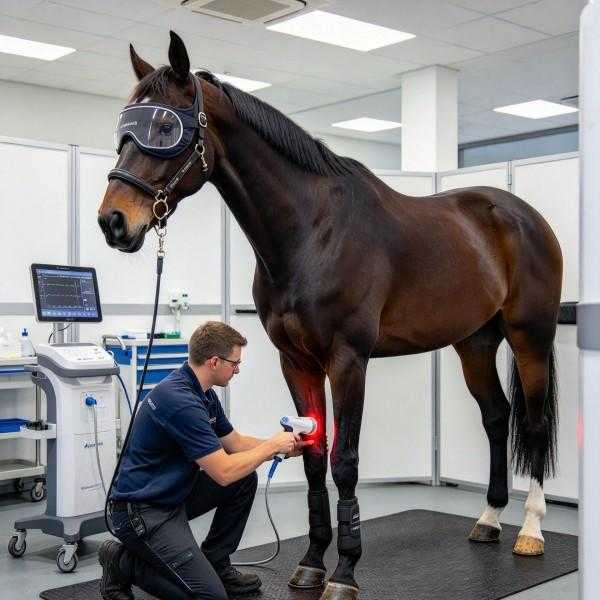
High-frequency duty cycle gating eliminates this thermal trap. By modulating the continuous beam into rapid square-wave pulses with on-time ratios between 20% and 40% and pulse frequencies ranging from 500 Hz to 6,000 Hz, the photon burst delivers instantaneous therapeutic energy followed immediately by a silent cooling phase. The targeted deep structures receive sufficient photon density to trigger mitochondrial ATP generation, while the surrounding hoof horn and dermis dissipate accumulated thermal energy into interstitial blood flow during the off-cycle. Practitioners deploying an advanced laser horse system ensure the patient remains completely relaxed during treatment while achieving uniform, deep biostimulation without dermal burning or pain responses.
+-----------------------------------------------------------------------------+
| Hoof & Foot Structure | Primary Optical Barrier | Photonic Solution         |
+=======================+=========================+===========================+
| Keratinized Sole/Wall | Extreme Scatter/Melanin | High Peak Fluence Bypass  |
+-----------------------+-------------------------+---------------------------+
| Digital Cushion       | Fibro-Fatty Scatter     | 980nm Hemoglobin Affinity |
+-----------------------+-------------------------+---------------------------+
| Navicular Bursa Fluid | Water-Dense Synovium    | 1470nm Water Dissipation  |
+-----------------------+-------------------------+---------------------------+
| Navicular Bone Core   | Deep Cortical Sclerosis | ATP-Driven Osteogenesis   |
+-----------------------+-------------------------+---------------------------+
Podotrochlear Syndrome Clinical Case Record
The following multi-phase rehabilitation course took place at the Alpine Equine Podiatry & Performance Institute, documenting an elite dressage horse through complete recovery.
Case Identifier: EQ-PODO-2026-0631
Subject: 9-year-old Dutch Warmblood Gelding, Advanced Dressage (FEI Prix St. Georges)
Clinical Diagnosis: Bilateral Chronic Navicular Syndrome (Left Front worse than Right Front), Grade 3 Podotrochlosis with active navicular bursal effusion, flexor cortical erosion, and enthesopathy of the collateral sesamoidean ligaments
Baseline Metrics: Lameness Grade 3/5 on the AAEP scale on a left circle on hard asphalt; positive hoof tester response across the middle frog; diagnostic palmar digital nerve block eliminated 90% of lameness; baseline magnetic resonance imaging confirmed significant hyperintense fluid signal within the navicular bursa and subchondral bone edema in the left navicular flexor cortex
| Behandlungsphase | Zeitleiste | Wellenlängen-Balance | Spitzenleistung (W) | Modulation (Hz) | Einschaltdauer | Die Energiedichte | Gesamtenergie pro Fuß |
| Phase 1: Sitzungen 1–4 | Tag 1 bis Tag 8 | 980 nm 60 % / 1470 nm 40 % | 18 W | 600 Hz | 25% | 8,0 J/cm² | 3,200 Joules |
| Phase 2: Sitzungen 5–9 | Tag 11 bis Tag 22 | 980nm 45% / 1470nm 55% | 24 W | 1.800 Hz | 35% | 11,5 J/cm² | 4,600 Joules |
| Phase 3: Sessions 10-14 | Day 26 to Day 38 | 980 nm 35 % / 1470 nm 65 % | 28 W | 4,500 Hz | 45% | 14,0 J/cm² | 5,600 Joules |
| Phase 4: Sessions 15-18 | Day 44 to Day 56 | 980 nm 50 % / 1470 nm 50 % | 20 W | 250 Hz | 30% | 9,0 J/cm² | 3.600 Joule |
By session 6, frog palpation with hoof testers failed to elicit any withdrawal reflex. Intermediate ultrasound evaluation through the hollow of the pastern on day 30 demonstrated marked reduction of the hypoechoic effusion pocket inside the navicular bursa. Follow-up standing MRI on day 60 showed complete resolution of the bone marrow edema signal inside the navicular cortex and normal synovial thickness. The horse returned to full collected trot and canter work on day 70, exhibiting symmetrical stride mechanics and renewed shoulder freedom.
Coherent Light Outperforms Needle Injections and Long-Term NSAIDs
Conventional podiatric care for chronic navicular syndrome traps the horse in a vicious cycle of temporary masking and long-term joint degradation. Intra-articular and intra-bursal corticosteroid cocktails calm acute synovial inflammation, but they shut down proteoglycan synthesis inside the articular cartilage, rendering the flexor surface brittle and prone to catastrophic cracking under athletic strain. Repeated needle insertions through contaminated collateral grooves introduce risks of deep septic bursitis that can end a horse’s life. Meanwhile, continuous administration of systemic phenylbutazone causes right dorsal colitis, blunts gastric mucosal defense, and does nothing to repair the necrotic bone architecture.
Adopting high-intensity Class IV photon therapy offers a completely non-invasive, tissue-reconstructing path forward. Pure monochromatic light penetrates the coronary band, heel bulbs, and sole without puncturing synovial envelopes or exposing the foot to infectious pathogens. By directly upregulating mitochondrial electron transport chains, the therapy stimulates tenocytes and osteoblasts to deposit healthy, organized extracellular matrix, reversing bone sclerosis and strengthening damaged flexor fibers. Trainers and barn managers observe a permanent restoration of stride length, zero gastrointestinal fallout, and an enduring athletic career that invasive injections and palliative shoeing cannot secure.