 FotonMedix



Deep Meniscal Tears In Stifles Defeat Mild Photons
High-wattage dual-wavelength Class IV photons cross dense fibrous stifle joints to trigger deep intra-articular fibrocartilage repair without thermal skin breakdown.
Equine veterinarians and sports stable trainers frequently face stubborn stifle lameness and femorotibial joint effusion in elite reining and cutting horses. The clinical picture is painfully predictable: a high-caliber performance quarter horse suddenly struggles to sit deep on its hocks during a sliding stop, drags its hind toes, and pins its ears when flexing the joint. Grooms spend endless hours applying sweating wraps, packing stifles with poultice mud, and holding entry-level handheld wands against the medial collateral ligament while the horse kicks out in agitation. Barn operators invest heavy budgets into generic laser treatment for horses, expecting structural joint remodeling that never happens because low-output light extinguishes inside dense subcutaneous fascia. Reaching intra-articular meniscal fibrocartilage buried beneath heavy joint capsules requires high-power optical density that under-powered equipment cannot project.
Joint Capsule Tissue Scatters Insufficient Therapeutic Photons
The equine stifle joint represents one of the thickest, most mechanically complex anatomical zones in large-animal rehabilitation. The medial meniscus and femorotibial ligaments sit deeply shielded behind thick skin, subcutaneous adipose deposits, dense joint capsules, and tough fibrous retinacula.
Photons attempting to penetrate this dense musculoskeletal junction face massive biological scatter and uncontrolled attenuation. In accordance with computational light-transport equations established by Cheong in tissue optics, photon distribution through dense fibrous structures decays nonlinearly as beam energy scatters across cellular boundaries. A dark, coarse coat and fibrous joint capsule scatter incident light across the outer margins.
When a practitioner uses weak power outputs, the beam loses nearly all its usable energy within the first twelve millimeters of tissue depth. The damaged fibrocartilaginous matrix of the meniscus, the compressed synovial membranes, and the insertions of the cranial cruciate ligaments receive zero photon stimulation. The target chondrocytes and tenocytes remain starved of biostimulatory energy, leaving chronic intra-articular effusion and micro-tears to degrade the joint into irreversible osteoarthritis.
Multi Wavelength Targeting Through Swollen Synovial Effusion
Penetrating a congested, inflamed equine stifle joint requires pairing specific wavelengths to target the exact biological obstacles within joint injuries: severe synovial effusion and chronic intra-articular ischemia.
The 1470nm wavelength interacts directly with free and bound water molecules within the swollen joint capsule. When acute stifle trauma causes severe femorotibial synovitis, excessive inflammatory fluid pools inside the joint pouch, stretching synovial envelopes and causing severe mechanical pain. The 1470nm spectrum exhibits an exceptionally sharp absorption peak in water. As photons engage this fluid-heavy environment, localized photo-acoustic energy dissipates joint fluid congestion, stimulates synovial lymphatic clearance, and rapidly eases the hydrostatic pressure irritating joint sensory receptors.
Simultaneously, the 980nm wavelength matches the secondary absorption peak of oxygenated and deoxygenated hemoglobin. The inner two-thirds of the equine meniscus are notoriously avascular, meaning torn fibrocartilage receives virtually no systemic repair nutrients. High-density 980nm photons penetrate directly into the vascularized outer red zone of the meniscus and peri-articular synovial margins. This absorption stimulates microvascular endothelial cells, triggers sustained nitric oxide synthesis, and drives hyperemic microcirculation that delivers regenerative growth factors straight toward avascular tear boundaries.
Combining water-targeted drainage at 1470nm with vascular biostimulation at 980nm overcomes synovial swelling while fueling deep cellular repair where standard single-wave systems fail.
Thermal Gating via Calibrated Pulse Duty Cycles
Directing high therapeutic power deep into the stifle presents a critical physical challenge: preventing surface thermal accumulation on the sensitive skin surrounding the patellar ligaments. Equine skin has a rapid thermal relaxation threshold. Continuous-wave laser beams concentrate surface heat faster than cutaneous capillaries can dissipate it, causing sudden heat buildup that risks burning skin and forces the operator to pull away before therapeutic energy reaches deep intra-articular layers.
Thermal accumulation is eliminated by using microsecond pulse duty cycles. By chopping continuous laser energy into microsecond bursts followed by controlled resting intervals, the skin and outer joint structures cool while deep intra-articular cartilage absorbs cumulative therapeutic energy.
Running a 30-watt peak beam on an engineered 40 percent duty cycle (for example, 40 milliseconds on and 60 milliseconds off at a 10 Hz frequency) creates intense photon penetration during the pulse. During the 60-millisecond dark phase, the cutaneous vascular network sweeps surface heat away. The deeper fibrocartilaginous structures, which retain therapeutic energy longer, stay charged with cellular stimulation without thermal discomfort. This enables veterinarians to deliver thousands of restorative joules safely through the joint capsule without triggering thermal discomfort or epidermal blistering.
Class IV Deep Systems Versus Low Power Horse Laser Modalities
Equine performance clinics must recognize the distinct operational differences between low-power equipment and high-power multi-wavelength Class IV medical units. These differences dictate whether complex joint injuries heal or develop into chronic soundness issues.
| Clinical Parameter | Class IV High-Power Deep System | Conventional Horse Laser Modality |
| Peak Operational Power | 30W multi-wavelength pulsed/continuous | 200mW to 2W low-level output |
| Depth Penetration | 7 cm to 11 cm into dense joint cavities | 1 cm to 2 cm maximum tissue depth |
| Treatment Time | 8 to 10 minutes per joint capsule | 45 to 80 minutes per stifle quadrant |
| Chondrocyte Activation | Surpasses cellular stimulation threshold | Falls short of mitochondrial activation depth |
| Thermal Protection | Calibrated microsecond duty cycles | Continuous wave or uncalibrated slow pulse |
| Functional Recovery | Sound joint loading within 4 to 6 weeks | Stalled recovery with persistent joint effusion |
Attempting to treat equine meniscal tears with a standard low-output horse laser frustrates both vet and patient. Delivering six thousand joules through a heavy joint capsule with a one-watt wand requires more than an hour of continuous application, which is completely impractical with a restless, sore performance horse. In contrast, an advanced high-power multi-wavelength system delivers that exact energy volume in eight minutes, penetrating deep articular recesses smoothly and painlessly.
Investing in advanced horse laser therapy reshapes stable management. Trainers avoid continuous cycles of expensive joint injections, save costly staff hours, and prevent months of unproductive box stall confinement. Restoring sound, pain-free joint articulation quickly protects long-term athletic value and keeps horses competing at their peak.
Clinical Case Protocol: Grade II Medial Meniscal Tear and Femorotibial Desmitis
Documented clinical records show the rapid functional and structural recovery delivered by high-power multi-wavelength photobiomodulation in complex equine joint injuries.
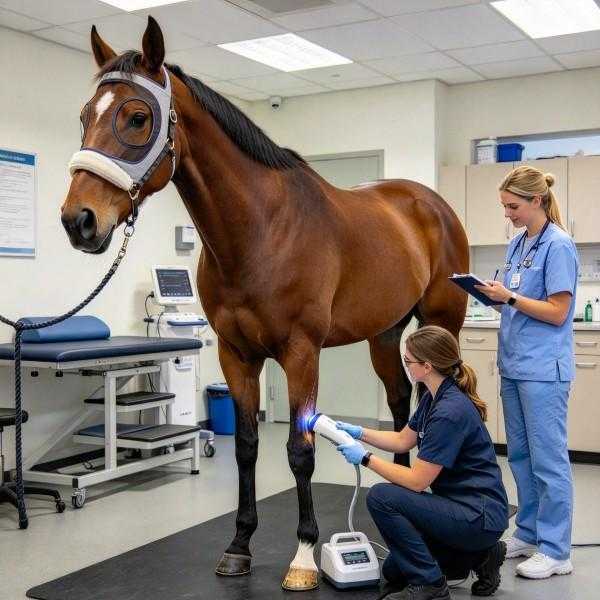
Case History and Pathological Staging
A 5-year-old American Quarter Horse gelding competing in reining presented with acute right hindlimb lameness (Grade 3/5 on the AAEP scale) following a sudden pivot during competition. The horse refused to engage the hind end into sliding stops, showed marked resentment on stifle flexion, and carried severe joint distension over the medial femorotibial joint pouch. Diagnostic high-resolution ultrasound confirmed a Grade II tear of the cranial horn of the medial meniscus, characterized by focal hypoechoic fiber disruption, irregular meniscal contours, and accompanying desmitis of the medial collateral ligament.
Previous conservative management, including systemic phenylbutazone, joint cold hosing, and four weeks of stall rest, brought zero reduction in joint distension, and the horse remained visibly lame at the trot. A high-power multi-wavelength Class IV laser protocol was started as the primary restorative therapy.
Laser Intervention Dosimetry and Operational Matrix
The gelding underwent a five-week targeted therapeutic protocol utilizing synchronized 980nm and 1470nm wavelengths. Treatments combined high-frequency non-contact scanning across the stifle pouches to resolve acute effusion with deep contact massage over the medial joint margin using a curved optical handpiece.
| Case Identifier | Patient Profile | Diagnosis and Lesion Extent | Operating Parameters | Dosimetric Delivery | Clinical Horizon |
| EQ-ST-2026-1188 | 5yo Quarter Horse Gelding (510 kg) | Grade II Medial Meniscal Tear with Femorotibial Effusion | 980nm (18W) + 1470nm (12W); 30W Peak; 40% Duty Cycle | 15 Hz, 9,000 J per session (7.5 min); 15 sessions across 5 weeks | Week 2: Joint distension down 35%; Week 5: Meniscal contour normalized, grade 0/5 lameness |
Measured Recovery Trajectory
Sessions one through five focused on clearing synovial effusion and calming localized synovial inflammation. The 1470nm wavelength was set at 65 percent of total output at a pulse frequency of 40 Hz with a 30 percent duty cycle. By session four, digital calipers confirmed a 35 percent reduction in medial joint pouch circumference, and the horse allowed manual stifle manipulation without evasive tail swishing.
From session six through fifteen, treatment shifted to stimulate cellular remodeling in damaged meniscal fibrocartilage and collateral ligament fibers. The 980nm wavelength was raised to its maximum output with a lower pulse frequency of 15 Hz at a 40 percent duty cycle to maximize deep cellular uptake. Diagnostic ultrasound on day 35 confirmed marked tissue repair: the hypoechoic tear line in the cranial meniscal horn showed dense echogenic fill, and collateral ligament borders smoothed out completely. The horse walked and trotted soundly on hard circles and began progressive under-saddle conditioning without joint swelling.
Intra Articular Regeneration Outperforms Repetitive Steroid Injections
High-power multi-wavelength photobiomodulation provides equine athletic programs with an effective alternative to repeated intra-articular steroid injections.
Relying on intra-articular corticosteroids to manage stifle injuries introduces serious long-term risks. While steroids suppress pain and quiet synovitis temporarily, they impair chondrocyte viability, inhibit collagen synthesis, and accelerate joint cartilage thinning, leaving the joint vulnerable to catastrophic re-injury under heavy loads. Non-steroidal anti-inflammatory drugs only mask discomfort while the horse continues to aggravate underlying soft tissue tears. Class IV multi-wavelength laser therapy operates via cellular biostimulation rather than pharmaceutical masking.
By driving high photon density into the mitochondria of deep chondrocytes, synoviocytes, and fibroblasts, the therapy ramps up cellular ATP synthesis, accelerates endogenous growth factor release, and stimulates the formation of strong, organized fibrocartilaginous repair tissue. At the same time, clearing intra-articular fluid via water-specific acoustic mobilization relieves mechanical pressure on joint margins, letting joint capsules flex smoothly without friction.
Where standard rest and superficial therapies lead to chronic lameness and early retirement, high-power Class IV multi-wavelength laser technology resolves the structural damage inside deep joint capsules. Performance stables keep their horses sound, eliminate lengthy rehabilitation stalls, and extend athletic longevity through proven optical physics.