 FotonMedix











Deep Tissue Canine IVDD Energy Loss and Thermal Stall
Multi-wavelength Class IV delivery counters non-linear photon scatter, targets water absorption at 1470nm, and uses dynamic thermal relaxation intervals to drive sub-surface healing without epidermal heat accumulation.
Veterinary surgeons routinely face the same clinical barrier when managing grade 3 intervertebral disc disease (IVDD) in large-breed dogs: low-powered beams disperse across dense epaxial muscle coats, losing their therapeutic irradiance before reaching the spinal canal. The traditional reflex is cranking continuous wattage to force depth, yet the dog flinches, superficial skin scalds, and therapy stalls. True therapeutic photobiomodulation does not rely on brute radiant energy; it hinges on matching the optical window of dense mammalian structures while balancing cellular stimulation against thermal relaxation thresholds.
Veterinarians scouring the market for dependable veterinary laser therapy equipment frequently encounter generic hardware that simply cannot deliver deep-seated photophysical changes without thermal injury. When reviewing high-powered veterinary laser for sale options, clinical directors must bypass superficial marketing claims and evaluate how multi-frequency delivery, fluid absorption peaks, and precision temporal gating conquer tissue scatter at depth.
The Biomechanical Barrier of Deep Epaxial Tissue Penetration
Delivering adequate fluence through thick canine hair, skin, adipose barriers, and rigid paravertebral musculature is governed by photon scattering and unselective chromophore absorption. As photons enter biological tissue, their primary path deflects according to Mie scattering inside fibrous structures and Rayleigh scattering within microscopic cellular organelles. In high-density tissues surrounding the lumbar spine, backscatter accounts for the loss of up to sixty percent of delivered surface irradiance within the first three millimeters of the dermal matrix.
According to classical photon migration theory documented in biomedical optics literature by Jacques and colleagues, tissue penetration is fundamentally limited by the effective attenuation coefficient. This coefficient combines both the absorption coefficient and the reduced scattering coefficient. When a mono-wavelength Class IV unit fires into vascularized deep tissue, radiant energy attenuates exponentially following Beer-Lambert calculations adapted for turbid biological media. If the delivered surface profile fails to account for the competitive uptake of localized fluid and hemoglobin, photons never establish the minimum photon density threshold of four to eight joules per square centimeter required at the nerve root.
This scattering effect generates a hazardous bottleneck. Superficial melanin and subcutaneous fats absorb incoming high-intensity waves, triggering rapid molecular friction and rapid surface temperature spikes. The clinician must keep the handpiece moving at high speeds to avoid epidermal burns, which inadvertently causes erratic, sub-therapeutic dosing to the underlying ventral spinal tissues. Overcoming this physical limitation requires dual-action optical targeting that pairs hemoglobin photolysis with targeted interstitial fluid resonance, decoupling penetration depth from superficial heat retention.
Optical Coupling Dynamics Across Target Tissue Layers
Targeted Class IV therapy succeeds only when specific photon channels address distinct biological absorbers inside living tissue. Mono-wavelength therapy often falls flat because a single wavelength cannot manage both vascular clearance and cellular metabolic elevation at the exact same moment.
980nm Hemoglobin Resonance and Microvascular Perfusion
The 980nm emission band exhibits an optimal balance between water absorption and deoxygenated hemoglobin uptake. At this specific frequency, photon absorption generates localized, sub-ablative photo-thermal gradients inside stagnant capillary beds. This response activates local nitric oxide stores, dislodging the molecule from cytochrome c oxidase binding sites and inducing immediate precapillary vasodilation.
When high-power Class IV veterinary laser therapy equipment introduces this frequency into compressed or ischemic muscular beds, microvascular perfusion rises rapidly. The sudden influx of oxygen-rich erythrocytes displaces local tissue acidosis and reduces pressure on local nociceptors. This targeted vascular clearance simultaneously alters the optical scattering characteristics of the overlying muscle: well-oxygenated, moving blood scatters fewer photons than congested, stagnant venous pools, effectively opening an optical corridor for subsequent wavelengths to travel deeper into the vertebral canal.
1470nm Interstitial Water Absorption and Edema Evacuation
Targeting deeper perineural compression demands a frequency tuned precisely to free water molecules. The 1470nm profile delivers an absorption coefficient in water roughly forty times higher than standard near-infrared frequencies below 1000nm. Because disc herniation and nerve root compression manifest as severe extracellular edema, inflammatory exudate, and localized collagen swelling, 1470nm energy concentrates its activity inside these localized water-rich deposits.
Rather than dispersing unchecked into adjacent neural tissue, 1470nm photons activate intra-tissue water molecules, accelerating lymphatic drainage through selective photothermal stimulation of local lymphatic valves. This rapid clearance relieves hydrostatic pressure within the tightly enclosed spinal canal. By reducing tissue swelling around compromised nerve fibers, this fluid clearance restores local interstitial mechanics, relieving structural mechanical pinch and letting compressed axonal pathways regain neuro-electrical transmission.
Preventing Dermal Heat Build Through Pulse Duty Cycle Management
Sustained continuous emission from a high-output veterinary laser therapy machine risks driving the target zone past the physiological thermal threshold of 42 degrees Celsius, at which structural proteins begin to denature. Deep clinical conditions cannot be resolved with rapid surface scanning; they demand continuous, sustained energy deposits directly into target joints or vertebral structures. Overcoming this physical constraint requires the integration of chopped super-pulsing and variable duty cycle programming.
The thermal relaxation time of vascularized mammalian tissue dictates how long a treated zone takes to shed fifty percent of absorbed optical heat. By configuring delivery into precise microsecond bursts followed by controlled quiescent intervals, the laser allows surrounding microcapillary networks and conduction currents to dissipate superficial caloric loads during the baseline phase.
Thermal Relaxation Duty Cycle Phase:

Peak Pulse On-Time  [====== 20ms ======] -> Photons drive through tissue barrier
Baseline Off-Time                      [================== 80ms ==================] -> Heat dissipates safely
Thermal Balance     [-- Tissue Heats --] [-- Capillaries Clear Energy, Cooling Occurs --]
Operating at a twenty to thirty percent duty cycle permits peak powers up to thirty watts to surge through skin layers without driving tissue to structural pain thresholds. High-amplitude photon packets drive deep into target tissue during the on-phase, saturation-firing cytochrome c oxidase inside deep Schwann cells. During the immediate off-phase, thermal conduction pulls heat away through capillary circulation, preserving surface cellular integrity while maintaining high, uninterrupted cumulative fluence across deep pathologies.
Clinical Case Record
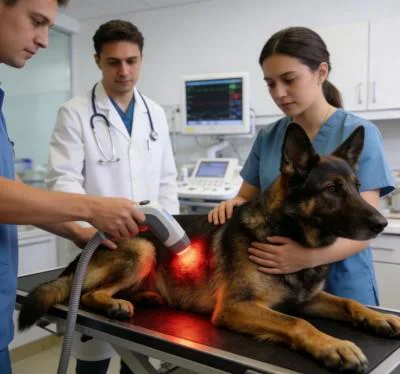
The following data reflects a structured clinical rehabilitation program for canine intervertebral disc disease managed under high-irradiance multi-wavelength Class IV veterinary intervention.
| Clinical Parameter | Case Specification Record |
| Case Reference Code | VET-NEURO-2026-084B |
| Patient Profile | Canine, German Shepherd Dog, 6.5 Years, Male Intact, 38.2 kg |
| Clinical Presentation | Acute pelvic limb paresis, severe back pain, proprioceptive deficit |
| Definitive Diagnosis | Hansen Type I IVDD (L2-L3 Vertebral Junction), Grade 3 Non-Ambulatory |
| Equipment Profile | Multi-Wavelength Class IV System (Fotonmedix High-Power Platform) |
| Wavelength Modulation | 980nm (Vascular clearing) + 1470nm (Anti-edema fluid resonance) |
| Peak Output Power | 24 Watts (Combined Dual-Band Peak Matrix) |
| Pulse Frequency Mode | 50 Hz to 200 Hz Variable Pulsed Profile |
| Operating Duty Cycle | 25% (5ms Pulse Duration, 15ms Inter-Pulse Interval) |
| Beam Spot Diameter | 30 mm Non-Contact Collimated Contour Handpiece |
| Fluence at Target | 12 Joules per square centimeter across spinal canal projection |
| Cumulative Energy Dosed | 4,200 Joules per session across a 350 square centimeter grid |
| Treatment Frequency | Three sessions weekly for Weeks 1-2; Two sessions weekly for Weeks 3-4 |
Longitudinal Rehabilitation Milestones
Recovery Milestones Over 28-Day Therapeutic Arc:

Day 01  [Score 18/24 Pain Index] -> Grade 3 paresis, deep pain intact, loss of conscious proprioception.
Day 07  [Score 11/24 Pain Index] -> Muscle spasms subside, conscious proprioception latency drops to 3 seconds.
Day 14  [Score 06/24 Pain Index] -> Voluntary motor control returns, patient supports assisted weight.
Day 28  [Score 01/24 Pain Index] -> Independent quadrupedal ambulation restored, full proprioceptive recovery.
Initial interventions focused on suppressing localized neurogenic pain and eliminating mechanical edema at the L2-L3 spinal segment. By Session 3 (Day 7), local lumbar muscle hypertonicity relaxed entirely, and deep postural thrust responses initiated without vocalization. Mid-point reassessment on Day 14 revealed stable voluntary motor function in both hind limbs, with conscious proprioception reflex delays dropping from indefinite to under two seconds. By Day 28, the dog demonstrated uninterrupted weight-bearing trotting, verified via pressure-plate gait analysis showing symmetrical four-quadrant weight distribution, completely circumventing surgical spinal decompression.
Surgical Decompression and Pharmacological Management Versus Non-Invasive Photobiomodulation
Standard treatment pathways for moderate-to-severe canine spinal disc disease have long relied on aggressive hemilaminectomy or long-term therapeutic courses of non-steroidal anti-inflammatory drugs and corticosteroids. While surgical intervention effectively removes extruded disc material, it introduces operational risks, extensive soft-tissue trauma, irreversible disruption of paravertebral stability, and prolonged, painful recoveries in kennel confinement.
Long-term medical management using corticosteroids and NSAIDs carries severe biological consequences. Canine hepatic filters and renal perfusion pathways degrade rapidly under high chronic pharmaceutical loads, frequently triggering severe gastrointestinal ulceration, unmanageable pancreatitis, and toxic parenchymal organ stress. Crucially, oral pharmaceuticals depend entirely on systemic vascular circulation; they struggle to penetrate collapsed, hyper-pressurized, and ischemic disc compartments where microvascular flow has dropped to zero.
High-power Class IV veterinary laser therapy equipment circumvents these biological bottlenecks by acting directly on the damaged tissues through localized physical photon interactions rather than systemic chemical exposure. The non-invasive delivery of 980nm and 1470nm energy:
- Drives vascular recruitment directly into compressed capillary beds, flushing inflammatory enzymes without loading renal or hepatic filtration pathways.
- Clears spinal canal edema by vibrating interstitial water matrices, achieving tissue decompression comparable to mechanical relief without surgical bone resection.
- Accelerates neural ATP synthesis by supplying immediate photon energy to stalled mitochondrial chains, driving spontaneous axonal repair in days rather than months.
- Relieves patient pain immediately within the treatment suite, allowing active physical rehabilitation without relying on systemic sedatives.
- Eliminates the risk of nosocomial surgical site infections, soft-tissue scarring, and postoperative wound dehiscence.
Adopting advanced high-power multi-wavelength laser technology redefines patient care trajectories in clinical settings. Pet owners observe rapid, drug-free comfort and restored mobility without post-operative distress, while practices eliminate reliance on high-risk pharmaceutical regimens. Integrating targeted Class IV photon delivery resolves the physical challenge of deep-tissue energy drop-off, providing veterinary clinics with a powerful, repeatable, non-invasive therapeutic solution for deep-seated mobility conditions.