 FotonMedix











news
Company News丨Industry News丨Products News
Search the whole station
Company News丨Industry News丨Products News
Arthritis affects more than 20% of adult dogs and up to 80% of senior dogs. Pain management strategies have shifted significantly over the last decade, with veterinary clinics adopting non-drug modalities to improve long-term mobility. Among these, vet laser therapy has become a core component of integrative orthopedic treatment.
This article examines whether laser treatment produces measurable improvements compared with traditional therapies alone. The discussion includes advanced photobiomodulation principles, dosing guidelines, and a complete clinical case from an orthopedic specialty hospital.
Laser therapy treatment for dogs utilizes specific wavelengths of light to stimulate tissue repair, decrease inflammation, and modulate pain. The term “laser” in veterinary applications refers primarily to therapeutic (cold or hot) lasers designed for photobiomodulation, not surgical cutting lasers.
Veterinary lasers are classified by their output power, with Class IV systems delivering higher penetration suitable for deep musculoskeletal structures.
Laser therapy influences various biological pathways:
• Increases mitochondrial ATP generation
• Enhances oxygen utilization
• Modulates COX-2 inflammatory signals
• Stimulates fibroblast and chondrocyte activity
• Reduces nociceptor firing rate
These effects are particularly relevant to dog laser therapy for arthritis, where inflammation and functional compromise dominate clinical progression.
Veterinarians have incorporated lasers into daily practice because:
Laser therapy allows long-term arthritis patients to maintain quality of life, especially when drug-based approaches become limited or contraindicated.
Hospital: Northern Victoria Canine Orthopedic & Sports Medicine Centre
Patient: “Atlas,” Male Neutered, 6-year-old German Shepherd, 38 kg
Occupation: Active K9 detection dog
Primary Complaint: Persistent left forelimb lameness following prolonged work shifts.
History: Diagnosed with early elbow dysplasia at 18 months; progressive osteoarthritis despite joint supplements and NSAIDs.
Previous Treatment: NSAIDs, physiotherapy, joint nutraceuticals, intermittent rest cycles.
• Lameness Grade: 3/5
• Pain with flexion and full extension of left elbow
• Crepitus palpable on manipulation
• Radiographs: Marked medial coronoid disease with advanced degenerative remodeling
Because Atlas is a working dog requiring long duty hours, long-term NSAID monotherapy was no longer feasible due to gastrointestinal sensitivity. Veterinary recommendation: initiate laser therapy treatment for dogs with a high-energy Class IV system.
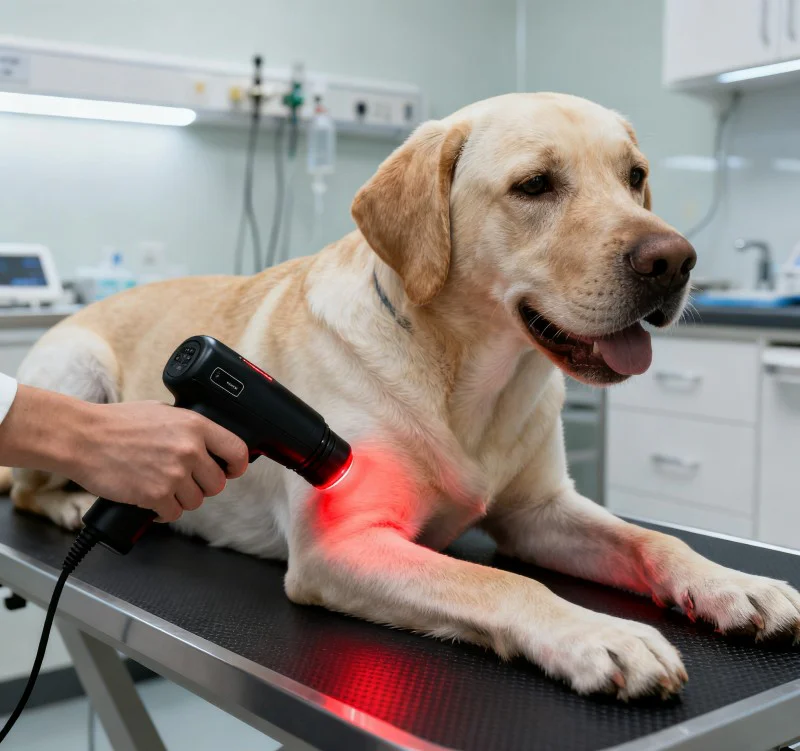
Wavelength: 810 nm + 980 nm combination
Power Setting: 10 W peak; adjusted to 6 W for medial elbow tissues
Dose Range: 10–18 J/cm²
Treatment Field: Elbow joint capsule, triceps insertion, biceps tendon region
Frequency: 3× weekly for 4 weeks, followed by biweekly maintenance
Week 1:
• Reduced heat and swelling around the joint
• Slight improvement in stance and weight distribution
Week 2:
• Lameness reduced from grade 3/5 to 2/5
• Owner reports easier transitions from sit to stand
• Increased enthusiasm during training sessions
Week 4:
• Lameness improved again to 1/5
• Elbow flexion improved by 20%
• Marked decrease in pain on palpation of medial joint compartment
Week 8:
• Returned to modified duty work with no post-shift lameness
• Pain score: 1/10
• No gastrointestinal issues since NSAIDs reduced to minimal dosage
Laser therapy provided better stability of joint function, reduced inflammation, and extended Atlas’s ability to remain on active duty. He continues maintenance therapy every 3–4 weeks and remains stable, with improved joint performance on long training days.
Laser therapy benefits arthritic dogs in several ways:
• Decreases synovial inflammation and effusion
• Reduces cartilage breakdown mediators
• Improves local circulation to periarticular muscles
• Slows progression of chronic joint degeneration
• Promotes neuromuscular support and improved gait
In advanced arthritis cases, improvement is measurable in gait analysis, owner-reported pain scales, and joint mobility tests.
To achieve optimal clinical response, veterinary clinics follow structured parameters:
• Dose based on chronicity rather than breed size
• Higher energy density for elbow, hip, and stifle joints
• Grid-pattern scanning for even distribution
• Complementary therapy including physiotherapy and weight control
Dog laser therapy for arthritis is most effective when applied early in the disease course, but even advanced cases benefit from improved comfort and reduced reliance on pharmaceuticals.
Laser therapy is safe when operated by a trained veterinarian. However, precautions include:
• Avoiding treatment over active tumors
• Protecting patient and operator eyes
• Adjusting power for thin-coated or heat-sensitive dogs
• Avoiding direct application over open growth plates in young dogs
Laser therapy is one aspect of a comprehensive arthritis care plan that may also include:
• Omega-3 fatty acids for inflammation reduction
• Joint-specific physiotherapy protocols
• Controlled exercise and hydrotherapy
• Body weight optimization
• Surgical intervention when indicated (e.g., FCP removal, arthroscopy)
Combining therapies enhances canine joint health and preserves mobility.
Does vet laser therapy provide measurable relief for dogs with arthritis? Clinical cases and accumulated research strongly indicate yes. When dosed correctly and integrated with broader management strategies, laser therapy treatment for dogs significantly improves mobility, reduces pain, and supports long-term joint health. For many chronic orthopedic patients, dog laser therapy for arthritis offers a practical, safe, and sustainable method of improving daily comfort and extending functional lifespan.