 FotonMedix



Equine Navicular Bursitis Defeats Underpowered Beams
High peak power dual-wavelength Class IV delivery clears deep podotrochlear bursal congestion while preventing pododermal thermal injury through calibrated duty cycles.
Mobile equine veterinarians dread winter farm calls involving chronic caudal heel pain in western pleasure horses and show hunters. The practical headache is consistent: crouching on cold concrete in a drafty barn aisle, attempting to hold an underpowered battery-operated wand against a flared hoof wall or deep into the collateral sulci while a six-hundred-kilogram animal stomps its feet in agitation. Ambulatory practitioners frequently test a generic cold laser therapy device for horses hoping to manage deep podotrochlear inflammation, only to realize that milliwatt photon output cannot penetrate the dense, keratinized ungual cartilage and thick fibrofatty digital cushion. Field practitioners shopping for the best cold laser therapy device for horses routinely find themselves misled by marketing claims that ignore basic optical attenuation physics. When mobile doctors evaluate the top equine laser therapy devices for ambulatory veterinarians, the true technical benchmark is not lightweight handheld convenience, but whether the system generates enough therapeutic photon density to reach deep intra-capsular structures before battery failure or horse restlessness terminates the session. Modern clinical laser therapy horses protocols demand high-power medical-grade output to conquer the extreme optical barrier of the equine foot.
Optical Penetration Limits Across Keratinized Hoof Structures
Delivering photobiomodulation therapy to the equine podotrochlear apparatus represents one of the most severe anatomical hurdles in veterinary practice. The target tissues—comprising the navicular bursa, deep digital flexor tendon fibrocartilage, and the impar ligament—are encapsulated by a dense, cornified hoof capsule, the heavy fibroelastic digital cushion, and the thick vascular plexus of the coronal corium.
Light traveling through this structural matrix suffers severe optical attenuation. Based on transport lattice models established by Jacques and Prahl in biological tissue optics, incident photon density degrades nonlinearly as light encounters dense turbid media characterized by high scattering coefficients. The keratinized matrix of the hoof wall reflects and scatters incoming photons across superficial surface planes.
When mobile vets deploy low-power equipment, photon flux drops into non-functional background scatter within the first five to eight millimeters of hoof horn. Zero therapeutic energy reaches the navicular bone or its surrounding synovial envelope. Cytochrome c oxidase inside hypoxic fibrochondrocytes remains unactivated, leaving chronic intra-bursal adhesions and bony remodeling to progress unchecked despite hours spent running low-level light wands.
Dual Wave Interactions Inside Ischemic Heel Pockets
Overcoming the high optical density of the heel requires matching specific laser wavelengths to the biological targets within chronic navicular syndrome: chronic podotrochlear fluid congestion and severe intra-osseous ischemia.
The 1470nm wavelength interacts directly with free and bound water molecules within the congested navicular bursa. In chronic bursitis, inflammatory exudate thickens within the synovial space, producing intense hydrostatic pressure against the dorsal flexor cortex of the navicular bone. Water exhibits a high absorption peak at 1470nm. When this wavelength enters the bursal recess, localized photo-acoustic acoustic agitation breaks down thickened, protein-rich effusion, accelerates drainage through regional lymphatic networks, and relieves compressive mechanical pain on the sensory branches of the palmar digital nerves.
Concurrently, the 980nm wavelength matches the secondary absorption bands of oxygenated and deoxygenated hemoglobin. In longstanding caudal heel disease, compression by the deep digital flexor tendon induces local vascular strangulation, creating ischemic core zones across the flexor cortex. High-intensity 980nm photons penetrate the collateral sesamoidean ligaments and vascular foramina, stimulating capillary endothelial cells and triggering sustained nitric oxide release. This localized vascular expansion restores arterial inflow, evacuates stagnant venous blood, and delivers reparative nutrients straight to the ischemic bone-ligament interface.
Pairing water absorption at 1470nm with targeted hemoglobin excitation at 980nm eliminates fluid congestion while restoring nutrient delivery to deep podotrochlear tissues.
Thermal Gating via Precision Pulsed Duty Cycles
Delivering high-energy Class IV wattage into the narrow confines of the equine heel introduces a direct physical hazard: overheating the sensitive coronary band and the thin skin above the bulbs of the heel. The coronary band and epidermal laminae possess specific thermal relaxation properties. Continuous-wave laser beams concentrate surface energy faster than dermal capillary beds can disperse it, producing surface thermal spikes that agitate the horse and force the operator to remove the handpiece before deep energy saturation occurs.
Thermal injury is avoided through calibrated microsecond pulse duty cycles. By dividing laser emission into microsecond energy bursts separated by dark resting periods, superficial tissues dissipate thermal energy while deep internal structures retain cumulative therapeutic photon density.
Operating at 28 watts of peak power with an engineered 40 percent duty cycle (for example, 40 milliseconds active emission followed by 60 milliseconds quiet interval at 10 Hz) drives intense photon penetration during the pulse. During the 60-millisecond quiescent phase, the capillary bed of the coronal corium carries heat away from the skin. The deeper, fibrous collateral ligaments and the navicular bursa, which have slower thermal dissipation profiles, retain therapeutic photon absorption. This enables mobile practitioners to deliver substantial energy volumes into the hoof capsule safely below the 42-degree Celsius thermal damage limit.
Class IV High Power Versus Low Level Mobile Laser Units
Ambulatory equine practitioners must understand the performance differences between low-level light therapy wands and high-power multi-wavelength Class IV medical systems. This operational contrast determines whether caudal heel pathologies resolve or cause permanent retirement.
| Performance Indicator | Class IV High-Power Deep System | Conventional Cold Laser Unit |
| Peak Optical Output | Up to 30W multi-wavelength continuous/pulsed | 100mW to 1W total diode output |
| Penetration Depth | 6 cm to 10 cm through hoof wall, frog, and fascia | 0.5 cm to 1.5 cm maximum penetration |
| Dosing Duration | 6 to 9 minutes per foot | 45 to 90 minutes per foot |
| Intra-Bursal Energy Delivery | Surpasses the cellular biostimulation threshold | Drops to zero before reaching the bursa |
| Thermal Mitigation | Configurable microsecond pulse duty cycles | Continuous wave or fixed slow chopping |
| Clinical Resolution Horizon | Sound palmar digital loading in 4 to 6 weeks | Stalled recovery with persistent heel pain |
Attempting to treat chronic navicular disease using a low-power cold laser therapy device for horses leaves ambulatory clinicians at a major practical disadvantage. Delivering five thousand joules to the podotrochlear bursa with a 500-milliwatt unit requires nearly three hours of stationary application, which is completely unrealistic with an anxious, weight-shifting horse. In contrast, an advanced high-power multi-wavelength medical platform delivers this dosage in seven minutes, driving light through the central sulcus of the frog and the collateral fossa smoothly.
Selecting durable, high-power equipment among the top equine laser therapy devices for ambulatory veterinarians directly benefits mobile practice economics. Field clinicians cut on-farm treatment times by eighty percent, handle more patients daily, and eliminate the frustration of hauling low-powered units that fail on dense hoof structures. Investing in the best cold laser therapy device for horses requires looking beyond deceptive low-level wattages to acquire true Class IV deep-penetrating optical power.
Clinical Case Protocol: Chronic Bilateral Navicular Bursitis and DDFT Desmopathy
Documented clinical metrics confirm the structural and functional changes induced by high-power multi-wavelength photobiomodulation in chronic caudal heel syndrome.
Case History and Pathological Staging
A 9-year-old American Quarter Horse gelding used for competitive reining presented with a four-month history of bilateral forelimb lameness (Grade 3/5 on the AAEP scale, worse on the left fore). The horse pointed both forelimbs at rest, landed toe-first at the trot, and exhibited strong pain during palmar digital hoof tester application across the middle third of the frog. Diagnostic local anesthesia of the palmar digital nerves at the level of the ungual cartilages produced complete soundness in the left fore, shifting the primary lameness to the right fore.
Standing low-field magnetic resonance imaging identified severe bilateral podotrochlear bursitis, marked by extensive synovial effusion, localized fibrocartilage erosion along the flexor surface of the navicular bone, and concurrent Grade II desmopathy of the deep digital flexor tendon within the hoof capsule.
Previous therapy consisting of corrective egg-bar shoeing, bilateral navicular bursa corticosteroid injections, and systemic flunixin meglumine provided transient improvement that relapsed completely within four weeks. A high-power multi-wavelength Class IV laser protocol was instituted as the definitive regenerative intervention.
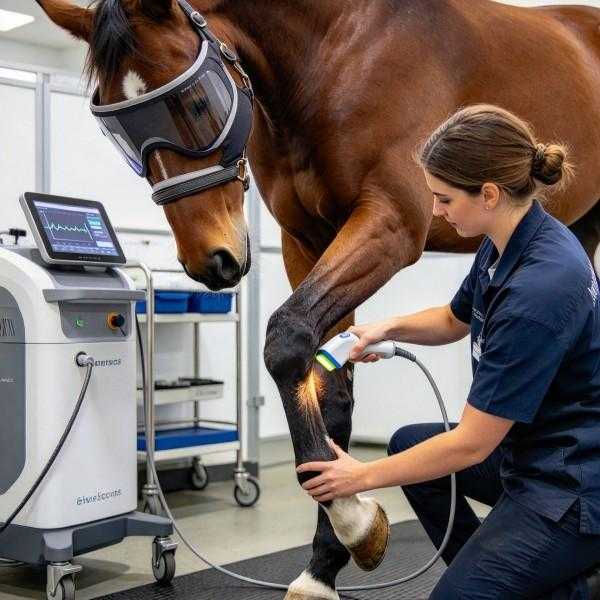
Laser Intervention Dosimetry and Operational Matrix
The gelding underwent a six-week intensive rehabilitation protocol utilizing synchronized 980nm and 1470nm wavelengths. Treatments were delivered using a specialized high-power curved quartz contact handpiece, applying direct mechanical pressure into the central and collateral sulci of the frog and around the bulbs of the heels to minimize photon scattering across the hair-skin-horn junction.
| Case Identifier | Patient Profile | Diagnosis and Lesion Extent | Operating Parameters | Dosimetric Delivery | Clinical Horizon |
| EQ-NAV-2026-1240 | 9yo Quarter Horse Gelding (535 kg) | Chronic Bilateral Navicular Bursitis with DDFT Desmopathy | 980nm (16W) + 1470nm (12W); 28W Peak; 40% Duty Cycle | 12 Hz, 8,400 J total per hoof (7.5 min); 14 sessions across 6 weeks | Week 2: Hoof tester reaction negative; Week 6: MRI confirms bursal effusion cleared, sound flat foot placement |
Measured Recovery Trajectory
Sessions one through four concentrated on clearing podotrochlear synovial effusion and relieving local neurovascular spasm. The 1470nm wavelength was prioritized at 65 percent of total output, utilizing a 40 Hz pulse frequency with a 30 percent duty cycle. Laser energy was applied directly into the bulbs of the heels and the collateral fossa. Following the third session, hoof tester sensitivity dropped by 80 percent, and the gelding shifted from a pronounced toe-first landing to a flat foot impact at the walk.
Sessions five through fourteen shifted to driving fibrocartilaginous remodeling and neovascularization across the flexor cortex of the navicular bone and deep flexor fibers. The 980nm wavelength was increased to maximum output at a lower pulse rate of 12 Hz with a 40 percent duty cycle to maximize deep tissue energy absorption.
Follow-up low-field magnetic resonance imaging at the conclusion of week six confirmed complete resolution of the fluid distension within the navicular bursa, accompanied by structural remodeling of the deep digital flexor tendon fibrocartilage without soft-tissue adhesions. The horse trotted soundly on hard surface circles, displayed normal heel expansion during locomotion, and returned to controlled training without lameness recurrence.
Photobiological Rebuilding Versus Invasive Chemical Injections
High-power multi-wavelength laser therapy provides equine sports practices with substantial clinical advantages over repeated intra-bursal corticosteroid and hyaluronic acid injections.
Intra-bursal steroid administration carries distinct biological trade-offs. While corticosteroids temporarily quiet local synovial inflammation, they weaken deep digital flexor tendon fibers, inhibit proteoglycan synthesis in articular cartilage, and increase the risk of tendon rupture under hard competitive stops. Non-steroidal anti-inflammatory drugs merely blunt central pain signals, encouraging horses to overload structurally compromised bone and soft tissue. In contrast, deep-penetrating Class IV laser energy works through active biological repair mechanisms rather than pharmaceutical suppression.
By delivering high photon density directly to the mitochondrial respiratory chains of deep tenocytes and chondrocytes, high-power photobiomodulation surges cellular adenosine triphosphate production, triggers vascular endothelial growth factors, and accelerates the synthesis of organized type-I collagen fibers. Simultaneously, rapid evacuation of bursal effusion via water-targeted acoustic mobilization relieves painful mechanical tension inside the podotrochlear space, enabling the deep digital flexor tendon to glide smoothly over the navicular bone without friction.
Where standard care leaves equine athletes trapped in progressive soundness decline, advanced Class IV multi-wavelength laser technology resolves the underlying structural damage within the hoof. Veterinary practices protect their competitive patients, streamline field treatment workflows, and deliver lasting soundness through verified optical physics.