 FotonMedix




Prévention des risques d'incontinence sphinctérienne et de compression fasciale fibrotique
Direct submucosal photocoagulation preserves structural anal tone while penetrating deep fibrous barriers to accelerate tenocyte recovery without mechanical trauma.
Surgical dissection within narrow, friable anatomic spaces consistently risks compromising critical motor structures or leaving deep, ischemic scar beds that fail to heal. In conventional anorectal procedures, mechanical shearing and uncontrolled electrosurgical spread routinely risk permanent internal anal sphincter fragmentation. Similarly, in severe chronic myofascial entrapment and degenerative tendon pathology, surface-level physical modalities cannot deliver sufficient photon density through overlying dense fascia to activate stagnant cellular metabolic pathways. Overcoming these procedural limitations requires fine optical energy tuning to match distinct target tissue layers.
Optical Penetration Depths across Complex Human Tissue Matrices
Photon transport through living tissue depends on absorption, scatter, and reflection dynamics within variable biological media. Connective tissue, adipose layers, dynamic vascular networks, and interstitial fluids scatter light unevenly, attenuating uncollimated beams within the initial millimeters of dermal and mucosal surfaces.
In deep soft-tissue pathology, overcoming this optical barrier demands specific near-infrared spectral combinations. Delivering an 810nm output directly targets the copper centers of cytochrome c oxidase inside mitochondrial membranes. Stimulating this respiratory enzyme accelerates electron transport, hyperpolarizes the mitochondrial membrane, and boosts baseline intracellular ATP synthesis. To supplement this reaction, pairing 810nm with a 980nm wavelength leverages moderate water and hemoglobin absorption bands. The resulting localized, non-destructive thermal gradient induces instant capillary vasodilation, sweeping away bradykinin and substance P while drawing oxygenated blood into ischemic, fibrotic tissue beds.
In the anorectal submucosa, the therapeutic priority shifts from deep penetration to strict spatial containment. Interstitial water absorption dominates energy capture at the 1470nm spectrum. Water molecules inside the target tissue absorb 1470nm photons nearly forty times more readily than at 980nm, restricting the effective thermal reaction zone to an ultrathin layer of 1 to 1.5 millimeters around the emitter.
Combining 1470nm and 980nm creates a balanced therapeutic field: 1470nm instantly vaporizes intra-epithelial fluids to induce smooth tissue shrinkage, while 980nm seals microvascular networks through selective hemoglobin photocoagulation. This pairing collapses enlarged vascular lumens and sinus tracts without generating erratic lateral necrosis that could threaten adjacent muscular planes.
When addressing deep lumbosacral fascial thickening or chronic tendinopathies, single-wavelength devices often lack the clinical flexibility to treat mixed tissue depths. Relying on a multi-wavelength therapeutic laser system lets clinicians drive therapeutic doses through dense fibrous sheaths without causing superficial skin burns, delivering therapeutic irradiance straight to degenerated tenocytes.
Microsecond Gating Dynamics for Critical Sphincter Protection
Continuous-wave energy delivery causes progressive heat accumulation within static tissue beds. When applying high power continuously, heat diffuses radially away from the optical fiber axis. In endo-anal spaces, this uncontrolled thermal spread quickly exceeds the thermal relaxation threshold of delicate internal sphincter fibers, leading to tissue necrosis, painful sloughing, and long-term incontinence.
Preventing collateral thermal damage requires microsecond-gated pulsing. Gated pulsing divides laser output into active energy bursts (Pulse On) separated by thermal dissipation windows (Pulse Off). Adjusting the pulse duty cycle lets clinicians tailor the energy output to the exact thermal relaxation time of the target tissue:
Rapport cyclique (%) = [Durée d'activation de l'impulsion / (Durée d'activation de l'impulsion + Durée de désactivation de l'impulsion)] × 100
Setting shorter pulse durations with proportional interpulse intervals limits heat conduction strictly to the targeted fistula wall or vascular cushion. The adjacent sphincter muscle disperses absorbed heat through surrounding capillary networks during the quiet intervals, keeping muscle temperatures safely below the 43-degree Celsius threshold where irreversible structural protein denaturation occurs.
Treating severe chronic soft tissue pain requires an adaptable approach. Delivering high instantaneous peak power via a 20% to 40% duty cycle pushes dense photon packets past superficial adipose barriers to reach deep target structures, while the extended off-cycles protect the epidermis from thermal discomfort.
Precision Laser Proctology for High Complex Fistulae and Sinus Tracts
Managing transsphincteric anal fistulae and recurrent pilonidal sinus tracts remains a difficult challenge in pelvic surgery. Traditional core-out fistulectomy or wide excision creates large open wounds in areas subject to continuous bacterial loading, requiring extensive secondary-intention packing over two to three months while carrying a significant risk of anal sphincter damage.
Modern laser proctology replaces tissue-destructive excision with endoluminal shrinkage and tract obliteration. After identifying the primary internal opening and lightly debriding necrotic debris, a flexible radial-emitting optical fiber is passed entirely through the fistula tract.
Emitting a 360-degree radial ring of combined 1470nm and 980nm energy delivers a uniform, circumference-matched thermal field to the internal lumen walls. As the operating surgeon retracts the fiber at an objective rate of 1 millimeter every two to three seconds, the localized thermal effect vaporizes the tract lining, denatures chronic granulation tissue, and collapses the collagen framework. The tract seals completely behind the retreating fiber tip. Because energy transfer remains tightly localized within the tract boundary, the adjacent internal and external anal sphincters experience minimal heat, fully preserving continence and eliminating open surgical wounds.
Applying this technique to symptomatic Grade III and IV hemorrhoids follows an equally conservative approach. Introducing an optical fiber directly into the submucosal hemorrhoidal cushion via a micro-puncture allows selective thermal closure of the terminal branches of the superior rectal artery. This process shrinks the enlarged vascular tissue immediately without requiring mucosal incisions, excisional suturing, or painful postoperative packing.
Multi-Wave Class IV Laser Machine for Pain Treatment in Deep Spinal Pathologies
Chronic soft tissue disorders—such as chronic lumbosacral radicular pain, deep piriformis entrapment, and calcific shoulder tendinopathies—often fail to respond to standard conservative physical therapies. Superficial heat packs, electrical stimulation, and low-power devices cannot generate sufficient photon flux to penetrate deep beneath dense muscle and thick fascial layers.
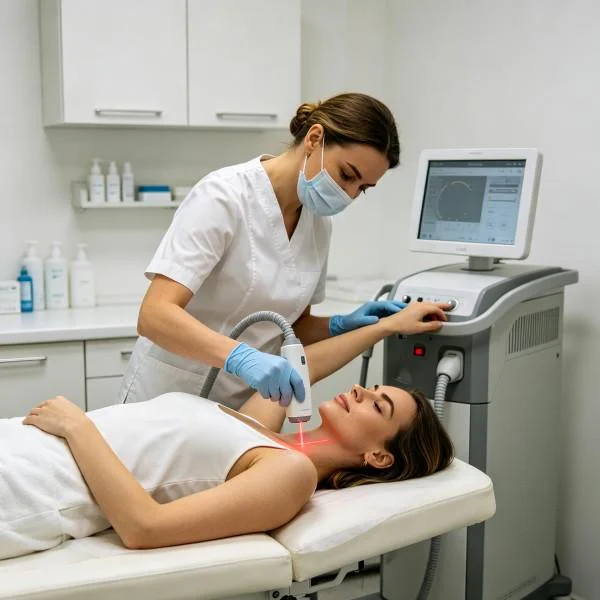
Deploying a multi-wavelength Class IV laser machine for pain treatment bypasses these penetration limits. By delivering high photon densities deep into soft-tissue structures, these systems activate targeted cellular repair pathways:
- Immediate Neuro-Conduction Suppression: High-density photon flux dampens the excitability of peripheral nociceptive fibers. By modulating membrane channel potentials along hyperactive A-delta and C nerve pathways, laser irradiation reduces abnormal ectopic firing and provides fast relief from chronic neurogenic pain.
- Long-Term Extracellular Matrix Remodeling: Photons penetrating into damaged tendon matrices stimulate localized cellular transcription. Activating mitochondrial signaling pathways upregulates basic fibroblast growth factor (bFGF) and increases procollagen mRNA transcription. This normalizes the structural alignment of dense Type I collagen fibers, resolving stubborn tendinopathies, clearing fascial adhesions, and restoring joint mobility without requiring systemic anti-inflammatory drugs or steroid injections.
Pratique clinique normalisée et dossier thérapeutique détaillé
The following clinical log details an integrated surgical and pain management protocol addressing a complex transsphincteric fistula alongside chronic lumbosacral radiculopathy.
Clinical Registry Record: FMX-2026-SR9024
| Groupe de paramètres | Détails des spécifications | Valeur cible clinique |
| Identification du dossier | Référence du cas clinique | FMX-2026-SR9024 |
| Caractéristiques démographiques des patients | Âge / Sexe biologique | 46 Years / Female |
| Pathologies primaires | Diagnostic ano-rectal | Transsphincteric Anal Fistula (Parks Classification Type II, High Tract) |
| Pathologies secondaires | Diagnostic musculo-squelettique | Chronic L4-L5 Lumbar Radiculopathy with Deep Piriformis Entrapment |
| Configuration de l'appareil | Classification opérationnelle | Dual-Wavelength High-Intensity Class IV Medical Laser |
| Mécanismes de l'accouchement (proctologie) | Fibre optique de transmission | 400-micron Radial Hemispherical Fiber (360-degree emission) |
| Mécanismes de l'accouchement (douleur) | Pièce à main transcutanée | Deep-Tissue Collimated Focus Handpiece with Integrated Motion Sensor |
| Mesures de longueur d'onde (proctologie) | Rapport double spectre | 1 470 nm (80 %) + 980 nm (20 %) |
| Indicateurs de longueur d'onde (douleur) | Rapport trispectral | 810nm (50%) + 980nm (30%) + 1064nm (20%) |
| Chirurgie (proctologie) | Réglage de la puissance | 10.0W to 12.0W Gated Pulse |
| Puissance opérationnelle (douleur) | Réglage de la puissance | Mode pulsé avec cycle de service maximal de 18,0 W |
| Fréquence du pouls (proctologie) | Taux de répétition | 2.5 Hz |
| Fréquence du pouls (douleur) | Taux de répétition | 15.0 Hz modulated down to 2.0 Hz |
| Energy Dose (Proctology Tract) | Nombre total de joules fournis | 120J per linear centimeter of tract (Total: 660J) |
| Energy Dose Per Spine Session | Nombre total de joules fournis | 4,200J across paravertebral and gluteal trigger points |
| Prise en charge anesthésique (proctologie) | Type d'anesthésie | Saddle Block Spinal Anesthesia |
| Surface Cooling (Pain Protocol) | Epidermal Protection | Integrated Contact Thermoelectric Chill Tip (5°C) |
Évolution du traitement et indicateurs cliniques objectifs
| Étape du traitement | Fistula Drainage & Healing Index | Tract Lumen Obliteration (%) | Radicular Pain Score (VAS 0-10 Scale) | Lumbar Flexion Distance (Finger-to-Floor, cm) | Clinical Observations and Functional Status |
| Base (avant le traitement) | Continuous purulent discharge, external induration | 0% (Patent 5.5 cm fistula tract) | 8.0 / 10 | 28 cm | Active perianal discharge; marked motor restriction from severe sciatic nerve irritation |
| Day 4 (Post-Proctology) | Serosanguinous trace discharge, zero active pus | 60% Lumen Closure | 7.5 / 10 (Pre-Laser Pain Protocol) | 28 cm | External orifice clean, zero perianal pain on sitting; sphincter continence intact (Wexner Score 0) |
| Week 2 (Pain Session 3) | Orifice closed, clear fibrous healing seal | 85% Tract Consolidation | 4.0 / 10 | 14 cm | Complete internal and external tract closure; radicular burning in the left lower limb significantly reduced |
| Week 4 (Pain Session 6) | Completely healed external skin, no induration | 95% Fibrotic Remodeling | 1.5 / 10 | 4 cm | Fistula tract completely obliterated on transanal ultrasound; spinal mobility returned to near-normal levels |
| Semaine 8 (Évaluation finale) | Stable anatomical restoration, no recurrence | 100% Complete Obliteration | 0.5 / 10 | 0 cm (Palms reach floor) | Patient resumed full endurance athletic training; complete preservation of anal sphincter integrity |
Références scientifiques et cadres biophysiques
The clinical efficacy of endoluminal laser fistula closure builds on research by Dr. A. Wilhelm, published in Techniques in Coloproctology. His clinical trials confirmed that delivering radial laser energy into complex anal fistulae yields high primary healing rates while fully protecting sphincter musculature from thermal or mechanical disruption.
Managing tissue thermal spread through pulsed laser delivery aligns with thermal transport models established by Dr. Ashley J. Welch and Dr. Martin J. C. van Gemert in their textbook Optical-Thermal Response of Laser-Irradiated Tissue. Their work demonstrated that pulse gating restricts heat strictly to target tissue boundaries, preventing structural damage to surrounding healthy tissue.
The biological mechanisms driving photobiomodulation in chronic musculoskeletal disorders are supported by research from Dr. Michael R. Hamblin, published in the Journal of Biomedical Optics. His findings showed that near-infrared photon absorption activates reactive oxygen species (ROS) signaling cascades inside cellular mitochondria, accelerating cell migration, reducing chronic inflammation, and initiating collagen repair.
Furthermore, clinical trials conducted by Dr. Jan Bjordal and colleagues in Physical Therapy in Sport established that high-intensity Class IV laser therapy improves microcirculatory perfusion and reduces pain scores in refractory tendinopathies significantly faster than low-power laser systems or standard physical therapy protocols.
Réalités cliniques : laser à haute intensité vs approches conventionnelles
Moving away from conventional surgical excision and long-term drug regimens toward advanced high-intensity laser therapy marks a clear step forward in clinical outcomes.
Traditional approaches to complex anorectal conditions rely on invasive knife dissections, broad-spectrum antibiotics, and mechanical drain setons. These procedures often leave deep surgical wounds that require weeks of painful daily packing, carrying long recovery times and persistent risks of structural sphincter damage that can permanently impair quality of life.
Employing precision multi-wavelength laser proctology eliminates these clinical drawbacks. Direct endoluminal energy application seals chronic tracts and shrinks vascular cushions from within. Because the procedure avoids mucosal cutting, it causes negligible blood loss and eliminates postoperative wound care, allowing patients to resume full daily routines within days rather than months.
Similarly, conventional management of chronic musculoskeletal pain often relies on masking symptoms with oral non-steroidal anti-inflammatory drugs, relying on muscle relaxants, or administering recurrent corticosteroid injections. Over time, these interventions carry risks of gastrointestinal ulceration, systemic renal strain, and localized tendon weakening.
A high-intensity Class IV laser machine for pain treatment addresses the root cause of chronic tissue dysfunction. Delivering calibrated multi-wavelength photon flux deep through thick fascial layers restores normal cellular energy production, calms hyperactive pain pathways, and accelerates tissue remodeling without systemic toxicity or surgical trauma.
Adopting these advanced medical laser platforms equips modern clinics with a predictable, tissue-sparing approach, delivering reliable outcomes across outpatient proctology and advanced pain management.