 FotonMedix











High-Fluence Canine Elbow Dysplasia Relief Without Steroid Shots
38W super-pulsed multi-wavelength output bypasses thick thoracic coats, 810nm peak absorption drives chondrocyte ATP repair, and duty-cycle gating prevents peri-articular skin overheating.
Walk into any small-animal orthopedic clinic on a Friday afternoon, and you will see a young working dog sidelined in the prime of its life. A four-year-old German Shepherd Dog limps stiffly off the examination scale with a pronounced right forelimb head bob, diagnosed with bilateral elbow dysplasia, fragmented medial coronoid process (FMCP) secondary osteoarthritis, and chronic flexor tendonitis. Because the canine elbow is a tight, complex hinge joint surrounded by dense bone interfaces and covered by thick double-layered thoracic fur, conservative care hits an immediate wall. Intra-articular corticosteroid injections provide only fleeting relief while accelerating cartilage matrix erosion, daily oral anti-inflammatories trigger chronic gastritis, and standard low-wattage therapy devices scatter harmlessly off dark guard hairs without ever penetrating the medial joint compartment.
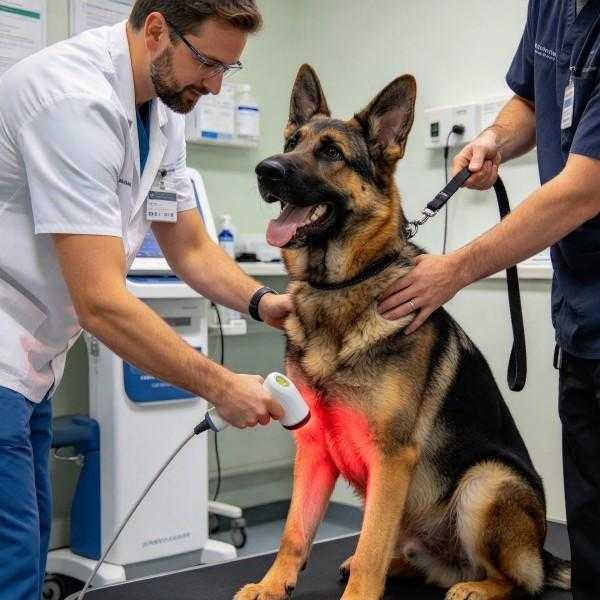
When veterinary surgeons and rehabilitation teams adopt high-intensity Class 4 laser therapy for dogs, that therapeutic bottleneck breaks open. Rather than clipping bald patches across a working dog’s coat or exposing young organs to years of systemic pharmaceuticals, high-power multi-wavelength photobiomodulation drives concentrated photonic energy directly through dense double coats into the deep humeroulnar and humeroradial joint spaces. Using a 38-watt veterinary platform like the VetMedix-Max, clinicians can suppress synovial prostaglandin cascades and restore joint lubrication in under seven minutes without risking epidermal burns.
Navigating Melanin Scattering and Dense Bone Interfaces in Canine Elbows
Treating the canine elbow presents an optical challenge distinct from fleshy hip musculature. The cubital joint sits beneath thick, heavily pigmented double fur coats, yet possesses very little subcutaneous fat padding directly over the medial and lateral epicondyles. According to optical transport studies in pigmented mammalian tissue, dark guard hairs and dense undercoat scatter up to seventy percent of incident photons before they even reach the stratum corneum. Once photons cross the epidermis, melanin and superficial capillary beds absorb another twenty percent along the exponential attenuation curve described by the Beer-Lambert law, while dense cortical bone reflects scattered light sharply. A conventional Class 3B cold laser emitting less than half a watt loses almost its entire photon flux within the first eight millimeters—leaving the inflamed medial coronoid region completely unstimulated.
Delivering effective dog laser therapy into a tight, osteoarthritic elbow joint requires synchronized multi-wavelength emission capable of bypassing surface melanin while saturating intra-articular synovium and peri-articular flexor tendons. Combining five distinct wavelengths (650nm, 810nm, 915nm, 940nm, and 980nm) at peak outputs up to 38 watts orchestrates simultaneous cellular recovery across every tissue layer:
- 650nm (Superficial Dermal & Micro-Vascular Priming): Absorbed within upper epidermal layers to boost localized capillary perfusion and support healthy dermal barrier turnover without contributing to deep joint heat accumulation.
- 810nm (Mitochondrial Cytochrome C Oxidase & Chondrocyte Activation): Targets the exact absorption peak of cytochrome c oxidase inside stressed articular chondrocytes and synovial fibroblasts. Photons at 810nm dissociate inhibitory nitric oxide from the mitochondrial respiratory chain, restoring electron transport and accelerating adenosine triphosphate (ATP) synthesis required for proteoglycan and Type II collagen maintenance.
- 915nm and 940nm (Melanin Bypass & Hemoglobin Oxygen Offloading): Positioned past the steepest epidermal melanin absorption slope, these wavelengths traverse dark coats cleanly while stimulating oxygen dissociation from oxyhemoglobin into hypoxic, fibrotic joint capsules.
- 980nm (Synovial Fluid Viscosity Reduction & Nociceptor Desensitization): Exhibits targeted affinity for interstitial water molecules, establishing gentle micro-thermal gradients that lower inflammatory synovial fluid viscosity, accelerate lymphatic drainage of substance P and bradykinin, and slow C-fiber nociceptive transmission.
Clinical research published in the American Journal of Veterinary Research and Veterinary Surgery confirms that high-fluence near-infrared photobiomodulation significantly reduces synovial fluid interleukin-1 beta and matrix metalloproteinase concentrations in dysplastic canine elbows, measurable via improved peak vertical force on force-plate gait analysis.
Super-Pulsed Duty Cycle Engineering Over Bony Epicondyles
Firing thirty-eight watts of optical power over the bony prominences of the canine elbow—where skin lies stretched tightly over the olecranon and humeral epicondyles—demands strict thermal modulation. Holding an uninterrupted continuous 38W beam over dark fur and thin periosteal tissue would rapidly elevate skin temperature past the forty-three-degree Celsius thermal pain threshold, causing immediate patient flinching. Experienced veterinary clinicians eliminate this hazard not by sacrificing power—which would collapse intra-articular penetration—but by regulating pulse frequency, duty cycle, and continuous scanning velocity.
During a clinical laser therapy for dogs arthritis protocol, Super-Pulse gating fires ultra-short, high-intensity bursts at 38W peak output—providing the photon momentum required to penetrate deep joint recesses—separated by calibrated millisecond dark intervals matching the thermal relaxation time of pigmented canine hair follicles and periosteum.
| Emission Mode | Peak Power Output | Duty Cycle & Thermal Dynamics | Primary Physiological Mechanism | Target Canine Elbow & Forelimb Condition |
| Super-Pulse Mode | Up to 38W peak | Low average thermal load (25%–35% duty) | Deep intra-articular penetration without periosteal or coat heating | Medial compartment elbow disease, fragmented coronoid arthritis, ununited anconeal process |
| Pulsed Mode | 18W – 28W | Balanced on/off gating (50% duty) | Potent synovial analgesia and peri-articular effusion drainage | Sub-acute biceps brachii tenosynovitis, carpal hyperextension strain, post-arthroscopy swelling |
| Continuous Wave (CW) | 12W – 22W | Steady emission (100% duty with brisk scanning) | Deep myofascial relaxation and localized vasodilation | Compensatory triceps, shoulder, and cervical paraspinal muscle guarding |
Pairing Super-Pulse modulation with a smooth massage-ball optical handpiece allows the clinician to part thick thoracic guard hairs and gently compress superficial tissues around the medial and lateral joint margins. This direct contact blanches dermal capillaries, removing competing hemoglobin absorption and boosting intra-articular photon delivery by up to thirty percent while keeping the coat completely unclipped.
Clinical Case Study: Bilateral Elbow Dysplasia in a Working German Shepherd
To evaluate how 38-watt multi-wavelength dosimetry restores forelimb biomechanics and eliminates chronic lameness without repeated steroid injections, examine the documented clinical record of a working dog treated at an orthopedic veterinary rehabilitation center using the VetMedix-Max protocol.
Patient Presentation and Orthopedic Baseline
- Case Reference ID: VET-CUBIT-2026-0884-ED
- Patient Demographics: 4-year-old intact male sable German Shepherd Dog, weighing 38.4 kg, active search-and-rescue canine
- Diagnosis: Computed tomography (CT) and radiographically confirmed bilateral elbow dysplasia secondary to medial coronoid disease (International Elbow Working Group Grade II right elbow, Grade I left elbow), accompanied by moderate peri-articular osteophytosis and right biceps brachii insertional tendonitis
- Pathological Grading: Canine Brief Pain Inventory (CBPI) Pain Severity Score of 7.6/10 and Pain Interference Score of 8.0/10; Forelimb Lameness Grade 3/5 (pronounced head bob at a trot, shortened cranial stride phase, and reluctance to jump into transport vehicle); right elbow flexion-extension range of motion restricted to 88 degrees (normal ~130 degrees)
- Prior Interventions: Eighteen months post-arthroscopic fragment removal; managed with intermittent oral grapiprant and two intra-articular triamcinolone injections over the past year, with diminishing relief intervals and recurring gastrointestinal upset
Staged Dosimetry and Functional Recovery Table
Because treating bilateral elbows plus compensatory shoulder and cervical musculature through a dense sable double coat requires high cumulative energy delivered safely over bony prominences, the clinician structured a ten-session protocol over four weeks, advancing from high-frequency Super-Pulsed analgesia to high-fluence regenerative scanning.
| Session Number | Treatment Stage | Wavelength Ratio Configuration | Peak Power (W) | Pulse Frequency (Hz) | Duty Cycle / Mode | Total Energy Delivered (Joules) | Session Duration | Functional & Orthopedic Milestones |
| Session 1 | Acute Synovial Analgesia | 810nm (30%) + 915nm (25%) + 940nm (20%) + 980nm (25%) | 20W | 6000 Hz | Super-Pulse (25% Duty) | 4,200 J (2,400 J R / 1,800 J L) | 7.5 min | Dog relaxed calmly in lateral recumbency without muzzle or restraint; immediate post-session trot showed visibly softer forelimb landing. |
| Session 2 | Acute Synovial Analgesia | 810nm (30%) + 915nm (25%) + 940nm (20%) + 980nm (25%) | 22W | 5000 Hz | Super-Pulse (30% Duty) | 4,800 J (2,700 J R / 2,100 J L) | 7.5 min | Palpable reduction in medial joint capsule effusion; CBPI Pain Severity Score dropped from 7.6 to 5.1/10. |
| Session 4 | Effusion Clearance & Tendon Relief | 650nm (5%) + 810nm (35%) + 915nm (25%) + 940nm (15%) + 980nm (20%) | 26W | 2500 Hz | Pulsed (45% Duty) | 5,600 J (3,200 J R / 2,400 J L) | 8.0 min | Forelimb lameness improved to Grade 1/5 at a walk; discontinued oral grapiprant completely with zero appetite or GI issues. |
| Session 6 | Chondrocyte ATP & Flexor Recovery | 650nm (5%) + 810nm (40%) + 915nm (25%) + 940nm (15%) + 980nm (15%) | 30W | 1200 Hz | Pulsed (55% Duty) | 6,400 J (3,600 J R / 2,800 J L) | 8.0 min | Right elbow range of motion expanded from 88 degrees to 112 degrees; dog voluntarily jumped onto low grooming platform without hesitation. |
| Session 8 | Intra-Articular Matrix Remodeling | 650nm (10%) + 810nm (40%) + 915nm (20%) + 940nm (15%) + 980nm (15%) | 34W | CW / 300 Hz Hybrid | 75% Duty Cycle | 7,200 J (4,000 J R / 3,200 J L) | 7.5 min | Completed 20-minute uneven-terrain search drill with zero post-exercise stiffness; CBPI Pain Interference Score fell from 8.0 to 1.8/10. |
| Session 10 | Biomechanical Consolidation | 650nm (10%) + 810nm (40%) + 915nm (20%) + 940nm (15%) + 980nm (15%) | 38W | CW (Continuous Scanning) | 100% Scanning CW | 8,000 J (4,400 J R / 3,600 J L) | 7.5 min | Lameness Grade 0/5 at walk and trot; elbow range of motion reached 122 degrees; cleared for full operational search-and-rescue deployment. |
Circumferential Joint & Compensatory Chain Scanning Technique
To saturate the tight humeroulnar joint space without dwelling over superficial epicondylar bone, the clinician flexed and extended the elbow gently through passive range of motion while delivering sixty percent of the dosage circumferentially across the medial coronoid region, lateral joint line, and anconeal fossa at 3 centimeters per second. The remaining forty percent was swept proximally along the biceps brachii tendon, triceps belly, and lower cervical paraspinal muscles to release compensatory forequarter guarding. Throughout every session, skin surface temperatures remained comfortable and unclipped coat integrity was preserved completely.
Scaling Wavelength Precision Across Equine, Human, and Surgical Specialties
The exact optical engineering that enables a 38-watt veterinary platform to restore a working dog’s elbow mobility anchors high-performance clinical results across equine sports medicine, human rehabilitation, and minimally invasive surgery. In equine practices, veterinarians rely on the battery-powered Theralux-Max 38W system to penetrate dense metacarpal fascia and heavy gluteal musculature, treating proximal suspensory desmitis and sacroiliac strain trackside without sedation or prohibited competition medications.
In human outpatient clinics, the LaserMedix-Max 30W applies identical five-wavelength synchronization and peak penetration depth maintaining technology to saturate deep lumbar nerve roots and osteoarthritic hip capsules in under ten minutes. Meanwhile, in minimally invasive surgical suites, dual-wavelength platforms combining 1470nm and 980nm—such as the SurgMedix-Max—exploit the forty-fold higher water absorption of 1470nm to perform bloodless endovenous saphenous ablation, sphincter-sparing anal fistula closure, and precision veterinary oral surgery without collateral nerve damage. Across every species and medical discipline, matching multi-wavelength physics to target tissue biology replaces systemic drug reliance and invasive trauma with rapid cellular repair.
Comparing Class 4 Canine Photobiomodulation Against Traditional Elbow Care
For veterinary clinic directors, orthopedic specialists, and medical equipment distributors evaluating capital investments, comparing a 38-watt multi-wavelength platform for dog laser therapy against conventional pharmaceutical and low-power modalities reveals decisive clinical and economic advantages.
| Veterinary Evaluation Metric | High-Intensity Class 4 Veterinary Laser (38W Multi-Wavelength) | Conventional Class 3B Cold Laser (less than 0.5W) | Intra-Articular Corticosteroid Injections | Daily Oral NSAIDs / Coxibs (Carprofen / Grapiprant) |
| Double-Coat & Joint Penetration | Penetrates unclipped sable/dark coats down to 15cm via 38W bursts | Scattered within 8mm by thick guard hairs and cortical bone interfaces | Direct needle puncture into tight elbow joint space under heavy sedation | Systemic oral absorption; unaffected by coat thickness |
| Time to Deliver 4,000 Joules per Elbow | 3.5 to 4 minutes per joint | Over 130 minutes (clinically unworkable in active dogs) | 30 to 45 minutes including sedation, sterile clipping, and recovery | Daily owner pill administration with ongoing compliance burden |
| Impact on Articular Cartilage & Tendons | Stimulates chondrocyte ATP, proteoglycan synthesis, and synovial drainage | Negligible deep intra-articular fluence; primarily superficial warming | Rapidly suppresses inflammation, but accelerates cartilage matrix degradation | Blocks inflammatory prostaglandins only; does not repair damaged cartilage |
| Systemic & Procedural Risk Profile | Zero hepatic, renal, or GI toxicity; thermal safety governed by Super-Pulse | Safe, but high rate of clinical non-response in deep elbow dysplasia | Risk of septic arthritis, post-injection flare, and sedation complications | Risk of gastric ulcers, vomiting, and hepatorenal strain over lifelong use |
| Clinic Revenue & Client Retention | High-margin 8-to-10 session packages executed by veterinary technicians | Low client satisfaction due to slow or imperceptible gait improvement | High single-visit fee, but limited repeat frequency and owner anxiety | Low-margin pharmacy refills easily lost to online pet medication retailers |
Repeated intra-articular steroid injections inevitably thin articular cartilage and require heavy sedation alongside sterile coat clipping—an unacceptable drawback for working and sporting dogs. Low-wattage Class 3B devices lack the photon density to cross dense thoracic fur and tight cubital joint capsules within a standard appointment slot. Meanwhile, lifelong daily NSAIDs carry persistent gastrointestinal and organ risks in active dogs.
Adopting high-intensity Class 4 laser therapy for dogs equips veterinary practices with a safe, non-invasive, drug-free modality that restores genuine joint comfort and athletic longevity. Working and companion dogs return to pain-free movement in weeks rather than months, while veterinary hospitals build a high-retention rehabilitation service line trusted by pet owners.