 FotonMedix











news
Company News丨Industry News丨Products News
Search the whole station
Company News丨Industry News丨Products News
Chronic lower-extremity pain imposes significant physical limitations and economic burdens. Patients seeking conservative management often cycle through NSAIDs, corticosteroid injections, bracing, or physiotherapy without long-term success. With the rising clinical acceptance of photobiomodulation, knee laser therapy has become a central topic in orthopedic research and rehabilitation protocols. The technology is now widely implemented in orthopedic departments, sports medicine hospitals, and multidisciplinary pain-management centers.
This article investigates key differences between photobiomodulation and traditional orthopedic interventions, the rationale for using laser therapy for knee pain, and how addressing foot biomechanics using laser therapy for feet contributes to comprehensive lower-limb management.
Traditional treatment strategies focus on symptom suppression rather than cellular repair. Photobiomodulation, however, initiates mitochondrial and vascular changes that physically alter tissue recovery potential.
Braces support alignment but do not directly influence synovial biology, tendon remodeling, or microcirculation.
Procedures such as arthroscopy or partial meniscectomy may accelerate degenerative processes in certain age groups.
The following measurable effects justify widening adoption:
Photobiomodulation accelerates fibroblast proliferation and collagen organization in ligaments and tendons. This is critical for knee stabilization and patellar tracking correction.
Reduced synovial membrane thickness and enhanced synovial fluid exchange improve movement quality and decrease crepitus.
Laser irradiation moderates dorsal horn hyper-excitability, useful for chronic osteoarthritis patients with central sensitization.
Since knee disorders are rarely isolated, addressing alignment, muscle activation, and foot mechanics amplifies therapeutic outcomes.
Many patients present with combined lower-extremity dysfunction:
Using laser therapy for feet to control inflammation and restore foot mechanics often accelerates knee improvement by reducing abnormal load transfer along the kinetic chain.

Standard hospital parameters:
Laser therapy complements:
This multimodal approach produces higher return-to-function rates compared to single-modality treatments.
“Chronic Medial Knee Osteoarthritis Complicated by Sural Nerve Irritation and Plantar Overload: A Combined Knee and Foot Laser Therapy Approach”
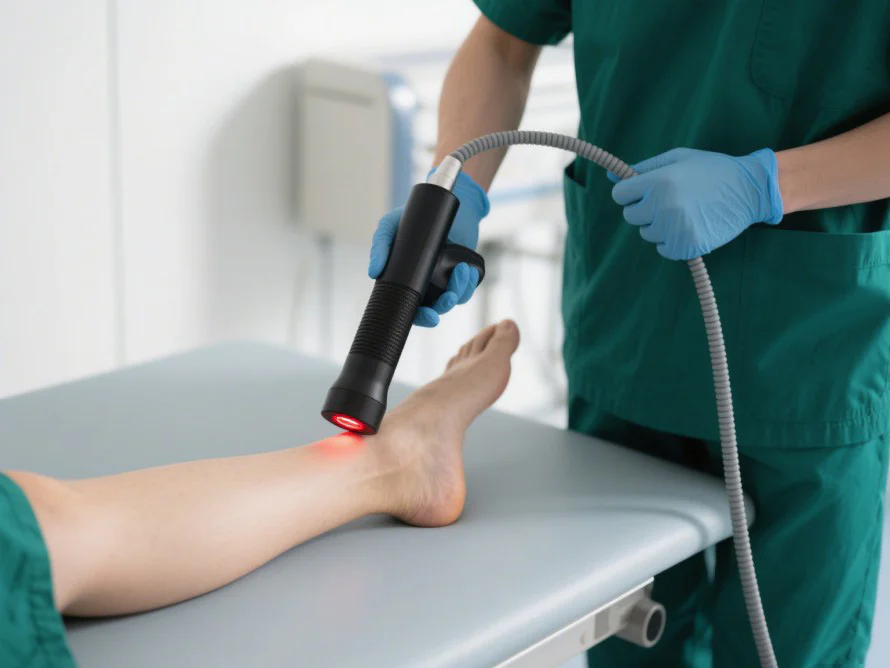
This case demonstrates that treating both knee and foot pathology simultaneously can correct biomechanical errors, reduce neural sensitization, and halt degenerative progression.
Patients significantly decrease NSAID use after completing laser sessions.
No puncture, incision, or infection risk.
When used pre-operatively, laser therapy decreases inflammation, making post-operative recovery smoother.
Gait correction through addressing foot pathology produces lasting improvements in knee loading, reducing recurrence.
As medical evidence supports its regenerative and anti-inflammatory effects, laser therapy for knee pain continues to replace outdated treatment models that offer only temporary relief. Particularly when applied alongside laser therapy for feet, clinicians observe superior biomechanical corrections, lower pain scores, and more consistent functional gains. Combining both regions’ treatment ensures a complete kinetic-chain approach essential for modern orthopedic rehabilitation.