 フォトンメディックス












熱の測定誤りにより、レーザー背部治療が失敗する
腰痛の問題は、多くの場合、治療の深さの問題である
慢性腰痛の患者は、リハビリテーションクリニックを訪れ、次のようなごく簡単なことを口にするかもしれません。「寝ているときは楽なのですが、立ったり、かがんだり、30分間座り続けると痛みが戻ってきます。」“
その一文は、多くのレーザー治療プロトコルに潜む実際的な問題点を浮き彫りにしている。.
臨床医は、十分な光エネルギーを発生させるレーザーを使用している場合でも、照射されたエネルギーが必ずしも患者の症状を引き起こしている組織層に到達しているとは限りません。表層の筋トリガーポイント、脊柱傍筋膜、刺激を受けた神経経路、およびより深部の関節周囲組織は、同じ波長に対しても同じようには反応しないからです。.
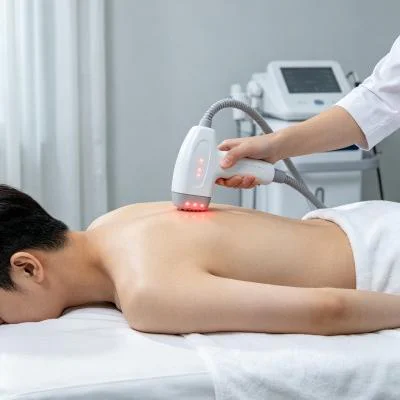
そこで レーザー背中療法 単に高出力の機器を選び、治療時間を延ばすだけという単純な話ではなく、より複雑なものとなります。.
評価を行う診療所については 痛みのためのレーザー光治療, 、より有意義な問いは「その装置の出力はいくつのワットか?」ではなく、「光エネルギーは実際にはどこへ行き、どのくらいの速さで吸収され、標的組織にはどの程度の熱負荷が到達するのか?」ということです。“
この区別が重要なのは、レーザーと組織との相互作用が、波長、吸収、散乱、スポットサイズ、出力、照射時間、組織の組成、アプリケーターの動き、およびパルス構造によって左右されるためである。.
980 nmのビームと1470 nmのビームは、同じ公称光出力を供給できる一方で、吸収されるエネルギーの空間分布は大きく異なる。.
腰痛クリニックにおいて、その違いによって、治療が「制御された深部温熱療法」として感じられるか、それとも単なる「表層的な温熱処置」になってしまうかが決まるのです。.
レーザーの出力が高ければ高いほど、必ずしも背中の治療効果が向上するとは限らない理由
購入の際によくある間違いの一つは、ほぼ最大ワット数だけで機械を比較してしまうことです。.
その手法は生体組織に対しては効果が低い。.
近赤外レーザー光が皮膚や皮下組織に入ると、一部の光子は散乱され、一部は水やヘモグロビンなどの発色団によって吸収され、残りの光エネルギーは組織のさらに奥へと進みます。.
重要な点は、吸収と浸透が互いに相反する作用を持つということです。.
強く吸収される波長は、通常、より急速に減衰します。吸収がそれほど強くない波長は、そのエネルギーが放出されるまで、より遠くまで伝播することができます。.
だからこそ、臨床医は波長や治療モードを知らずに「30 W」といった仕様値を解釈することはできないのです。.
例えば、FotonMedix社の「LaserMedix-MAX」は、650 nm、810 nm、915 nm、 940 nm、980 nmの5つの波長を採用しており、最大出力は30 Wとされている。メーカーは、このシステムを、腰痛、坐骨神経痛、椎間板に関連する疾患などを含む、非侵襲的な疼痛緩和、炎症管理、組織修復、および深部組織理学療法向けの製品として位置付けている。.
この多波長アーキテクチャは、治療者がすべての解剖学的層を、あたかもそれらが同一の光学特性を持っているかのように扱わなければならないという制約を受けないという点で、臨床的に興味深いものである。.
真のメリットは、単に仕様書に5つの数値が記載されていることだけではありません。さまざまな治療目的に合わせて選択できる、複数の波長オプションが用意されている点にあります。.
組織の深さによってレーザー照射量の意味が変わる
レーザーエネルギーは、均一な光柱として体内を伝播するわけではありません。.
近赤外光は、組織内を伝播する際に吸収と散乱の両方を経験する。皮膚、脂肪組織、筋肉、筋膜、および血液を含む組織は、それぞれ光の伝播に影響を与える。.
およそ800 nmの波長域では、組織による散乱が比較的少なく、光の浸透に適しています。 波長が長くなるにつれて、特に1470 nm付近では、水による吸収がますます重要になってきます。980 nmと1470 nmのレーザーと組織との相互作用を比較した実験によると、1470 nmの波長は980 nmに比べて水による吸収が著しく強く、光の浸透深度もはるかに浅いことが示されています。.
あるヒトの静脈組織の比較研究では、調査条件下において、980 nmの波長では約1.26 mm、1470 nmの波長では0.22 mmの浸透深度が報告されている。組織の光学特性、形状、および治療条件が異なるため、これらの値を腰部筋肉にそのまま適用することはできないが、その根本的な原理は極めて関連性が高い: 吸収が強くなると、エネルギーの蓄積が速くなり、有効浸透深さが浅くなります。.
だからこそ、1470 nmの外科用レーザーが、単に外部からの疼痛治療に適した波長であると安易に想定すべきではないのです。.
この波長は、水分を多く含む組織による吸収を制御することが臨床上の目的となる場合、極めて有用である。これは、局所的な光熱効果を意図的に必要とする低侵襲処置において用いられる。.
これは、数センチメートルの軟組織を通して非侵襲的な光生体調節を行うこととは、治療上の課題が異なるものです。.
1470 nmが実際に何を変えるのか
1470 nmという波長は、水が主要な吸収体となるため、特に興味深い。.
人体の組織には大量の水分が含まれているため、1470 nmのエネルギーを比較的浅い領域に効率的に蓄積させることができます。.
この特性は、組織の切断、気化、凝固、あるいは局所的な熱による組織再構築を必要とする外科的用途において有用です。.
FotonMedix社の「SurgMedix-MAX」は、最大20 Wの1470 nm、最大40 Wの980 nm、および最大0.5 Wの635 nmを組み合わせています。 本システムは、EVLT、泌尿器科、婦人科、肛門科、耳鼻咽喉科などの手術やその他の外科的用途に対応する手術用プラットフォームとして設計されています。.
この違いは、B2Bの医療機器購入担当者にとって重要です。.
1470 nmの外科用レーザーシステムと理学療法用レーザーは、どちらも「医療用レーザー」と呼ばれることがありますが、それぞれが解決する課題は異なります。.
背中の外部治療においては、水の吸収率が非常に高い波長が必ずしも望ましいとは限りません。エネルギーが皮膚表面のすぐ近くで吸収されてしまうと、出力を上げても、深部の脊柱傍組織へのエネルギー伝達効率が向上するよりも早く、表面の加熱が進んでしまう可能性があります。.
したがって、臨床医は次のような観点から考える必要がある。 エネルギー沈着深度, 、単に最大出力だけではなく。.
なぜ980 nmは単なる「深部レーザー」よりも複雑なのか“
980 nmの波長は、水とヘモグロビンの両方が吸収に寄与するため、興味深い領域に位置しています。.
これまでに発表された光学に関する研究によると、810、940、980 nmなどの波長の短い近赤外光はヘモグロビンとの相互作用が強く、一方、1470 nmなどの波長の長い近赤外光は水への吸収とより強く関連していることが示されている。.
980 nmでは、水による吸収も局所的な熱効果を生み出すのに十分な強度です。高エネルギー光生体調節に関する実験研究により、組織中の水が光吸収に寄与するため、980 nmの照射によって局所的な急速な加熱が生じることが実証されています。.
このため、制御された熱刺激が治療戦略の一部となる場合、980 nmの波長が有用となります。.
しかし、これはまた、980 nmのプロトコルをある患者から別の患者へ単純に適用できない理由も説明しています。.
同じ公称出力であっても、以下の要因によって異なる温度応答が生じることがあります:
- 組織の厚さ
- 皮膚の色素沈着
- 脂肪層の厚さ
- 血行
- アプリケーターの動き
- スポットサイズ
- 接触圧力
- パルス幅
- デューティサイクル
- 処理時間
- 治療範囲
したがって、「980 nmレーザー治療」という言葉だけでは、臨床医に伝えられる情報は一部に過ぎない。.
デューティサイクルの実用的な役割
高出力レーザーシステムを使用する場合、熱管理は特に重要になります。.
連続波レーザーは、途切れることなくエネルギーを照射することができます。これは、臨床医が広い治療領域全体にわたって持続的な熱効果を得たい場合に有用です。.
しかし、エネルギーを連続的に供給することで、照射の合間に組織が熱を放散する機会も少なくなってしまう。.
パルス運転では、この関係が変わります。.
デューティサイクルとは、パルスシーケンス中にレーザーが実際に発振している時間の割合を指します。デューティサイクルが低いほど、組織への照射は、レーザーが発振しない期間を挟んで行われることになります。.
そうした休みの期間は、決して無駄な時間ではありません。.
これらは、熱が吸収量が最も高い領域から放散されるようにし、表面温度が過度に上昇するリスクを低減することができます。.
この原理は、FotonMedix社の馬用治療プラットフォームにも反映されており、同プラットフォームでは「スーパーパルス」、「パルス」、「連続波」という3つのレーザーモードが説明されています。パルスモードは、過熱を避けつつ治療効果を高めることを目的とした断続的な照射として具体的に説明されており、一方、連続波モードは、短時間に高エネルギーを必要とする状況向けに位置づけられています。.
この工学的な原理は、人間の理学療法にも当てはまります。.
目的は、組織を可能な限り低温に保つことではありません。過度な冷却は、望ましい熱効果を損なう恐れがあります。目的は、対象となる組織に十分な光エネルギーを供給しつつ、温度を制御された治療範囲内に保つことです。.
だからこそ、優れたプロトコルでは、波長や出力以上の項目を規定すべきなのです。.
また、治療時間、照射モード、治療範囲、アプリケーターの動き、および患者の熱反応についても定義すべきである。.
その違いを明らかにする、公表済みの臨床プロトコル
臨床的に特に有用な比較の一つは、60名の参加者を対象とした慢性非特異的腰痛に関する無作為化比較試験から得られたものである。.
研究者らは、12週間にわたる介入期間において、低出力レーザー療法、高出力レーザー療法、および対照群を比較した。.
HILTプロトコルでは、12 Wの1064 nmダイオードレーザーを使用し、150 J/cm²の照射量、1回のセッションあたり約1,200 Jの総エネルギーを照射した。 治療は12週間にわたり週2回実施され、各回の治療時間は約15分であった。プローブは、特定の部位に静止させるのではなく、痛みのある腰部全体を連続的に移動させながら照射した。.
本研究は、機器のマーケティングにおいて見過ごされがちなある点を理解する上で役立つ。.
そのプロトコルには、単に「12 Wのレーザーを使用する」とだけ書かれていたわけではない。“
そこには、波長、出力、線量、治療部位、動き、1回の治療時間、および治療頻度が明記されていた。.
これらの変数が組み合わさって、治療法が形成される。.
A separate clinical study of high-level laser therapy for lower back pain compared 650 nm, 810 nm and a combined 810/980/1064 nm protocol. The researchers kept the other principal parameters constant at 5 W and 50 J/cm² for ten daily sessions. All three groups improved over time, while the 810 nm group demonstrated better pain and disability outcomes at the four-month follow-up in that study.
これは、810 nmが980 nmや1064 nmよりも普遍的に「優れている」という意味ではありません。.
これは、臨床現場での購入判断において、さらに有用なことを示しています: 他の治療変数を同等に保った場合でも、波長の選択は結果に影響を与える可能性がある。.
公表されたエビデンスに基づく臨床症例表
データを提示する前に、重要な点を指摘しておく必要があります。.
このトピックに関して公表されている研究では、マーケティング型の症例報告で求められるような患者レベルの変数がすべて提供されているわけではない。特に、無作為化試験では、個々の患者の性別、正確な病理学的悪性度、波長比、および経時的なエネルギー記録を特定するのではなく、一般的に群レベルの人口統計学的データや治療プロトコルが報告されている。.
そうした分野をでっち上げると、記事はより詳細に見えるようになる一方で、信頼性は低下してしまうだろう。.
したがって、次の表では 公表された臨床データ, 、そして、元の研究では報告されていなかった情報を明示的に示している。.
| 臨床項目 | 公表された臨床的エビデンス |
|---|---|
| 対象患者群 | 慢性非特異性腰痛のある成人 |
| 研究デザイン | 無作為化比較試験 |
| 標本サイズ | 参加者60名 |
| 年齢 | 成人集団;本研究報告書では、特定の症例について、その患者の年齢は特定されていなかった。 |
| セックス | 集団レベルの人口統計情報。個々の患者のプロファイルは報告されていない。 |
| 病理学 | 慢性非特異性腰痛 |
| 病理学的悪性度 | Not applicable; nonspecific LBP was clinically diagnosed rather than graded as a disc herniation stage |
| Laser group | 高強度レーザー治療 |
| 波長 | 1064 nm |
| 出力電力 | 12 W |
| エネルギー密度 | 150 J/cm² |
| Approximate total energy | 1,200 J per session |
| 治療の頻度 | 週2セッション |
| 治療期間 | 12週間 |
| セッション | 24 sessions |
| Session time | 約15分 |
| Application area | Lumbar region |
| Applicator technique | Probe positioned vertically and moved horizontally across the affected area |
| Comparator | 850 nm LLLT and no-laser control groups |
| Clinical outcomes | Pain severity, disability, lumbar mobility and quality of life were evaluated |
| Source | Randomized comparative study of HILT, LLLT and control in chronic nonspecific LBP |
The important lesson from this table is not that 1,200 J is a universal prescription.
It is that a clinically meaningful laser protocol has to connect energy delivery to anatomy and treatment objectives.
Another 980 nm Protocol Gives a Different Picture
A separate randomized controlled trial investigated 100 patients with chronic low back pain.
The laser-plus-exercise group received a 980 nm GaAlAs diode laser with a 32 cm² irradiation spot, 20 W continuous-wave output, a fluence of 37.5 J/cm² and 1,200 J total energy per treatment point. Treatments were performed three times weekly for three weeks and were combined with an exercise program.
At the end of three weeks, the laser-plus-exercise group had a greater reduction in VAS pain score than the exercise-only group, with mean VAS changes of 3.96 versus 2.23.
Again, this should not be interpreted as proof that every 980 nm high-power laser will reproduce those results.
The study used a specific handpiece, spot size, power, fluence, total energy and exercise program.
Changing any of those variables changes the treatment.
For a clinic evaluating a new system, this is exactly why protocol flexibility matters.
What a Real Back-Pain Treatment Session Looks Like
Consider a patient with chronic lumbar pain who reports that walking is tolerable but prolonged standing produces a deep aching sensation around the lower lumbar and paraspinal region.
The therapist first needs to determine whether the presentation is appropriate for conservative rehabilitation.
Red flags, severe neurological deficits, suspected fracture, infection, malignancy, progressive motor weakness and other conditions requiring medical assessment should not be hidden behind a laser-treatment protocol.
For appropriate patients, the laser treatment can then be treated as one component of a rehabilitation plan rather than a replacement for clinical reasoning.
The treatment area can be mapped according to the patient’s painful structures rather than treating the entire lower back indiscriminately.
A lower-power or less thermally aggressive wavelength can be used when the target is closer to the surface.
A deeper-penetrating near-infrared wavelength can be considered when the treatment objective involves deeper muscular or periarticular structures.
The applicator should generally keep moving when the protocol calls for scanning rather than stationary irradiation.
The clinician should watch the patient’s thermal sensation instead of assuming that a preset power is appropriate for every patient.
This matters because pain relief during treatment is not the same thing as tissue healing.
A patient may report immediate relief because of sensory modulation, changes in muscle tone or thermal comfort. Those effects can be useful, but the longer-term objective should be improved function.
That means the treatment response should be measured using outcomes such as pain score, range of motion, walking tolerance, sit-to-stand performance, sleep disturbance, disability scales and the patient’s ability to return to normal activity.
Why Laser Should Usually Sit Inside a Rehabilitation Program
The strongest clinical argument for laser therapy is not that it replaces exercise, manual therapy, education or other conservative care.
For chronic low back pain, that would be an overly simple claim.
The World Health Organization’s 2023 guideline emphasizes person-centered, multimodal management of chronic primary low back pain, including education, exercise, selected physical therapies, psychological approaches and appropriate medication.
The evidence for photobiomodulation in nonspecific low back pain is also mixed.
A systematic review and meta-analysis published in the 『理学療法ジャーナル』 included 12 randomized trials involving 1,046 participants and concluded that PBMT did not produce a clinically important improvement in pain or disability compared with sham PBMT in nonspecific low back pain.
That finding should not be ignored in a commercial article.
It actually gives clinicians a more useful way to think about the technology.
Laser therapy should not be sold as a universal answer to every lumbar complaint.
Its value depends on patient selection, treatment parameters, tissue target and integration with rehabilitation.
How FotonMedix’s Multi-Wavelength Approach Fits This Problem
The LaserMedix-MAX platform provides 650 nm, 810 nm, 915 nm, 940 nm and 980 nm wavelengths with a stated maximum output of 30 W. The manufacturer describes the platform as a high-energy photobiomodulation system with non-invasive treatment, pain relief, anti-inflammatory applications and indications including chronic low back pain, sciatica and lumbar disc degeneration.
For a rehabilitation clinic, the more interesting point is the ability to select among wavelengths rather than treating every patient with the same optical setting.
The 650 nm component is relatively superficial compared with the longer near-infrared wavelengths.
The 810 nm region has historically been widely investigated for photobiomodulation and tissue penetration.
The 915, 940 and 980 nm wavelengths move the treatment further toward the near-infrared region where tissue absorption and thermal interaction become increasingly relevant.
The 980 nm option is particularly useful when controlled thermal stimulation is part of the treatment strategy, but it also demands attention to power density, exposure duration and heat accumulation.
This gives a clinician more room to build a protocol around anatomy instead of forcing anatomy to fit a fixed laser preset.
The Difference Between a Physiotherapy Laser and a Surgical Laser
This distinction is important for international medical-equipment buyers.
A surgical laser is built to create a deliberate photothermal effect in a localized tissue target.
A physiotherapy laser is generally used externally, where the goal is to deliver optical energy through the skin and underlying tissues without creating surgical tissue ablation.
FotonMedix’s SurgMedix-MAX lists 1470 nm at 20 W and 980 nm at 40 W, together with a 635 nm source. Its intended applications include tissue cutting, coagulation, evaporation and incision across multiple surgical specialties.
By contrast, the LaserMedix-MAX is presented as a non-invasive physiotherapy platform using five wavelengths and 30 W maximum output.
For a clinic treating low back pain externally, buying a surgical laser simply because it has a higher maximum wattage would be the wrong comparison.
について 最高のレーザー治療器 is not necessarily the machine with the highest power.
It is the system whose wavelength range, output control, emission modes, treatment head, thermal management and clinical protocols fit the intended patient population.
Where Pulse Modulation Becomes a Practical Advantage
A clinician treating a thin patient with a relatively superficial painful structure has a different thermal problem from a clinician treating a heavily muscled patient with deeper lumbar tissue.
This is one reason pulse modulation can be useful.
Suppose the treatment system delivers a high peak power during a short pulse but reduces the average thermal load through an appropriate duty cycle.
The instantaneous optical intensity can remain clinically useful while the average heat accumulation is lower than it would be under uninterrupted emission.
FotonMedix’s veterinary and equine platforms explicitly describe super-pulse operation as providing high peak power with adjustable thermal sensation and pulse operation as intermittent emission intended to reduce overheating.
Although these platforms are intended for animals, the engineering principle is the same one that matters in human high-power laser design.
The protocol still has to be validated for the specific human device and clinical indication.
Duty cycle should not be treated as a magic safety number.
If the tissue target requires thermal stimulation, reducing the duty cycle too aggressively can reduce the desired effect. If the tissue is already warm or poorly dissipating heat, the same duty cycle may still be excessive.
The clinician needs feedback.
What Should Be Measured After Each Session
A clinic that wants meaningful clinical data should avoid recording only “patient felt better.”
A more useful treatment record includes:
| パラメータ | Before treatment | During treatment | After treatment |
|---|---|---|---|
| VAS/NRS pain | Baseline pain | Change during irradiation | Immediate response |
| Thermal sensation | ベースライン | Comfortable, warm, hot or excessive | Residual sensation |
| Tenderness | Palpation finding | Treatment response | Post-treatment change |
| Lumbar ROM | Flexion/extension or relevant measure | Not always measured | Repeat where practical |
| Functional task | Standing, walking or sit-to-stand | — | Compare with baseline |
| Laser wavelength | Planned wavelength | Confirm actual output | Record completed mode |
| パワー | Planned W | Actual W if monitored | Record |
| モード | CW/pulse/super pulse | 確認済み | 確認済み |
| エネルギー | Planned J | Delivered J | Final total |
| 治療エリア | Anatomical map | 確認済み | 確認済み |
| 有害反応 | Baseline skin status | Heat or discomfort | Skin and symptom check |
This level of documentation makes it possible to distinguish a reproducible clinical protocol from an anecdotal treatment.
It also creates useful information for future equipment procurement.
If most patients require deeper near-infrared treatment with controlled heating, a clinic can justify its equipment choice from actual treatment data rather than from a brochure.
What International Buyers Should Ask Before Choosing a Device
For distributors, rehabilitation hospitals and private physiotherapy clinics, several questions are more useful than asking for the maximum wattage.
Can the device control wavelength independently?
If the machine has several wavelengths, the clinician should know whether they can be selected independently or whether they are locked into fixed combinations.
Can power be adjusted precisely?
A 30 W maximum does not mean every patient should receive 30 W.
Fine power adjustment is more useful than a large maximum-output number when protocols need to be individualized.
Does the system provide pulse and continuous modes?
A system that supports different emission modes gives the clinician more options for managing heat accumulation.
Is treatment temperature monitored or indicated?
FotonMedix describes therapeutic temperature indication technology on its high-energy therapy platforms, along with “hot and cold” treatment functionality.
For high-power external laser treatment, thermal feedback is much more meaningful than simply knowing the nominal laser output.
Can protocols be reproduced?
A clinic should be able to record wavelength, power, mode, treatment duration and total energy so another trained clinician can reproduce the treatment.
Is the device intended for the actual clinical application?
A surgical laser and a physiotherapy laser may use overlapping wavelengths, but that does not make them interchangeable.
What the Evidence Really Says About Laser Light Therapy for Pain
The evidence supports a cautious position.
Laser therapy can produce clinically relevant effects under specific protocols, and several randomized trials have reported improvements in chronic low back pain using different laser wavelengths and treatment regimens.
At the same time, systematic reviews have found inconsistent results, particularly for nonspecific low back pain.
That inconsistency is not surprising when the term “laser therapy” covers everything from low-level 810 nm treatment to high-intensity 1064 nm irradiation and from fixed-point exposure to moving high-power treatment.
It is similar to saying “exercise works” without specifying whether the patient is performing walking, maximal squats or rehabilitation exercises after surgery.
治療パラメータは重要です。.
解剖学的標的は重要です。.
The diagnosis matters.
And the patient’s response matters.
The Practical Takeaway for Laser Back Therapy
The most useful way to think about レーザー背中療法 is as controlled energy delivery rather than simply “putting a laser on the back.”
The first question is where the target tissue is.
The second is how the selected wavelength is absorbed by that tissue.
The third is how much energy can be delivered before thermal accumulation becomes excessive.
The fourth is whether the patient is actually improving in a meaningful functional outcome.
This explains why 1470 nm is not automatically the best external back-treatment wavelength simply because it has strong water absorption.
It also explains why 980 nm should not be treated as a generic deep-heating setting without considering hemoglobin interaction, water absorption and thermal management.
For non-invasive rehabilitation, a multi-wavelength physiotherapy system such as the LaserMedix-MAX provides a broader parameter space than a single-wavelength device, while the separate SurgMedix platform demonstrates why 1470 nm and higher-power 980 nm systems are more naturally associated with controlled surgical photothermal applications.
The comparison with conventional care should therefore not be framed as “laser versus medicine.”
That is too simplistic.
A better comparison is between a rehabilitation program that treats pain as one undifferentiated symptom and a program that uses objective assessment, exercise, appropriate physical therapy and, where clinically justified, controlled laser energy as one component of treatment.
Laser does not remove the need for diagnosis.
It can, however, give the clinician another controllable physical modality with adjustable wavelength, power, exposure time and emission mode.
For a B2B clinic buyer, that is the real value.
について 最高のレーザー治療器 is not the one that produces the biggest number on the specification sheet. It is the one that lets trained clinicians control where energy is delivered, how quickly tissue absorbs it, how much heat accumulates, and how consistently the protocol can be reproduced.
That is the difference between owning a powerful laser and actually having a clinically useful laser therapy platform.
Clinical Evidence Note
The clinical data in this article are based on published studies rather than an invented single-patient success story. Where the original publications did not disclose an individual patient’s age, sex, pathology grade or wavelength ratio, those fields are explicitly identified as not reported. This approach preserves the distinction between published clinical evidence and a manufacturer-created illustrative case.
Key evidence includes the randomized controlled trial comparing high-intensity and low-level laser therapy for chronic nonspecific low back pain, the 980 nm diode laser randomized controlled trial combining laser therapy with exercise, the high-level laser wavelength comparison study, and systematic reviews evaluating photobiomodulation for low back pain.