 フォトンメディックス













Lumbar Facet Arthropathy and Laser Attenuation Limits
High-intensity Class 4 laser therapy resolves chronic lumbar facet joint pain by pairing 30W five-wavelength output with 980nm microcirculation activation and pulsed duty cycles, driving photons past dense paraspinal muscle layers without superficial thermal buildup.
Step into a spine rehabilitation clinic at 10:15 AM on a Wednesday, and you will see one of the most stubborn mechanical pain patterns in orthopedics. A 61-year-old male civil engineer leans forward over his cane just to take pressure off his lower back. Standing upright for more than five minutes or twisting to check his blind spot while driving triggers a sharp, locking ache radiating from his L4-L5 and L5-S1 facet joints into his upper glutes. Over the past eight months, he has cycled through lumbar traction, oral muscle relaxants that left him too drowsy to review blueprints, and two radiofrequency neurotomy consultations he wanted to avoid. When a physical therapist attempts to treat deep lumbar facet joint capsules using standard low-level modalities, the session becomes a twenty-minute exercise in futility. The target synovial capsules lie buried beneath five to seven centimeters of skin, thoracolumbar fascia, and dense multifidus and erector spinae musculature. Low-power units lose virtually all their photons before reaching the posterior vertebral elements, while turning up a conventional single-wavelength high-power laser over the lower back rapidly overheats the skin and triggers involuntary lumbar muscle guarding.
Optical Scattering Barriers in Deep Paraspinal Anatomy
Treating chronic lumbar spine pathology exposes a sharp physical limitation in non-invasive rehabilitation: severe photon attenuation across thick, multi-layered paraspinal tissues. Unlike superficial tendons at the wrist or ankle, the lumbar zygapophyseal joints are shielded by dense collagenous fascia and thick bundles of skeletal muscle rich in myoglobin and capillary networks.
According to tissue optics measurements published in the Journal of Biomedical Optics, biological scattering coefficients in human dermis and skeletal muscle extinguish roughly 90 percent of incident near-infrared light within the first 20 millimeters of penetration. When a clinician uses a Class 3B cold laser capped under 500 milliwatts, the residual photon density at a depth of 6 centimeters drops far below the cellular activation threshold established by the Arndt-Schulz law. The photons simply scatter harmlessly in the superficial subcutaneous layer while the inflamed facet joint capsule remains hypoxic and swollen.
Attempting to solve this depth deficit with an older, single-wavelength continuous-wave クラス4レーザー治療 device introduces an equally frustrating thermal bottleneck. A single-wavelength 980nm beam carries high absorption affinity for both intracellular water and hemoglobin. When delivered at 12W or 15W in continuous wave mode over the lumbar paraspinals, thermal energy accumulates rapidly in the upper dermis. Within fifteen seconds, skin surface temperatures exceed 43 degrees Celsius. The patient feels an acute burning pinch, forcing the operator to reduce wattage or sweep the handpiece so quickly that the deep facet capsule never receives a therapeutic Joule dose.
| 臨床手法 | 標準出力 | 有効浸透深度 | Primary Mechanism in Lumbar Spine | Main Operational Bottleneck in Facet Pain |
| Lumbar Traction & TENS | Mechanical / < 100 mA | Superficial / Mechanical | Joint space distraction and sensory gating | Temporary relief; fails to resolve capsular synovitis |
| 超音波治療 | 1.5 – 2.5 W/cm² | 3.0~5.0 cm | Deep acoustic heating of muscle fascia | Rapid energy reflection at vertebral lamina bone interfaces |
| Class 3B Low-Level Laser | < 0.5 W | 0.5~1.5 cm | Superficial mitochondrial stimulation | Cannot penetrate dense erector spinae and multifidus layers |
| 多波長クラス4レーザー | 最大30 W | 最大15.0 cm | パルスゲーティングを用いた発色団の同期的ターゲティング | Requires precise anatomical grid mapping and velocity control |
Bridging the gap between deep vertebral penetration and epidermal safety requires a multi-wavelength optical platform. Systems engineered like the FotonMedix LaserMedix-Max resolve this clinical contradiction by combining five distinct wavelengths—650nm, 810nm, 915nm, 940nm, and 980nm—at peak power outputs reaching 30W. By spreading optical energy across five complementary absorption peaks rather than concentrating all power into a single superficial absorber, clinicians achieve genuine 深部組織レーザー治療 reaching 10 to 15 centimeters into the spinal column without thermal discomfort.
Multi-Wavelength Chromophore Targeting Across Spinal Layers
To understand why a five-wavelength array succeeds where single-wavelength lasers stall, we have to examine how each specific wavelength behaves as it passes through sequential tissue layers toward the lumbar spine.
- 650nm(皮膚痛覚受容体の調節): Absorbed within the upper 2 to 3 millimeters of the epidermis and dermis by melanin and surface capillaries. It calms hypersensitive cutaneous nerve endings over the posterior primary rami distribution, reducing the skin-level hyperalgesia that frequently accompanies chronic lower back spasms.
- 810nm(ミトコンドリアのATP生成促進): Positioned directly at the peak absorption spectrum of cytochrome c oxidase inside cellular mitochondria. As demonstrated in photobiomodulation research by Dr. Michael Hamblin at the Wellman Center for Photomedicine, 810nm photons dissociate inhibitory nitric oxide from the respiratory chain, accelerating adenosine triphosphate (ATP) synthesis and driving cellular repair within damaged facet joint cartilage and synovial membranes.
- 915nmおよび940nm(深部浸透ウィンドウ): Located in the optical trough where water and melanin absorption drop to minimal levels while hemoglobin interaction remains active. These two wavelengths bypass superficial skin and adipose layers with minimal scattering loss, carrying high photon density down to depths of 10 to 15 centimeters to reach deep lumbar facet capsules and multifidus attachments.
- 980nm(血管灌流および浮腫の解消): Strongly absorbed by intracellular water and oxygenated hemoglobin. It creates controlled, localized micro-thermal gradients inside the deep paraspinal vascular bed, reducing blood viscosity, dilating arterioles, and accelerating oxygen unloading into ischemic, spasming multifidus fibers.
Pulsed Duty-Cycle Gating and Thermal Relaxation Dynamics
Pushing 25W to 30W of optical power into the lower back safely depends on managing the thermal relaxation time of human skin. Thermal relaxation time measures how quickly a heated tissue layer sheds 50 percent of its absorbed thermal energy to surrounding structures. Human epidermis has a thermal relaxation time measured in milliseconds, whereas deep paraspinal muscle retains heat much longer due to its tissue volume.
When a high-power system runs in continuous wave mode, photons arrive uninterrupted, outpacing the dermal capillary network’s capacity to carry heat away. By operating in super-pulsed and gated duty cycles—such as pulsing at 1000Hz with a 50 percent duty cycle—the laser fires high-intensity peak pulses capable of driving photons past the thoracolumbar fascia, separated by microsecond off-periods. During each off-period, the skin surface dissipates excess heat through normal microcirculation while the deep facet joint capsule continues accumulating photochemical energy. Integrated therapeutic temperature indication technology on the treatment handpiece provides continuous surface feedback, allowing clinicians to hold tissue warming in the optimal therapeutic zone without ever triggering a pain reflex.
Disrupting the Facet Synovitis and Multifidus Spasm Loop
Chronic lumbar facet arthropathy is driven by a self-reinforcing biomechanical and biochemical loop. Degenerative narrowing of the intervertebral disc shifts excessive axial load onto the posterior facet joints, stretching the synovial capsule and triggering localized effusion. Inflamed synovial cells release prostaglandin E2 (PGE2), bradykinin, and tumor necrosis factor-alpha (TNF-α), which sensitize the medial branch nerves innervating the joint. In response, the deep multifidus muscles lock into protective reflex spasm, compressing the joint further and restricting local capillary blood flow.
高フルエンス レーザー治療 breaks this cycle across three physiological pathways simultaneously. First, the photothermal micro-gradient generated by 940nm and 980nm wavelengths increases paraspinal arterial perfusion, flushing stagnant inflammatory exudates and lactic acid out of the facet capsule. Second, the photochemical cascade initiated by 810nm photons downregulates pro-inflammatory cytokine synthesis and accelerates fibroblast repair of micro-tears in the joint capsule. Third, high-intensity near-infrared irradiation slows conduction velocity along unmyelinated C-fibers in the medial branch distribution, relaxing reflexive multifidus guarding within minutes of starting treatment.
Clinical Case Study: Chronic Bilateral L4-L5 and L5-S1 Facet Arthropathy
The following clinical case illustrates how calibrated wavelength ratios, pulsed duty cycles, and progressive Joule dosing resolve refractory lumbar facet pain that failed standard physical therapy and oral medication.
患者の臨床像およびベースライン時の病理所見
- 事案の特定: Spine-Rehab-2026-1428
- 患者の属性: 61-year-old male, senior civil engineer, BMI 28.1, paraspinal muscle and adipose thickness measured at 5.2 cm over L4-L5 via diagnostic ultrasound.
- 臨床診断: Chronic bilateral L4-L5 and L5-S1 lumbar facet arthropathy (Grade III degenerative joint space narrowing with synovial hypertrophy and capsular effusion on lumbar MRI) accompanied by chronic bilateral multifidus myofascial spasm.
- 症状の持続期間: 8 months of progressive axial lower back pain radiating into the bilateral sacroiliac and upper gluteal regions, severe pain during lumbar extension and rotation, and inability to stand upright for more than 5 minutes.
- 過去に失敗した介入: 10 weeks of outpatient physical therapy (mechanical lumbar traction, core stabilization, interferential current), daily oral meloxicam (15mg), and cyclobenzaprine at bedtime.
- ベースラインの客観的指標: Visual Analog Scale (VAS) pain score of 8/10 during standing lumbar extension; Oswestry Disability Index (ODI) score of 54% (severe disability); Active Lumbar Extension limited to 8 degrees before sharp locking pain.
プロトコル設計と波長校正
Because the target L4-L5 and L5-S1 facet capsules sat more than 5 centimeters beneath dense paraspinal tissue, the clinical team structured an 8-session multi-wavelength protocol emphasizing deep penetration wavelengths (810nm, 915nm, and 940nm) combined with 980nm vascular stimulation. Irradiation was applied via a non-contact scanning technique across a 280 cm² bilateral paraspinal grid extending from the L2 spinous process down to the sacral base and sacroiliac borders.
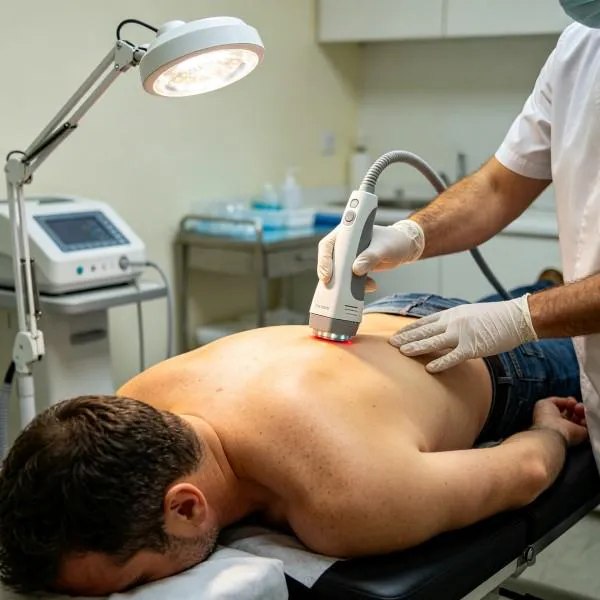
During Sessions 1 through 3, higher pulsing frequencies and a 50 to 60 percent duty cycle were utilized to induce rapid medial branch analgesia and relax protective multifidus guarding without overheating the lumbar skin. Starting in Session 4, peak output was elevated to 28W and 30W with higher duty cycles to maximize deep synovial remodeling and capsular repair as the patient began active lumbar stabilization exercises.
| セッション番号 | 臨床段階 | 波長比の設定 | ピーク出力 (W) | 周波数(Hz)およびデューティサイクル | 供給エネルギー総量(ジュール) | 解剖学的分娩法 | セッション後の機能的および臨床的転帰 |
| セッション1 | Analgesia & Multifidus Relaxation | 650nm(5%)、810nm(25%)、915nm(25%)、940nm(25%)、980nm(20%) | 20 W | 1500 Hz(デューティサイクル50%) | 7,200 J | 280 cm² bilateral grid; slow serpentine scan at 3 cm/sec | Immediate VAS drop from 8/10 to 5/10; palpable softening of L4-L5 paraspinal spasm |
| セッション2 | Analgesia & Multifidus Relaxation | 650nm(5%)、810nm(25%)、915nm(25%)、940nm(25%)、980nm(20%) | 22 W | 1200 Hz (50% Duty Cycle) | 8,580 J | 280 cm² grid; focused dwell over L4-L5 and L5-S1 facets | Patient stood upright for 15 minutes continuously without cane support; morning stiffness reduced |
| セッション3 | Capsular Edema & Perfusion Control | 650nm(5%)、810nm(30%)、915nm(25%)、940nm(25%)、980nm(15%) | 25 W | 800 Hz (60% Duty Cycle) | 11,250 J | 300 cm² including sacroiliac joints & quadratus lumborum | VAS pain dropped to 3.5/10; lumbar extension improved from 8° to 16° without locking |
| セッション4 | Synovial Biostimulation & Repair | 650nm(5%)、810nm(35%)、915nm(25%)、940nm(20%)、980nm(15%) | 28 W | 500 Hz(デューティ比70%) | 14,700 J | 300 cm²; dynamic pelvic tilt assisted scanning | Discontinued oral meloxicam and muscle relaxants; initiated pain-free bird-dog core drills |
| セッション5 | Synovial Biostimulation & Repair | 650nm(5%)、810nm(35%)、915nm(25%)、940nm(20%)、980nm(15%) | 28 W | 400 Hz (75% Duty Cycle) | 16,800 J | 300 cm²; dynamic prone press-up assisted scanning | VAS pain at 2/10 during rotation; drove 45 minutes to job site with zero gluteal radiation |
| セッション6 | Deep Capsular Remodeling | 650nm(5%)、810nm(40%)、915nm(25%)、940nm(20%)、980nm(10%) | 30 W | 250 Hz (80% Duty Cycle) | 19,200 J | 320 cm² covering L2-S2 paraspinals and posterior iliac crest | Active lumbar extension reached 24°; Oswestry Disability Index improved from 54% to 24% |
| 第7セッション | Deep Capsular Remodeling | 650nm(5%)、810nm(40%)、915nm(25%)、940nm(20%)、980nm(10%) | 30 W | 150 Hz ゲート制御(デューティ比 85%) | 20,400 J | 320 cm²; high-fluence delivery to L4-S1 posterior elements | VAS pain at 1/10 after full workday standing on construction site; zero post-activity flare |
| セッション8 | 機能統合 | 650nm(5%)、810nm(35%)、915nm(25%)、940nm(20%)、980nm(15%) | 26 W | 500 Hz(デューティ比70%) | 14,560 J | 300 cm²; full lumbar-pelvic maintenance sweep | Final VAS 0.5/10; ODI score dropped to 10% (minimal disability); full extension (28°) restored |
Dynamic Spinal Positioning During Irradiation
A decisive factor in delivering energy to deep lumbar facet joints is patient positioning during irradiation. Lying completely flat in prone position compresses the posterior facet joint surfaces together, narrowing the joint space and shielding the inner synovial folds. Starting in Session 4, the therapist placed a medium-density bolster beneath the patient’s lower abdomen to create mild lumbar flexion, gently opening the L4-L5 and L5-S1 facet joint spaces. While scanning the 30mm optical spacer handpiece at a steady 3 to 4 centimeters per second, the patient performed slow, controlled posterior pelvic tilts, allowing the collimated 810nm and 915nm beams to penetrate directly into the exposed capsular recesses.
Clinical Comparison: High-Intensity Laser vs. Traditional Spine Care
For orthopedic spine clinics, pain management centers, and physical therapy practices, chronic facet-mediated lower back pain accounts for a massive share of recurring patient visits. Traditional conservative pathways often leave both clinicians and patients frustrated. Oral NSAIDs and muscle relaxants offer only transient symptom blunting while causing sedation, gastrointestinal distress, and poor daytime productivity. Epidural or intra-articular corticosteroid injections require fluoroscopic guidance, carry procedural infection risks, and frequently lose efficacy within weeks as mechanical joint stress persists. Radiofrequency ablation destroys the medial branch nerves temporarily, but nerves regenerate within six to twelve months while the underlying synovial inflammation and multifidus atrophy remain unaddressed.
Adopting multi-wavelength クラス4レーザー治療 gives rehabilitation clinics a non-invasive, drug-free intervention that resolves deep spinal inflammation at its cellular source. By delivering 14,000 to 20,000 Joules safely through thick paraspinal muscle layers in a 10-to-12-minute session, clinicians break the pain-spasm cycle within the first two appointments. Patients discontinue systemic medications earlier, engage actively in core stabilization exercises without protective guarding, and return to full occupational duties weeks faster than with passive modalities. For clinic directors, achieving durable functional recovery in complex spine cases elevates clinical reputation, reduces reliance on invasive referrals, and maximizes treatment room profitability.