 フォトンメディックス












犬のレーザー治療で、痛みの原因となっている組織を治療対象から外してしまう場合
深度選択的なエネルギー照射、熱制御、多波長ターゲット照射。.
犬は立っているが、飼い主には何かおかしいとわかる。.
彼は右前足を慎重に地面につけ、左足で少し短い歩幅で歩みを進め、診療所のスロープの途中まで来て立ち止まった。家ではまだ遊びたがっているが、5分もすると横になる。食欲は普通だ。機嫌も普通だ。獣医師が、彼が体をきつくひねったり、床から立ち上がったりする様子を見るまでは、特に異常は見られない。.
これは、慢性肘関節変形性関節症によく見られる問題です。.
痛みのある関節は、皮膚のすぐ下にあるわけではありません。治療用ハンドピースと患部の関節の間には、毛髪、皮膚、皮下組織、筋膜、筋肉、その他の組織があり、これらが光エネルギーを散乱・吸収します。.
つまり、 犬のレーザー治療 組織への標的化の問題である。.
クラスIVの装置は、従来の低出力装置よりもはるかに多くの光エネルギーを照射できますが、そのエネルギーをどこに照射するかは、依然として臨床医が判断しなければなりません。治療が浅すぎると、犬は単に皮膚表面が温まるだけにとどまる可能性があります。一方、治療が強すぎると、対象とする組織に有効な線量が到達する前に、患者が不快感を感じる恐れがあります。.
問題は、電力が不足していることではない。.
問題は、出力、波長、治療部位、動き、および熱的曝露を、獣医師の目の前にある解剖学的構造に合わせて調整することにある。.
肘は、高強度の獣医用レーザー治療の効果を確かめるのに適した部位です
犬の肘は、非常に実用的な例と言えます。というのも、肘の変形性関節症では、比較的体表に近い関節の周囲に慢性的な変化が生じることが多い一方で、その周囲には治療効果に影響を与える構造物が存在するためです。.
犬には、骨棘、滑膜の変化、関節周囲の線維化、および慢性的な軟部組織の代償性変化が見られることがある。.
所有者は、それらの所見を個別に体験することはない。.
飼い主は、車に飛び乗る前にためらっている犬を見かける。.
獣医師は、伸展の制限、操作時の疼痛、体重負荷の異常、および代償性の筋緊張を確認する。.
レーザー治療は、これら2つの観点の間に位置づけられる必要がある。.
目的は、単に肘を温めることだけではありません。.
その目的は、患者の快適さを保ちつつ、より広範なリハビリテーション計画を支援しながら、患部に制御された光エネルギーを照射することです。.
『』誌に掲載された無作為化盲検プラセボ対照試験によると、 BMC Veterinary Research 自然発生した肘関節変形性関節症を患う犬を対象に、光生体調節療法の有効性を調査した。20頭の犬を実治療群と偽治療群に無作為に割り付け、両肘関節に対し週2回、6週間にわたり治療を行った。 実治療群では、最大出力12 Wの980 nm連続波出力が用いられた。本研究では、実治療群において跛行および疼痛の症状が改善したことが報告されており、実レーザー治療を受けた11頭のうち9頭は、研究期間中にNSAIDの投与量を少なくとも50%減らすことができた。.
それは臨床的に興味深いことですが、治療パラメータについても、治療結果と同様に十分な注意を払うべきです。.
この研究では、単に「強力なレーザーを使用せよ」と述べただけではありませんでした。“
この治療法では、特定の波長、定められた出力、定められた治療頻度、そして再現性のある臨床スケジュールを採用していた。.
皮膚と肘の間で光はどうなるのか
近赤外光が組織に入ると、吸収や散乱の影響を受けます。.
エネルギーの一部は、地表から比較的近い場所で吸収される。.
一部の光子は、元の方向とは異なる方向に散乱される。.
さらに奥へと進む者もいる。.
その結果生じるエネルギーの分布は、ハンドピースから関節へと伸びる単純な円筒形というわけではない。.
これは、臨床医が検出力を高めた場合に特に重要になります。.
出力が大きくなると、単位時間あたりに組織に到達する光エネルギーが増加します。しかし、それは肘関節に到達するエネルギーの割合が比例して増加することを意味するわけではありません。.
表層の構造物がエネルギーの大部分を吸収してしまう場合、出力を上げても、深部における有効線量が増加する速度よりもはるかに速いペースで表面温度が上昇してしまうことがあります。.
これこそが、高強度プロトコルにおいて、動きや体温のモニタリングが必要とされる理由の一つです。.
この治療用ハンドピースは、ごく狭い範囲に過剰な熱が集中するのを防ぎ、より広い範囲にエネルギーを分散させることができます。.
波長は、目的とする深度や吸収特性に応じて選択することができます。.
放射モードによって、平均エネルギーがどのくらいの速さで供給されるかが決まります。.
したがって、臨床医は単に電源ボタンを押すのではなく、エネルギーの経路を調整しているのです。.
高強度治療において980 nmが有用な理由
980 nmは、組織との相互作用が水分および血液による吸収の両方の影響を受けるため、高出力の獣医用レーザー治療において特に重要である。.
近赤外光を用いた研究によると、組織による吸収は波長によって大きく異なり、波長が長くなるにつれて水の吸収がますます重要になってくることが示されている。980 nm付近では、水の吸収が著しい一方で、同等の実験条件下では、1470 nmの場合よりも透過率が依然として高いままである。.
これにより、外部からの筋骨格系治療において、有用な中間的なアプローチが確立される。.
この波長では、制御された熱反応を引き起こしつつ、軟組織に有効なエネルギーを供給することができます。.
この犬を対象とした肘関節の臨床試験に関する論文は、最大12 Wの連続波で980 nmのクラスIVシステムを使用していたため、特に参考になる。.
したがって、本研究は、自然発生した肘関節の変形性関節症に対する高強度980 nm治療の適用について、獣医学的な臨床的指針を提供するものである。.
しかし、この研究を、12 Wが犬にとって普遍的な環境であるとするものとして解釈すべきではない。.
手足が細い小型犬に対する治療法は、単に大型犬のものからそのまま真似ることはできません。.
体重、被毛、治療部位、組織の厚さ、および耐熱性は、いずれも重要な要素となります。.
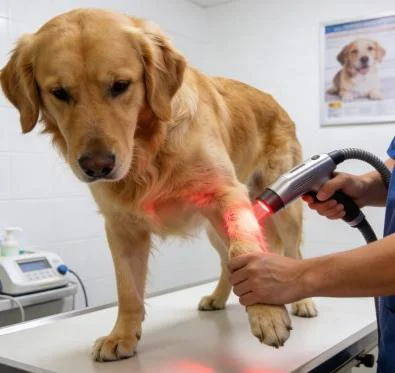
なぜ1470 nmは異なる挙動を示すのか
医療用レーザーの仕様書で、980 nmと並んで1470 nmという波長が記載されている場合、この波長について誤解されることがよくあります。.
その最大の特徴は、水による強い吸収である。.
そのため、臨床医が意図的に局所的な光熱的相互作用を誘導したい場合には、1470 nmが非常に有用となります。.
しかし、吸収が強いということは、減衰も速いことを意味します。.
980 nmと1470 nmの組織との相互作用に関する実験的比較により、1470 nmの方が浸透深度が著しく浅いことが実証されています。ヒトの静脈組織を調べたある研究では、その実験条件下において、1470 nmでの浸透深度は約0.22 mmであったのに対し、980 nmでは約1.26 mmであったと報告されています。 これらの数値をイヌの筋肉や関節組織に直接適用することはできないが、その根底にある光学的な原理は依然として重要である。.
犬の外部リハビリテーションにおいては、この区別が重要となります。.
肘関節の治療を行う獣医師は、水の吸収が最も強い波長が、必ずしも深部治療に最適な波長であるとは決めつけないようにすべきである。.
この治療の目的は、外科的な組織切除とは異なります。.
FotonMedix社の「SurgMedix-Max」は、切断、凝固、蒸発および関連する外科的処置を目的とした手術用プラットフォームにおいて、1470 nmおよび980 nmの波長を使用しています。これは、獣医学分野におけるクラスIVの外部用リハビリテーションとは異なる臨床用途です。.
同社はまた、650 nm、810 nm、915 nm、940 nm、980 nmの波長を採用し、高出力治療モードと温度制御機能を備えた、獣医専用のプラットフォームも提供しています。.
動物病院の場合、これら2つの用途を区別することで、よくある調達上のミスを防ぐことができます。.
出力が非常に高い外科用レーザーが、必ずしもリハビリテーション用レーザーとして最適であるとは限りません。.
連続高出力における真の問題点
連続波治療は理解しやすい。.
治療ヘッドが作動している間、レーザーは連続して照射されます。.
臨床医がハンドピースを安定して動かすと、エネルギーは治療部位全体に均一に分布します。.
しかし、骨の突出部の上でハンドピースの回転速度が低下したり、同じ箇所を繰り返し治療したりすると、熱がこもってしまうことがあります。.
そこで、パルス駆動が役立ちます。.
デューティサイクルの概念は単純明快です。.
25%のデューティサイクルで動作するレーザーは、サイクル時間全体のうち一部の時間のみ発光します。残りの時間により、組織は熱を再分配する機会を得ることができます。.
生物学的効果は、ピーク出力、パルス幅、パルス周波数、照射時間、および組織の熱的特性によって決まります。.
ピーク時の出力が高いからといって、必ずしも平均熱負荷も同様に高くなるわけではありません。.
この区別は、動物の治療において重要です。なぜなら、患者は特定の治療部位が熱くなりすぎたことを、獣医師に対して正確な専門用語で伝えることができないからです。.
犬はただその場を離れていくだけだ。.
あるいは落ち着かなくなる。.
あるいは、ハンドピースの方へ頭を向ける。.
あるいは、次回のセッションを断る。.
したがって、臨床的に有用なシステムには、獣医師が患者の耐性のみに全面的に依存することを強いられることなく、十分なエネルギーを供給できる治療モードが必要である。.
実際の治療中に変化するデューティサイクルとは
20 Wのピーク出力での治療を想像してみてください。.
連続運転中、組織には途切れることなく放射線が照射されます。.
パルス方式では、パルスサイクル全体にわたる平均出力は低くなる一方で、ピーク出力は高いまま維持される。.
この違いは、治療目標として高い瞬間的な強度が必要である一方で、過度な持続的な熱により患者の耐容性が低下してしまう場合に、特に有用となります。.
だからこそ、連続モード、パルスモード、スーパーパルスモードを切り替えられる機能こそが、単に最大ワット数を記載するよりも重要な意味を持つのです。.
FotonMedix社の「VetMedix-Max」は、650 nm、810 nm、915 nm、940 nm、980 nmの波長に対応し、ピーク出力は38 Wと記載されています。このプラットフォームには、スーパーパルスモード、パルスモード、連続波モードに加え、治療用温度表示技術が搭載されています。.
獣医リハビリテーション部門において、これにより臨床医は治療方針をより細かく管理できるようになります。.
重要なのは、パルス動作が常に安全であるとか、常に優れているということではない。.
適切なモードは、治療対象および臨床プロトコルによって異なります。.
デューティサイクルを低くすることで、平均的な熱蓄積を低減することができます。.
デューティサイクルを高く設定することで、より迅速にエネルギーを供給することができます。.
制御された加熱が必要な移動式処理パターンでは、連続運転が適している場合があります。.
獣医師には、選択する能力が必要です。.
コートの特性によって、治療体験が変わることもある
犬の被毛も、治療の一環として考慮すべき要素の一つです。.
当たり前のように聞こえるかもしれませんが、人間の理学療法の手法をそのままそのまま流用する場合、この点はしばしば見過ごされてしまいます。.
短毛の犬と長毛の犬では、交配の条件が大きく異なる場合があります。.
髪の長さや色素の量によって、皮膚に届く光エネルギーの量が左右されることがあります。.
これまでに発表された犬を対象とした研究では、被毛の長さ、被毛の色、波長、およびレーザー出力が、光の浸透深度や熱反応に及ぼす影響について具体的に検討されている。著者らは、これらの患者の特性が治療の経過に影響を与えることを明らかにし、レーザーのパラメータを設定する際にはこれらを考慮すべきであると結論づけている。.
これが、獣医師が機械のプリセットを固定の処方として扱ってはならない理由の一つです。.
毛並みが濃くて黒い30kgの犬は、毛が短くて明るい色の30kgの犬とは、見た目がまったく同じではない。.
同じ出力設定でも、表面の反応は異なる場合があります。.
だからといって、すべての犬にトリミングが必要だということではありません。.
つまり、臨床医は、治療用インターフェースが照射されるエネルギーにどのような影響を与えるかを理解する必要があるということです。.
公表された肘の治療プロトコルは、有用な臨床上の指針となる
2018年に実施された、無作為化・盲検・プラセボ対照の犬肘関節に関する研究は、獣臨床医にとって極めて有用な高強度治療に関する参考資料の一つとなっている。.
自然発生した肘関節変形性関節症を患う20頭の犬を、実効的なPBMT群と偽治療群に無作為に割り付けた。.
このアクティブシステムでは、最大12 Wの980 nm連続波治療が行われました。.
両肘に対して、6週間にわたり週2回の治療が行われた。.
研究者らは、跛行や痛みに関する所見を記録し、NSAIDの使用状況を追跡した。.
実薬群は偽薬群に比べて有意に良好な治療成績を示し、実薬治療を受けた11頭の犬のうち9頭では、NSAIDの投与量を少なくとも50%減らすことができた。.
この研究には限界もあった。.
サンプルサイズが小さかった。.
NSAIDの投与法は完全に標準化されていなかった。.
一部のアウトカム指標は、飼い主による報告に依存していた。.
研究期間は比較的短かった。.
そうした制限があるからといって、その結果が無価値になるわけではない。.
彼らは、自分たちにどれほどの信頼を置くべきかを教えてくれる。.
動物病院にとって、適切な結論は、高強度の980 nm PBMTには、犬の肘関節変形性関節症におけるさらなる使用を裏付ける臨床的根拠があるということであり、肘の痛みを抱えるすべての犬が同じように反応するということではない。.
犬の肘の患者を対象とした詳細な臨床症例モデル
以下の事例は、 公表されている犬の肘関節変形性関節症の研究に基づく、模擬の複合型獣医学リハビリテーション症例.
これは、FotonMedixの実際の患者記録として提示されているものではありません。.
その目的は、獣医師が公表されているクラスIVのエビデンスを、最新の多波長獣医学プラットフォームに適用した場合、詳細な臨床プロトコルや経過観察記録がどのようなものになるかを実証することにあります。.
公表された肘に関する研究では、最大12 Wの980 nm連続波治療が用いられました。以下のシミュレーション事例では、980/810 nmの多波長戦略を用いて、クリニックがより広範な高強度プロトコルをどのように構築できるかを実証しています。 したがって、810 nmの構成要素およびパルスパラメータはあくまで例示的なものであり、公表された試験で実際に使用されたことを示すものではありません。.
| 臨床分野 | 模擬症例記録 |
|---|---|
| 事件番号 | VET-ELB-2026-024 |
| 案件の状況 | 公表されている臨床的エビデンスに基づいたシミュレーションによる複合症例 |
| 患者 | 7歳のラブラドール・レトリバー |
| セックス | メス、避妊手術済み |
| 体重 | 29.8 kg |
| 主診断 | 両側の肘の変形性関節症 |
| 利き手 | 左ひじ |
| 病理学的悪性度 | X線所見による中等度の変形性関節症 |
| 主な苦情 | 運動後の左前肢の跛行 |
| 副次的な訴え | 階段を上ることや車に乗り込むことを嫌がる |
| ベースライン時の跛行 | 臨床歩行評価で3/5 |
| ベースライン時の疼痛スコア | 6/10 |
| ベースライン時の肘伸展 | 左に118°、右に124° |
| 一次処理波長 | 980 nm |
| 二次波長 | 810 nm |
| 波長戦略 | 80% 980 nm、20% 810 nm |
| 最大出力 | 8 W |
| 排出モード | パルス |
| 例示的な頻度 | 20 Hz |
| デューティサイクルの例 | 25% |
| おおよその平均出力 | パルス周期中の消費電力は2 W |
| 治療エリア | 肘の関節周囲領域および関連する前肢の筋肉群 |
| 治療法 | マッピングされた処理区域全体にわたる連続的な移動 |
| セッションの所要時間 | 約10分 |
| 1回のセッションで得られるエネルギー | 約1,200 J |
| 治療スケジュール | 週2回、3週間 |
| 入門コース | 全6回 |
| 運動 | 管理された歩行と段階的なリハビリテーション |
| 薬 | 獣医師が別段の判断を下さない限り、現状を維持する |
| 温度監視 | 体温表示機能付き継続的な臨床モニタリング |
| 主要評価項目 | 跛行と機能的活動 |
| 副次評価項目 | 肘の伸展と所有者による移動能力の報告 |
このシミュレーション事例では、高強度獣医療プラットフォームにおいて臨床的に妥当なパラメータを意図的に採用するとともに、公表されているエビデンスと構築されたプロトコル設計とを明確に区別している。.
1,200 Jのセッションエネルギーは、普遍的に推奨される線量として提示されているわけではありません。.
これはドキュメントの例です。.
獣医師は、患者の大きさ、解剖学的構造、被毛、組織の反応、および機器ごとの取扱説明書に基づき、実際の処置手順を調整する必要があります。.
6週間の治療記録(シミュレーション)
| タイムポイント | ペインスコア | 跛行 | 肘の伸展 | 機能観察 |
|---|---|---|---|---|
| 0日目 | 6/10 | 3/5 | 118° | 階段や車からのジャンプを避ける |
| 3日目 | 5/10 | 3/5 | 120° | 発酵が少しだけスムーズになる |
| 7日目 | 4.5/10 | 2/5 | 123° | より長く快適に散歩できる |
| 14日目 | 3.5/10 | 2/5 | 126° | 前肢への荷重の分散がより均一になる |
| 21日目 | 3/10 | 1–2/5 | 129° | ためらいの少ない階段 |
| 28日目 | 2.5/10 | 1/5 | 131° | すぐに休まず、短時間だけ遊ぶ |
| 42日目 | 2.5–3/10 | 1/5 | 130° | 機能の改善が維持されている |
これらの数値はシミュレーションによるものであり、特定の臨床患者の測定値ではありません。.
その目的は、獣医リハビリテーションサービスが記録できる縦断データの例を示すことです。.
「6回の治療を経て、その犬の状態は改善した」と書くよりも、はるかに有用です。“
適切な治療記録があれば、その動物の痛み、歩行状態、可動域、および日常の活動に実際に変化が見られるかどうかがわかります。.
セッションごとのエネルギー量を記録すべき理由
2つのクリニックが、どちらも「8 Wのレーザー治療」と宣伝していても、実際の施術内容は大きく異なる場合があります。.
クリニックAでは、8 Wを5分間連続して使用することが可能です。.
クリニックBでは、25%のデューティサイクルで、ピーク出力8 Wを10分間使用することがあります。.
供給される光エネルギーの総量は、大きく異なる場合があります。.
熱感も異なる場合があります。.
そのため、波長、出力、照射時間に加えて、総ジュール数も記録しておく必要があります。.
エネルギーだけでは、依然として治療の全容を説明しきれていません。.
広範囲の解剖学的領域に分散して照射される1,200 Jの治療は、1つの小さな点に集中して照射される1,200 Jの治療とは同等ではありません。.
したがって、エネルギー密度は依然として臨床的に重要な要素である。.
獣医師は、体内にどれだけのエネルギーが取り込まれたかだけでなく、そのエネルギーが体内のどの部位に配分されたかについても把握しておくべきである。.
ハンドピースを動かし続けるべき理由
高強度の外用療法を行う際には、患部を動かす治療法が特に重要となります。.
臨床医が高出力で治療ヘッドを1か所の狭い範囲に固定して照射した場合、同じエネルギーをより広い治療範囲に分散させた場合と比較して、その局所の温度ははるかに急速に上昇する可能性があります。.
これは特に、肘、股関節、膝など、骨の構造が比較的浅い部位において顕著です。.
この処理はグリッド形式で整理することができます。.
臨床医は、痛みのある領域を解剖学的ゾーンに分け、各ゾーンを一定の速度でスキャンすることができます。.
これにより、セッションの再現が容易になります。.
また、最も痛みを感じる部位にばかり時間をかけすぎて、その周囲の代償組織を顧みないというよくある間違いを防ぐこともできます。.
慢性肘関節症では、関節そのものが痛む場合もありますが、犬が数ヶ月にわたって体重のかかり方を変え続けてきたため、前肢の周囲の筋肉にも過度の負担がかかることがあります。.
周囲の軟部組織を考慮せずに関節を治療すると、機能上の問題の一部が改善されないままになる可能性があります。.
「痛みの治療」と「動きの治療」の違い
飼い主はこう言うかもしれません:
“「彼はそれほど痛がっていないようだ。」”
それは役に立ちますね。.
しかし、獣医師はもうひとつ質問をするべきです:
“「彼はその手足を以前よりうまく使えるようになったのか?」”
犬は、機能に目立った改善が見られないにもかかわらず、触診に対する反応が弱まることがあります。.
一方で、歩行距離や階段の昇降能力、立ち上がろうとする意欲に著しい改善が見られる一方で、犬には依然として多少の不快感が残っている場合もあります。.
だからこそ、成果の測定には、主観的な指標と機能的な指標の両方を含めるべきである。.
実用的な獣医療記録には、以下の事項を記録することができます:
痛み
「犬用簡易疼痛評価尺度(Canine Brief Pain Inventory)」、または必要に応じて他の妥当性が確認された評価尺度。.
歩行
可能であれば、臨床的な跛行スコア評価または客観的な歩行分析を行う。.
可動域
Goniometric measurement of elbow extension and flexion.
アクティビティ
Walking duration, daily activity or wearable accelerometer data when available.
Owner-specific function
Ability to climb stairs, enter a car, rise from a bed or play.
薬
Any change in NSAID or other analgesic use should be veterinarian-directed and documented.
This turns a laser treatment course into something measurable.
Published Research Supports the Need for Functional Outcomes
A separate prospective study of dogs with naturally occurring osteoarthritis used an accelerometer to assess mobility. The researchers treated affected joints and associated muscles weekly for six weeks using 808 nm laser therapy, with treatment parameters adjusted according to body weight and coat pigmentation. Twenty-three dogs completed the study, and the authors reported increased daily activity and step counts after treatment.
The study was not a Class IV protocol, so its parameters should not be copied into a high-intensity treatment.
Its importance here is methodological.
It shows why activity can be a useful outcome.
The owner may not notice a 10% change in movement.
An objective activity measurement may.
For a veterinary hospital investing in a high-intensity laser system, this kind of measurement can help determine whether the equipment is actually improving rehabilitation outcomes rather than simply creating a pleasant warming sensation.
What About Laser Versus NSAIDs?
This is where veterinary marketing often becomes too aggressive.
Laser should not be positioned as a simple replacement for NSAIDs.
NSAIDs can provide systemic analgesic and anti-inflammatory effects.
Laser therapy is a physical modality.
They work through different mechanisms and can potentially occupy different places in a multimodal treatment plan.
The evidence supporting concurrent laser treatment and NSAIDs in canine osteoarthritis is promising but still limited. A recent evidence summary identified only one relevant randomized controlled trial and rated the overall strength of evidence as weak, despite reported improvements in pain and lameness and reductions in NSAID dosing in the laser group.
That means a veterinarian should not promise an owner that laser treatment will allow medication to be stopped.
Medication changes belong to the veterinarian.
The more defensible clinical statement is that laser therapy may provide an additional non-invasive modality that can be integrated into a broader pain-management strategy.
Why 810 nm Still Has a Place in a Multi-Wavelength System
If 980 nm is useful for high-intensity tissue interaction, why have another near-infrared wavelength?
Because biological tissue is not optically uniform.
Different wavelengths experience different combinations of absorption and scattering.
A multi-wavelength platform gives the clinician the option to shift the optical profile instead of simply increasing power.
The 810 nm region has extensive photobiomodulation literature and is commonly used in musculoskeletal applications.
It can be useful as part of a broader wavelength strategy when the clinician wants a different balance of penetration and absorption.
This is one of the practical reasons VetMedix-Max offers 810 nm alongside 915, 940 and 980 nm rather than restricting treatment to a single near-infrared wavelength.
The point is not that combining wavelengths automatically produces a superior result.
The point is that the clinician has more options for matching the treatment to the tissue.
Why 650 nm Is Not Simply a Smaller Version of 980 nm
A common misunderstanding is that a shorter wavelength is simply a weaker version of a longer wavelength.
そうではありません。.
The optical behavior changes with wavelength.
650 nm is generally more superficial than near-infrared wavelengths used for deeper musculoskeletal treatment.
That can make it useful for surface-oriented applications, but it should not be presented as equivalent to 980 nm for a deep elbow or hip target.
A multi-wavelength veterinary system therefore becomes more useful when the veterinarian understands that each wavelength has a different role.
The treatment should follow the tissue.
The tissue should not be forced to follow the machine.
Where 1470 nm Fits in a Veterinary Laser Business
For a veterinary equipment distributor, the presence of 1470 nm in a product catalog can create confusion.
The wavelength has strong clinical relevance, but its strongest water absorption makes it particularly useful for controlled surgical tissue interaction.
FotonMedix’s SurgMedix-Max combines 1470 nm with 980 nm and is positioned for surgical procedures.
The VetMedix-Max, by contrast, focuses on veterinary therapy and includes multiple wavelengths extending from 650 nm through 980 nm.
This distinction can help hospitals choose the correct platform.
A surgical department may need strong localized water absorption.
A rehabilitation department may need controlled external energy delivery over joints and muscles.
The two systems can use overlapping wavelength technology while serving completely different clinical objectives.
That is why “higher power” should never be the only purchasing criterion.
What Makes a Deep Tissue Laser Therapy Machine Practical for a Veterinary Hospital
A 深部組織 レーザー治療器販売 needs to make sense from the perspective of the clinician using it every day.
The first consideration is wavelength selection.
Can the veterinarian choose the wavelength appropriate to the treatment objective?
The second is power control.
Can output be reduced for smaller dogs and superficial structures?
The third is emission control.
Can the system operate continuously, in pulses or in super-pulse mode?
The fourth is thermal feedback.
Can the veterinarian recognize when the treatment is approaching an uncomfortable thermal range?
The fifth is reproducibility.
Can the same treatment be repeated across multiple visits?
The sixth is workflow.
Can the machine be used efficiently while the dog is standing, lying down or positioned for rehabilitation?
The seventh is documentation.
Can the clinic record energy, wavelength, output and treatment time?
These details matter because a veterinary laser becomes financially useful only when it becomes clinically usable.
A Practical Purchasing Comparison
| Purchasing Question | Why It Matters |
|---|---|
| 複数の波長 | Allows treatment to be adapted to different tissue targets |
| 980 nm availability | Useful for high-intensity near-infrared treatment |
| 810 nm availability | Provides an additional near-infrared treatment option |
| Adjustable output | Helps adapt treatment to patient size and sensitivity |
| パルスモード | Helps control average energy and thermal accumulation |
| Super-pulse mode | Allows high peak output with a different thermal profile |
| Continuous mode | Useful when sustained energy delivery is appropriate |
| Temperature indication | Provides additional thermal feedback |
| Large treatment area capability | Improves workflow for hip, shoulder and spinal regions |
| 再現可能なプロトコル | Makes treatment records more consistent |
| Veterinary-specific design | Better suited to animal positioning and coat characteristics |
This is the framework that should be used when evaluating a veterinary laser rather than asking only for the maximum watts.
Why More Power Can Actually Reduce Treatment Efficiency
It sounds counterintuitive.
If a 38 W machine can deliver more energy than a 12 W system, why would more power ever make treatment worse?
Because the treatment target does not absorb energy in a linear, unlimited way.
At some point, the limiting factor becomes heat management.
The clinician may need to move faster.
The treatment area may need to increase.
The duty cycle may need to decrease.
The wavelength may need to change.
The patient may become uncomfortable.
The higher-output machine has not become less powerful.
The clinical protocol has become harder to control.
That is why a good Class IV platform should provide more than high peak output.
It should give the clinician control.
VetMedix-Max’s combination of multiple wavelengths, high peak output, pulsed and continuous treatment modes and temperature indication is designed around this type of control.
The Most Useful Definition of Vet Laser Therapy
For a veterinary rehabilitation team, 獣医レーザー治療 should not mean “using a laser whenever a dog is painful.”
It should mean using controlled optical energy as one part of a diagnosis-driven treatment program.
The veterinarian identifies the condition.
The therapist identifies the treatment region.
The wavelength is selected.
The output is adjusted.
The treatment head is moved over a defined area.
Thermal response is monitored.
Energy is documented.
Function is reassessed.
That is a clinical process.
The laser itself is simply the tool that delivers the energy.
What the Evidence Does and Does Not Prove
The evidence for 犬用レーザー治療 is encouraging in several musculoskeletal applications, but it is not uniform.
The randomized elbow osteoarthritis trial found significant improvements in pain and lameness outcomes and a substantial reduction in NSAID requirements among many dogs receiving active treatment.
The randomized Class IV study in canine osteoarthritis involving 20 dogs found better outcomes for the PBMT group at several follow-up points, including pain, function, gait and quality-of-life-related measures. The dogs had moderate or severe osteoarthritis, and follow-up extended to 90 days.
A more recent randomized controlled study of laser acupuncture in 19 dogs with osteoarthritis also reported improvements in pain and joint mobility, while the authors emphasized the preliminary nature of the findings and the need for larger trials.
At the same time, evidence summaries continue to describe the overall evidence base as limited for some specific questions, especially whether concurrent laser treatment is superior to NSAIDs alone.
That is a healthy position for a clinical technology.
It means the treatment has enough evidence to justify serious clinical use and continued investigation, but not enough evidence to support universal claims.
The Practical Difference Between Traditional Care and High-Intensity Laser
Traditional veterinary pain management often relies heavily on medication.
That remains appropriate for many dogs.
But medication does not directly provide a physical rehabilitation stimulus to the painful region.
A dog taking an NSAID may feel better, but the veterinarian still has to rebuild movement, strength and confidence.
This is where high-intensity laser can fit.
The treatment is local.
It can be repeated.
The energy can be adjusted.
The wavelength can be selected.
The treatment can be combined with exercise.
The dog can be reassessed after each course.
The real benefit is therefore not “laser instead of medicine.”
それは more control within a multimodal rehabilitation plan.
For the Labrador that no longer wants to climb stairs, that distinction is meaningful.
The veterinarian can use medication when appropriate, manage body weight, introduce controlled exercise, strengthen supporting musculature and use high-intensity laser as an additional physical modality.
The owner is not simply told to wait for the next pain flare.
The clinic can actively work on function.
The Final Clinical Takeaway
A successful canine laser session is not defined by how hot the treatment head becomes or how large the wattage number looks on the display.
It is defined by whether the clinician can deliver a controlled dose to an appropriate tissue target while keeping the patient comfortable.
That requires an understanding of optical attenuation.
It requires recognizing that 980 nm and 1470 nm do not behave the same way in water-rich tissue.
It requires understanding that stronger absorption at 1470 nm produces faster energy deposition and shallower penetration than 980 nm under comparable experimental conditions.
It requires understanding that 980 nm has meaningful interaction with water and blood-related chromophores and can produce useful thermal effects when carefully controlled.
It requires recognizing that duty cycle changes average energy delivery and thermal accumulation.
It requires accepting that coat characteristics, body size and tissue thickness can change the patient’s treatment response.
And it requires measuring the dog rather than simply measuring the laser.
For veterinary clinics searching for 犬のレーザー治療, the most useful platform is therefore not automatically the one with the largest maximum output.
The more useful system is the one that gives the veterinary team enough control to adapt treatment to the animal.
That is where a multi-wavelength Class IV platform becomes valuable.
FotonMedix’s VetMedix-Max provides 650, 810, 915, 940 and 980 nm wavelengths, up to 38 W peak output, super-pulse, pulse and continuous modes and therapeutic temperature indication.
For a hospital building a veterinary rehabilitation service, those features address the actual problems encountered during treatment.
A small dog may need a different protocol from a large dog.
A dark coat may behave differently from a light coat.
A superficial painful region may require a different approach from a deeper muscular target.
A chronic arthritic joint may need repeated sessions combined with exercise rather than one aggressive treatment.
A high-power laser does not solve those differences by itself.
Control does.
That is the real value of modern 獣医レーザー治療.
And when a clinic is evaluating a 深部組織レーザー治療器販売, the most important purchasing question is not “How many watts can it produce?”
それは:
Can our clinicians control the energy well enough to treat different animals, different tissues and different clinical situations safely and consistently?
If the answer is yes, the laser becomes more than another piece of rehabilitation equipment.
It becomes a controllable part of the clinical workflow.
For the dog that hesitates before taking the stairs, that is the difference that matters.