 FotonMedix











Multi-Platform Integration of 1470nm and 980nm Diode Systems: Advancing Endovascular Precision and Regenerative Orthopedics
High-performance 1470nm/980nm systems enable bloodless saphenous vein closure with minimal thermal spread, while simultaneous high-irradiance delivery optimizes chondrocyte metabolism to reverse degenerative joint symptoms and accelerate the recovery phase in complex musculoskeletal pathologies.
Modern clinical facilities are moving away from single-use hardware toward multi-disciplinary photonic platforms. For hospital procurement managers and specialized vascular surgeons, the implementation of endovenous laser therapy evlt is no longer a standalone service but part of a broader infrastructure that includes deep tissue laser therapy for post-operative rehabilitation and chronic pain management. The challenge for B2B stakeholders lies in selecting a system that balances the high energy required for endovascular collagen denaturation with the delicate bio-stimulatory parameters needed for laser therapy for arthritis.
Hemodynamic Closure and the 1470nm Radial Emission Paradigm
The efficacy of endovenous laser therapy evlt is fundamentally dependent on the targeting of intracellular water within the vein wall rather than hemoglobin. While older 980nm systems relied on excessive thermal energy to heat blood (often leading to ecchymosis and post-operative pain), the 1470nm wavelength interacts directly with the aqueous components of the tunica media. This specific absorption profile allows for a significant reduction in the Linear Endovenous Energy Density (LEED) required for total vein occlusion.
The thermal distribution during endovascular procedures can be modeled to ensure the preservation of the perivenous tissue. The temperature change ($\Delta T$) at a radial distance ($r$) from the fiber tip is governed by the heat conduction equation in cylindrical coordinates:
$$\rho c \frac{\partial T}{\partial t} = k \left( \frac{\partial^2 T}{\partial r^2} + \frac{1}{r} \frac{\partial T}{\partial r} \right) + Q_L$$
Where $Q_L$ represents the laser energy source term. By utilizing radial-emitting fibers in conjunction with a 1470nm source, clinicians achieve a circumferential energy distribution that minimizes the peak temperature at the intima, preventing vein wall perforation—a common complication in traditional high-heat procedures.
Regenerative Mechanisms in Laser Knee Therapy
Transitioning from the surgical theater to the rehabilitation ward, laser knee therapy addresses the chronic inflammatory environment of the synovial joint. Unlike systemic NSAIDs which merely suppress prostaglandin synthesis, high-power photobiomodulation (PBM) targets the mitochondrial respiratory chain. In cases of Grade II or III osteoarthritis, the goal is to shift the macrophage phenotype from M1 (pro-inflammatory) to M2 (pro-resolving).
The application of laser therapy for arthritis relies on the biphasic dose-response curve. To reach the intra-articular cartilage, the system must maintain sufficient irradiance to overcome the high scattering coefficient of the patellar ligament and synovial fluid. High-output Class IV diodes ensure that the photon density at the chondrocyte level is high enough to stimulate the production of Type II collagen and proteoglycans, effectively modulating the progression of joint space narrowing.
Comparative Clinical Performance: Fotonmedix Integration vs. Legacy Modalities
The economic justification for B2B procurement is built on the versatility of the SurgMedix and LaserMedix platforms. By consolidating vascular surgery and orthopedic rehabilitation into a single investment, clinics maximize patient turnover and device utilization.
| Performance Indicator | Conventional High-Heat 980nm / RFA | Fotonmedix 1470nm + Deep Tissue Protocol |
| Vascular Occlusion Accuracy | Moderate (prone to thermal tracking) | Superior (targeted water absorption) |
| Post-Op Ecchymosis (Bruising) | Significant (due to hemoglobin heating) | Minimal to None |
| Knee Therapy Depth | Superficial (Class 3b limits) | Deep (Class 4 penetration >8cm) |
| Patient Recovery Time | 7 – 14 Days | 2 – 4 Days |
| Treatment Efficiency | Variable; high operator fatigue | Optimized via high-irradiance presets |
The ability to switch from endovascular surgical modes to deep tissue laser therapy presets allows for immediate post-surgical intervention on the same patient, reducing the risk of Deep Vein Thrombosis (DVT) and accelerating the resolution of localized edema.
Clinical Case Study: Dual-Phase Management of Venous Insufficiency and Concomitant Gonarthrosis
Patient Background:
A 62-year-old female patient presenting with C3-class chronic venous insufficiency (CVI) of the Great Saphenous Vein (GSV) and Grade III Osteoarthritis of the ipsilateral knee. The patient’s mobility was severely restricted, and she was categorized as high-risk for traditional open vein stripping due to a history of delayed wound healing.
Diagnostic Foundation:
Duplex ultrasound confirmed a reflux time of >2.5s in the GSV. Radiographic imaging of the knee showed subchondral sclerosis and significant medial compartment narrowing. The clinical intent was to perform endovenous laser therapy evlt followed by a structured course of laser knee therapy.
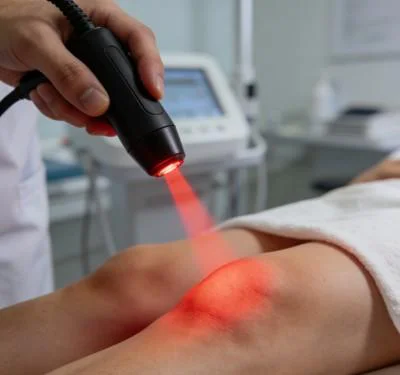
Clinical Parameters (Fotonmedix SurgMedix & LaserMedix Hybrid):
- Vascular Phase: 1470nm wavelength, 8W power, Radial Fiber delivery. LEED maintained at 60 J/cm.
- Orthopedic Phase (Post-Op Day 3): Deep tissue laser therapy using 810nm/980nm dual-emission.
- Knee Dosage: 12 J/cm² over 6 anatomical points (medial/lateral joint lines, suprapatellar pouch).
- Pulse Frequency: 10Hz (Super-pulsed) to manage chronic nociception.
Recovery and Results:
- 24 Hours Post-EVLT: Ultrasound confirmed 100% vein occlusion with no evidence of endovenous heat-induced thrombosis (EHIT).
- Week 4: The patient reported a 70% reduction in the Western Ontario and McMaster Universities Osteoarthritis Index (WOMAC) score.
- Month 6: Venous symptoms remained resolved. Knee mobility increased by 25 degrees of flexion.
Conclusion:
This multi-modal approach utilized the surgical precision of 1470nm for vascular closure and the regenerative power of Class 4 PBM for joint rehabilitation, providing a holistic solution for a complex geriatric patient.
B2B Risk Mitigation: Reliability, Safety, and Global Compliance
In the international medical trade sector, the “Reliability Index” is the primary driver of repeat orders. Fotonmedix addresses the common failure points of diode lasers through rigorous engineering and safety redundancies.
Advanced Optical Fiber Protection:
For endovenous laser therapy evlt, fiber failure during a procedure is a catastrophic event. Our systems utilize an Internal Fiber Recognition (IFR) protocol that monitors the optical back-reflection. If the fiber is damaged or improperly connected, the system automatically inhibits laser emission, protecting the patient’s vasculature and the device’s internal diode stack.
Thermal Stability and Duty Cycle Management:
When delivering deep tissue laser therapy, the diode stacks are subject to significant thermal loads. Our platforms utilize medical-grade thermoelectric cooling (TEC) modules that maintain a constant junction temperature. This prevents the “power sag” often seen in uncooled portable units, ensuring that the 10th patient of the day receives the exact same photonic dose as the first.
Regulatory and Safety Standards:
Compliance with IEC 60601-2-22 is standard for all Fotonmedix surgical and therapeutic units. For the B2B buyer, this ensures that the device meets the highest global requirements for electromagnetic compatibility and laser safety, including specific interlocks for surgical environments and OD6+ protective eyewear for the entire clinical team.
The Future of Integrated Photonic Medicine: AI-Driven Dosimetry
As we look toward 2026 and beyond, the integration of real-time tissue impedance sensors will allow laser knee therapy to automatically adjust power output based on the thickness of the patient’s joint capsule. This “Closed-Loop” dosimetry will further elevate the E-E-A-T profile of clinics using Fotonmedix technology, positioning them as leaders in precision medicine.
By investing in a dual-purpose 1470nm/980nm platform, hospitals can effectively capture the growing market for minimally invasive vascular surgery while simultaneously dominating the laser therapy for arthritis sector—all with a single, high-reliability equipment footprint.
FAQ: Professional and Technical Inquiries
Q: Why is 1470nm preferred over 940nm or 980nm for EVLT?
A: The absorption coefficient of water at 1470nm is significantly higher. This results in less energy being absorbed by hemoglobin and more energy focused on the collagen-rich vein wall, leading to fewer side effects like bruising and pain.
Q: Can deep tissue laser therapy be used immediately after a knee replacement?
A: Yes. In fact, applying laser therapy post-arthroplasty can significantly reduce surgical edema and accelerate the integration of the prosthetic by stimulating local microcirculation, provided the laser is used in non-contact, therapeutic modes.
Q: What is the expected lifespan of the diode stack in a high-volume B2B environment?
A: Fotonmedix utilizes premium GaAs diode modules rated for 20,000+ hours. In a typical hospital setting, this translates to roughly 7–10 years of heavy clinical operation before any significant power degradation is observed.