 FotonMedix











Neuro-Regenerative Protocols: Advancing Peripheral Neuropathy Treatment via High-Intensity Photobiomodulation
In the specialized field of clinical neurology and pain management, the therapeutic objective has shifted from simple analgesic masking to the active restoration of neural function. For decades, practitioners relied on the low laser therapy device to manage minor localized pain. However, these low-power systems often fell short when addressing the systemic and deep-seated complexities of Peripheral Neuropathy (PN). The advent of high-intensity systems, specifically those utilized in light force laser therapy, has introduced a new capability: the ability to influence axonal transport and Schwann cell activity at significant tissue depths.
Peripheral neuropathy, particularly in its diabetic or idiopathic forms, involves the progressive degradation of myelin sheaths and the slowing of nerve conduction velocities. Treating these conditions requires more than a superficial application of light; it necessitates a precise delivery of energy to the vasa nervorum (the small blood vessels that supply nerves) and the nerve trunks themselves. By leveraging the principles of lightforce laser therapy, clinicians can now deliver therapeutic doses to the sciatic nerve or the brachial plexus—areas previously unreachable by lower-classed devices—triggering a cascade of neuro-regenerative events that were once thought impossible outside of surgical intervention.
The Biological Blueprint of Nerve Repair and Wavelength Synergy
The efficacy of light force laser therapy in treating damaged nerves is rooted in its ability to modulate the cellular environment of the peripheral nervous system. When we examine the pathophysiology of neuropathy, we see a state of chronic ischemia and oxidative stress within the nerve bundle. High-intensity laser therapy (HILT) intervenes by addressing three critical pathways: metabolic enhancement, vascular optimization, and the suppression of pro-inflammatory cytokines.
In clinical practice, the choice of wavelength is the most significant variable. While a standard low laser therapy device might utilize a single 660nm or 808nm diode, advanced high-power systems employ wavelength summation to achieve a multi-layered biological effect.
- 810nm (The Metabolic Trigger): This wavelength is essential for nerve repair because it maximizes the activation of cytochrome c oxidase in the mitochondria of Schwann cells. Schwann cells are responsible for producing the myelin sheath; by increasing their ATP production, we accelerate the remyelination process.
- 915nm (The Oxygenation Driver): Peripheral nerves are highly sensitive to oxygen levels. This wavelength has a specific peak in hemoglobin absorption, facilitating the release of oxygen into the hypoxic nerve tissues, which is vital for reversing the “starvation” of the nerve fibers.
- 980nm (The Micro-Circulatory Catalyst): This wavelength targets the water in the interstitial fluid, creating a controlled thermal effect that induces vasodilation. This increases the drainage of metabolic waste products and reduces the endoneurial pressure that often causes the “burning” sensation associated with neuropathy.
By combining these wavelengths in a lightforce laser therapy protocol, we are not just treating pain; we are rehabilitating the entire micro-environment surrounding the nerve.
Overcoming the Depth Barrier: Why Power Matters for Neurological Outcomes
One of the most persistent myths in laser medicine is that “less is more.” While this may apply to superficial wound care, it is a clinical fallacy in the treatment of deep-seated nerve pathologies. The human body is a highly effective filter of light. By the time photons from a 0.5W low laser therapy device reach a depth of 3 to 5 centimeters—where the major nerve trunks reside—the power density has often dropped below the threshold required for photobiomodulation (PBM).
To achieve a clinical result in conditions like radiculopathy or tarsal tunnel syndrome, the clinician must account for the “Power Density at Depth.” High-intensity light force laser therapy solves this by providing sufficient “starting power” at the skin surface. If we require 5 J/cm² at the nerve level 4cm deep, and we know that only 3% of light reaches that depth in certain tissue types, we must deliver a much higher intensity at the surface to ensure the target receives the “minimum effective dose.” This is why Class IV lasers are now the gold standard for neurological rehabilitation; they provide the energy necessary to drive biological change through thick muscle and fascial layers.
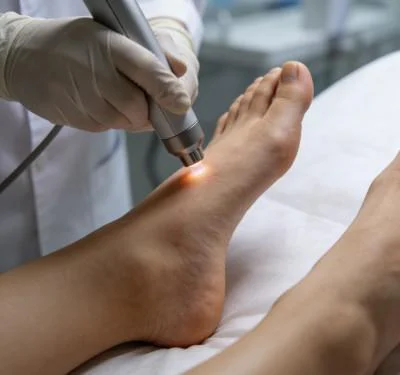
Clinical Case Study: Chronic Diabetic Peripheral Neuropathy (DPN)
This case highlights the transition from palliative care to regenerative lightforce laser therapy in a patient with long-standing metabolic complications.
Patient Background:
A 67-year-old female with a 12-year history of Type 2 Diabetes Mellitus. She presented with “stocking-distribution” numbness and burning pain in both feet (predominantly the left). Her symptoms had progressed to the point where she could no longer feel the ground clearly, leading to multiple “near-fall” incidents. Previous treatments included Gabapentin (900mg daily) and Duloxetine, which managed the pain but did not improve the numbness or proprioception.
Preliminary Diagnosis:
Severe Diabetic Peripheral Neuropathy (DPN). Electromyography (EMG) and Nerve Conduction Velocity (NCV) tests showed significant slowing of the sural and peroneal nerves. The patient’s Toronto Clinical Neuropathy Score (TCNS) was 14 (indicative of severe neuropathy). Her baseline pain on the VAS scale was 7/10.
Treatment Strategy:
The clinical objective was to utilize high-intensity light force laser therapy to stimulate axonal regeneration and improve microcirculation in the lower extremities. A scanning technique was used to treat the entire path of the sciatic, tibial, and peroneal nerves, from the popliteal fossa down to the plantar surface of the foot.
Clinical Parameters & Protocol:
| Parameter | Clinical Setting | Clinical Rationale |
| Primary Wavelengths | 810nm + 980nm + 1064nm | Triple-action for ATP, Blood Flow, and Depth |
| Power Intensity | 20 Watts (CW/Pulsed Blend) | Overcoming skin resistance and adipose tissue |
| Dose per Foot | 4500 Joules | Comprehensive dose for bilateral coverage |
| Frequency Settings | 20Hz (Deep) to 5000Hz (Superficial) | Frequency hopping to prevent tissue adaptation |
| Treatment Frequency | 2 sessions per week | Allowing 48-72 hours for cellular protein synthesis |
| Total Course | 15 Sessions | Standard timeframe for neural structural change |
| Application Method | Non-contact sweeping | Large area coverage to follow the nerve path |
The Treatment Process:
During the first 5 sessions, the patient reported a “tingling” sensation, which often indicates the reactivation of dormant nerve fibers. By session 8, the “burning” pain had significantly decreased. Between sessions 10 and 15, the focus shifted toward high-energy 1064nm delivery to the lumbar spine (L4-S1) to address the nerve roots, ensuring the entire “neural chain” was stimulated.
Post-Treatment Recovery & Results:
- Pain Reduction: VAS score decreased from 7/10 to 2/10. The patient requested a reduction in Gabapentin dosage under her physician’s supervision.
- Sensory Improvement: Monofilament testing showed a 50% improvement in light touch sensation.
- Functional Outcome: The patient reported feeling “steady” on her feet and resumed daily 20-minute walks.
- Follow-up (6 Months): Improvements were maintained. TCNS score dropped to 6 (mild neuropathy category).
Final Conclusion:
This clinical outcome suggests that the high-power delivery of lightforce laser therapy effectively bypassed the limitations of a standard low laser therapy device, providing enough energy to stimulate the vasa nervorum and restore nerve conductivity. The treatment not only addressed the symptoms but appeared to modify the underlying neural degradation.
Axonal Transport and the Glymphatic Influence of High-Intensity PBM
While ATP production is the most cited benefit of laser therapy, its impact on axonal transport is perhaps more critical for neuropathy patients. Neurons are the longest cells in the body; they rely on a “railway system” of microtubules to transport proteins and nutrients from the cell body in the spine to the fingertips and toes. In neuropathy, this transport system breaks down.
Recent research into light force laser therapy suggests that PBM stabilizes these microtubules and increases the speed of kinesin and dynein (the motor proteins). Furthermore, high-intensity laser application has been shown to improve the “glymphatic” clearance of the peripheral nerves—helping to wash away the toxic metabolic byproducts (like advanced glycation end-products in diabetics) that accumulate in the endoneurial space. This “cleaning and feeding” of the nerve is the fundamental difference between a temporary analgesic effect and a long-term regenerative outcome.
Class IV Laser Safety and the “Thermal Relaxation” Myth
A common concern with high-intensity lightforce laser therapy is the potential for thermal damage. However, when administered by a trained clinician using a moving-handpiece technique, the risk is virtually non-existent. The key is understanding “Thermal Relaxation Time” (TRT). This is the time it takes for tissue to dissipate 50% of the heat it has absorbed.
By using a pulsed wave (PW) instead of a continuous wave (CW), or by simply moving the laser head at a consistent speed, the clinician ensures that the target tissue never reaches a temperature that would cause protein denaturation. In fact, the mild thermal elevation produced by a Class IV light force laser therapy system is therapeutically beneficial—it reduces the viscosity of the interstitial fluid, making it easier for photons to penetrate even deeper into the tissue.
Integrating High-Power Laser Therapy into Chronic Pain Management
The modern pain clinic must evolve beyond the “shot and a pill” model. High-intensity lightforce laser therapy offers a bridge between conservative care and invasive surgery. For patients with chronic back pain, sciatica, or complex regional pain syndrome (CRPS), the laser acts as a powerful non-invasive neuromodulator.
When we compare the long-term cost-benefit of a low laser therapy device versus a high-intensity system, the high-power system wins on clinical throughput. Treating a lumbar spine with a 500mW laser could take an hour of stationary application, which is impractical and often ineffective due to lack of depth. A 25W Class IV system can deliver a therapeutic dose to the same area in 8 to 10 minutes, allowing for better patient compliance and more consistent results across a diverse patient population.
FAQ: Clinical Questions on LightForce and Nerve Regeneration
1. Can light force laser therapy actually “regrow” nerves?
Laser therapy stimulates the “sprouting” of axons and the repair of the myelin sheath. While it doesn’t create a new nerve from scratch, it significantly accelerates the natural repair mechanisms of damaged peripheral nerves.
2. Is it safe to use lightforce laser therapy if I have a metal rod in my leg?
Yes. Unlike ultrasound therapy, which can cause “periosteal burning” by heating metal implants, laser light is not reflected or absorbed by metal in a way that causes dangerous heat buildup. It is safe for patients with joint replacements or spinal hardware.
3. Why didn’t my low laser therapy device work for my sciatica?
The most likely reason is “under-dosing.” The sciatic nerve is deep beneath the gluteal muscles. A low-power laser simply cannot maintain enough intensity at that depth to trigger a biological response. You likely needed the higher power density of a Class IV system.
4. How soon will I feel a change in my neuropathy symptoms?
Neurological repair is slower than muscle repair. While some patients feel an immediate reduction in “burning” pain due to the analgesic effect, structural improvements in numbness and balance usually take 6 to 10 sessions to become noticeable.
5. Does high-intensity laser therapy hurt?
Not at all. Most patients describe it as a deeply relaxing, warm sensation. If the area is very sensitive, the clinician can adjust the pulsing frequency to ensure total comfort while still delivering the necessary energy.