 FotonMedix











Neurological Salvage: The Role of Class IV Laser in Canine IVDD Management
Intervertebral Disc Disease (IVDD) represents one of the most clinically challenging presentations in veterinary neurology. For the clinician, the dilemma is often binary: immediate surgical decompression (hemilaminectomy) or conservative medical management. However, a significant cohort of patients exists in the “grey zone”—those who are poor surgical candidates due to age or comorbidities, or owners who cannot financially access neurosurgery.
In this context, laser therapy for IVDD in dogs has graduated from an “alternative” therapy to a core component of multimodal neurological rehabilitation. But before we discuss efficacy, we must address the fundamental physiological question: Is photobiomodulation capable of influencing neural tissue deep within the spinal canal? And if so, why does it facilitate recovery where corticosteroids alone may fail?
The Pathophysiology of IVDD and the Photonic Intervention
To treat IVDD effectively with laser, one must understand that the pathology is not merely “back pain.” It is a mechanical compression leading to secondary biochemical trauma. When a Hansen Type I disc extrusion occurs, the nucleus pulposus impinges on the spinal cord. The primary damage is mechanical, but the secondary damage—ischemia, edema, and excitotoxicity—is what often determines the permanent neurological deficit.
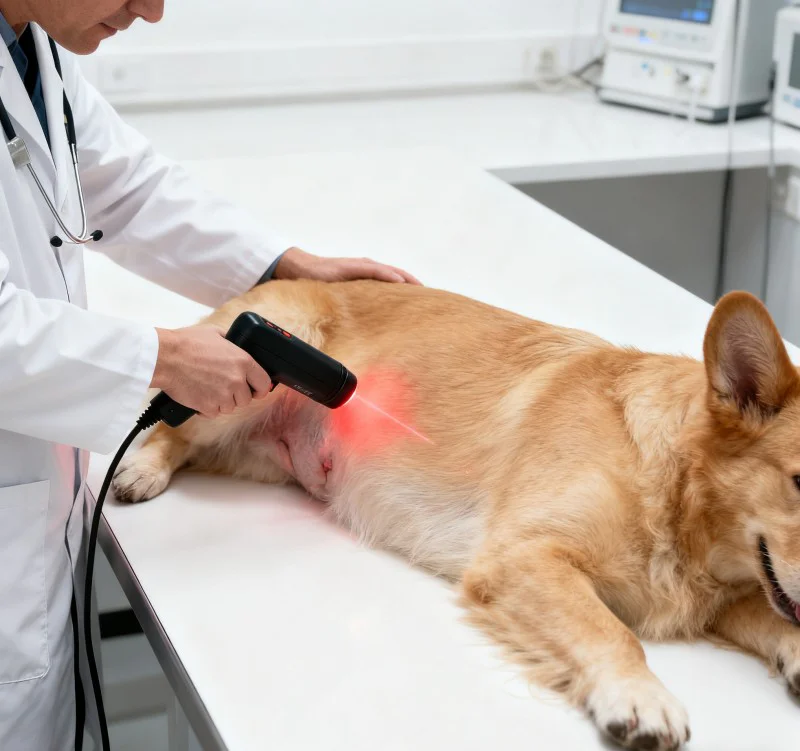
Why Lasers Work on the Spine: The “Neurological Rescue”
The spinal cord is encased in bone (vertebrae), which presents a significant barrier to photon penetration. This is why low-power class 3b lasers are largely ineffective for IVDD; they simply cannot deliver sufficient fluence to the cord itself. High-power Class 4 laser therapy is required to penetrate the dorsal spinal musculature and the lamina to reach the dura mater.
The therapeutic mechanism in IVDD differs from arthritis. In arthritis, we target inflammation. In IVDD, we target nerve regeneration and edema reduction.
- Reduction of Spinal Cord Edema: The most immediate threat to the spinal cord is swelling within a fixed bony canal. 980nm laser energy improves lymphatic drainage and modulates membrane permeability, reducing the intraneural pressure that kills neurons.
- Axonal Regeneration: 810nm wavelengths stimulate Schwann cells. Research indicates that PBM can increase the production of Nerve Growth Factor (NGF) and Brain-Derived Neurotrophic Factor (BDNF), which are essential for axonal sprouting and remyelination after injury.
- Prevention of Glial Scarring: By modulating the activity of astrocytes, laser therapy can reduce the formation of dense glial scars that physically block nerve reconnection.
Clinical Protocols: Treating the Spinal Column
Treating the spine requires a different technique than treating a hip or knee. The spinal cord is extremely sensitive to thermal buildup. Overheating the spinal cord can exacerbate neurological deficits. Therefore, technique is paramount.
Dosage Calculation for Deep Spinal Targets
The target dosage for neurological tissue is generally lower than for musculoskeletal conditions to avoid thermal stress, yet the surface dose must remain high to overcome the depth.
- Target Tissue Dose: 4-6 J/cm² (at the dura mater).
- Surface Dose Calculation: Due to the density of the epaxial muscles and the bone of the vertebral arch, we calculate a surface dose of approximately 10-12 J/cm² to ensure adequate delivery to the cord.
The “Spinal Pass” Technique
Unlike the static treatment of a wound, spinal treatment requires a longitudinal scanning technique.
- Central Channel: The probe moves along the dorsal midline, targeting the specific intervertebral space affected (e.g., T13-L1) but also treating one to two vertebrae cranial and caudal to the lesion.
- Paraspinal Muscle Relaxation: Conservative management for dog back pain also requires treating the intense muscle spasms (splinting) that occur in the epaxial muscles surrounding the injury. High power (10W+) is used here to release trigger points.
- Nerve Root Tracing: We trace the path of the nerve roots exiting the affected segment. For a lumbar lesion affecting the sciatic nerve, the treatment field extends down the lateral thigh.
Clinical Case Study: Conservative Recovery of a Stage 3 IVDD Patient
This case illustrates the efficacy of laser therapy as the primary modality in a non-surgical candidate.
Patient Profile:
- Name: “Luna”
- Breed: French Bulldog
- Age: 4 years
- Weight: 11 kg
- Diagnosis: Acute Thoracolumbar IVDD (T12-T13). MRI confirmed disc extrusion causing mild spinal cord compression.
- Neurological Status (Grade 3): Non-ambulatory paraparesis (unable to walk but can move legs), distinct ataxia, retained deep pain perception, intact bladder control.
1. Initial Assessment and Strategy
The owners declined surgery. Standard protocol involves strict cage rest (6 weeks) and prednisone. We integrated Class IV laser therapy to accelerate canine spinal injury recovery.
Parameters Selection:
- Wavelength: Dual-wavelength mix. 810nm (penetration/nerve repair) and 980nm (analgesia/circulation).
- Power: 8 Watts (Lower than orthopedic settings to control thermal rise in a small breed).
- Mode: Gated Pulse (20Hz to 50Hz) initially to manage inflammation, transitioning to CW (Continuous Wave) later.
2. Treatment Log and Dosage
| Phase | Frequency | Dosage (Spine) | Dosage (Muscles) | Clinical Focus |
| Acute (Days 1-5) | Daily | 600 J Total | 400 J Total | Edema control. Reducing pressure on the cord. Gated mode used to minimize heat. |
| Sub-Acute (Days 6-14) | 3x / Week | 800 J Total | 600 J Total | Nerve regeneration. Switched to Continuous Wave for biostimulation. |
| Rehab (Weeks 3-6) | 2x / Week | 1000 J Total | 800 J Total | Muscle strengthening. Treating compensatory strain in shoulders. |
3. Recovery Timeline
- Day 4: Proprioception deficits remained, but Luna began attempting to stand. Pain on palpation of T12-T13 significantly reduced.
- Day 10: Luna achieved unassisted standing. Ataxia (wobbly gait) still present, but motor function was returning rapidly.
- Day 21: Patient is ambulatory. Mild knuckling on the left hind paw only.
- Week 6: Full recovery of motor function. Gait is normal. No signs of pain.
4. Conclusion
The rapid return of motor function suggests that the laser therapy effectively mitigated the secondary injury cascade (ischemia/edema). While the disc material remains (as it was not surgically removed), the inflammation subsided enough to relieve the compression, and PBM accelerated the healing of the damaged neural pathways.
The Role of Adjunctive Rehabilitation
Laser therapy should rarely be a standalone treatment for IVDD. It is the foundation that allows neurological laser protocols to be effective, but it must be paired with:
- Strict Confinement: Laser cannot fix a spine that is constantly re-injured by jumping.
- Pharmacology: Gabapentin for neuropathic pain is often necessary in the first week.
- Hydrotherapy: Once the acute phase passes, underwater treadmill therapy complements laser treatment by building muscle without spinal loading.
Differentiating Marketing from Medicine
In the competitive landscape of veterinary equipment, many devices claim to treat IVDD. Clinicians must be discerning. A 0.5-Watt LED device will technically emit photons, but it lacks the power density to reach the spinal cord of a bulldog through thick paraspinal muscles.
Effective class 4 laser spine therapy is defined by the ability to deliver photons to the depth of the lesion within a reasonable timeframe. If a device takes 45 minutes to deliver 1000 Joules, it is clinically impractical. A true medical-grade Class IV system delivers this in under 2 minutes, ensuring high compliance and better patient outcomes.
FAQ
Q: Can laser therapy fix a paralyzed dog?
A: “Fix” is a strong word. If a dog still has “deep pain perception” (can feel a pinch on the toe), laser therapy has a very high success rate in aiding recovery. If deep pain is lost (Grade 5 IVDD), the prognosis is poor regardless of treatment, though laser may still help with inflammation.
Q: Is it safe to use laser therapy if my dog has metal implants or plates in their back?
A: Yes, but with caution. Laser light can reflect off metal or heat it up. However, in the spine, the metal is usually deep enough that standard protocols are safe. We typically reduce power slightly or move the handpiece faster to prevent any thermal buildup around the implant.
Q: How soon after a back injury should we start laser treatment?
A: Immediately. The sooner we treat, the faster we can stop the “secondary injury” caused by swelling. We often treat IVDD patients the same day they are diagnosed, or even immediately post-surgery to speed up incision healing and spinal recovery.
Q: Will the disc slip again?
A: Laser therapy heals the tissue but does not change the dog’s genetics or the structure of the other discs. Recurrence is possible with IVDD. Maintenance laser sessions (once a month) help keep the muscles loose and inflammation down, which may reduce the risk of future flare-ups.