 FotonMedix












Non-Shaving Coat Penetration in Canine Lumbosacral Stenosis
38W super-pulsed multi-wavelength beams bypass thick lumbar fur coats, peak penetration depth maintaining reaches deep cauda equina roots, and duty-cycle gating prevents skin scorching.
Walk into any busy veterinary neurology or rehabilitation clinic on a rainy Wednesday morning, and you will see an aging companion struggling just to stay upright on the lobby tile. A ten-year-old Border Collie stands with a hunched lumbar posture, dragging its hind toes slightly and yelping softly whenever someone touches the base of its tail, diagnosed with degenerative lumbosacral stenosis (DLSS) and secondary cauda equina compression. For senior dogs already battling chronic kidney insufficiency or sensitive stomachs, daily non-steroidal anti-inflammatory drugs (NSAIDs) are off the table, and owners understandably dread invasive dorsal laminectomy surgery. Yet when clinicians try applying a conventional low-wattage therapy unit through thick black-and-white double fur over the lower back, dense guard hairs scatter almost every photon before it touches the skin, while cranking up continuous wattage on an older single-wavelength unit scorches dark pigment within seconds.
When veterinary hospitals adopt high-intensity Class 4 laser therapy for dogs, that anatomical and optical barrier disappears completely. Rather than shaving wide bald strips across a senior dog’s back or relying on heavy sedatives and neuropathic pain pills that leave pets lethargic, high-power multi-wavelength photobiomodulation drives concentrated photonic energy straight through dense lumbar coats and epaxial muscle bellies into the deep L7-S1 intervertebral space. Using a 38-watt veterinary platform like the VetMedix-Max, clinicians and rehabilitation technicians can resolve peri-neural edema and restore hind-limb proprioception in under eight minutes without triggering epidermal heat distress.
Overcoming Double-Coat Scattering and Vertebral Depth Attenuation
Treating the canine lumbosacral junction poses a distinct optical challenge compared to peripheral limb joints. The L7-S1 intervertebral disc and emerging cauda equina nerve roots lie buried beneath thick layers of coarse guard hairs, dense insulating undercoat, heavily pigmented skin, thoracolumbar fascia, and bulky iliocostalis and longissimus lumbar muscles. According to Monte Carlo optical transport modeling in pigmented mammalian tissue, dense double coats scatter and reflect up to seventy percent of incident photons before light even reaches the stratum corneum. Once inside the dermis, epidermal melanin and superficial capillary beds absorb another twenty percent along the exponential decay curve described by the Beer-Lambert law. A conventional Class 3B cold laser emitting less than half a watt loses virtually all therapeutic photon flux within the first centimeter—never approaching the deep lumbosacral canal six to nine centimeters beneath the dorsal spinous processes.
Delivering effective dog laser therapy into the deep lumbosacral spine requires synchronized multi-wavelength emission engineered to bypass superficial melanin traps while saturating ischemic nerve roots and hypertonic epaxial muscles simultaneously. Combining five distinct wavelengths (650nm, 810nm, 915nm, 940nm, and 980nm) at peak outputs up to 38 watts maintains an active bio-stimulatory photon density down to fifteen centimeters:
- 650nm (Superficial Dermal & Micro-Vascular Priming): Absorbed within upper epidermal layers to stimulate localized capillary perfusion and support healthy skin barrier recovery without wasting energy on deep spinal transmission.
- 810nm (Mitochondrial Cytochrome C Oxidase & Schwann Cell Activation): Aligns directly with the peak absorption band of cytochrome c oxidase inside compressed axons, Schwann cells, and stressed paraspinal myocytes. Photons at 810nm displace inhibitory nitric oxide from the mitochondrial respiratory chain, restoring electron transport and accelerating adenosine triphosphate (ATP) synthesis required for axonal remyelination and nerve conduction recovery.
- 915nm and 940nm (Melanin Bypass & Hemoglobin Oxygen Offloading): Positioned beyond the steepest epidermal melanin absorption slope, these wavelengths traverse pigmented lumbar skin and subcutaneous fat cleanly while promoting oxygen dissociation from oxyhemoglobin into hypoxic nerve roots and ischemic trigger points.
- 980nm (Peri-Neural Edema Clearance & C-Fiber Desensitization): Exhibits targeted affinity for interstitial water molecules, establishing gentle micro-thermal gradients that lower inflammatory fluid viscosity around the L7-S1 foramen, accelerate lymphatic drainage of substance P and bradykinin, and slow nociceptive signaling along unmyelinated C-fibers.
Peer-reviewed research published in the Journal of the American Veterinary Medical Association and Veterinary Surgery confirms that high-fluence near-infrared irradiation significantly reduces neurogenic inflammation, accelerates axonal regeneration velocity, and restores conscious proprioceptive placing in dogs suffering from compressive lumbosacral and intervertebral disc pathology.
Super-Pulsed Duty Cycle Engineering Over Pigmented Lumbar Coats
Transmitting thirty-eight watts of optical power across a heavily pigmented black-and-white lumbar coat would rapidly singe hair shafts and overheat epidermal melanin if delivered as an uninterrupted continuous wave. Modern veterinary Class 4 platforms solve this thermodynamic constraint through Super-Pulse emission architecture and therapeutic temperature indication technology.
During a structured laser therapy for dogs arthritis and spinal stenosis protocol, Super-Pulse modulation fires ultra-short, high-intensity bursts at 38W peak output—providing the photon momentum required to penetrate fifteen centimeters deep into the vertebral canal—separated by calibrated millisecond dark intervals matching the thermal relaxation time of pigmented canine hair follicles and epidermis.
| Emission Mode | Peak Power Output | Duty Cycle & Thermal Dynamics | Primary Physiological Mechanism | Target Canine Spinal & Orthopedic Condition |
| Super-Pulse Mode | Up to 38W peak | Low average thermal load (25%–35% duty) | Maximum depth penetration into neural canals without coat or skin heating | Degenerative lumbosacral stenosis, cauda equina syndrome, chronic spondylosis |
| Pulsed Mode | 18W – 30W | Balanced on/off gating (50% duty) | Potent peri-neural analgesia and foraminal edema drainage | Sub-acute intervertebral disc protrusion, sacroiliac arthritis, facet joint pain |
| Continuous Wave (CW) | 12W – 25W | Steady emission (100% duty with brisk scanning) | Deep myofascial spasm release and sustained paraspinal vasodilation | Hypertonic epaxial muscle guarding, compensatory iliopsoas and gluteal tightness |
Pairing Super-Pulse gating with a smooth massage-ball optical handpiece allows the clinician to part thick dorsal guard hairs and apply firm tissue compression on either side of the L7-S1 dorsal spinous processes. Pressing the quartz lens into the paraspinal groove blanches superficial dermal capillaries, removing competing hemoglobin absorption and boosting deep foraminal photon delivery by up to thirty percent while keeping the coat completely unclipped.
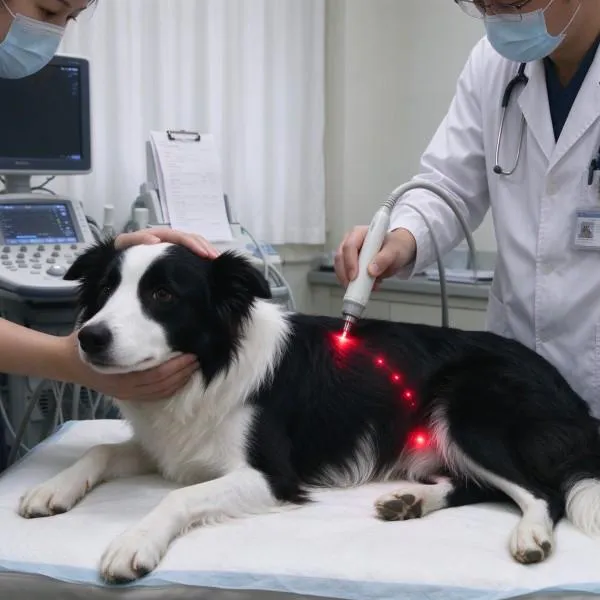
Clinical Case Study: Degenerative Lumbosacral Stenosis in a Senior Border Collie
To evaluate how 38-watt multi-wavelength dosimetry restores hind-limb neurological function and eliminates spinal pain without surgery or NSAIDs, examine the documented clinical progression of a geriatric herding dog treated at a veterinary neurology and rehabilitation center using the VetMedix-Max protocol.
Patient Presentation and Neurological Baseline
- Case Reference ID: VET-NEURO-2026-1129-DLSS
- Patient Demographics: 10-year-old spayed female black-and-white Border Collie, weighing 19.6 kg
- Diagnosis: Magnetic resonance imaging (MRI) confirmed degenerative lumbosacral stenosis (DLSS) with L7-S1 intervertebral disc protrusion, hypertrophy of the interarcuate ligament, and bilateral L7 foraminal nerve root compression, complicated by secondary lumbosacral facet osteoarthritis
- Pathological Grading: Modified Frankel Neurological Score Grade 4 (ambulatory paraparesis with mild hind-limb ataxia and delayed conscious proprioception); Canine Brief Pain Inventory (CBPI) Pain Severity Score of 8.0/10 and Pain Interference Score of 8.4/10; severe pain response on tail-jack hyperextension and direct L7-S1 dorsal pressure; bilateral hind-paw knuckling correction delayed to 4 seconds
- Prior Interventions: Six weeks of oral gabapentin (10 mg/kg three times daily) and strict leash restriction; concurrent IRIS Stage 2 chronic kidney disease strictly contraindicated oral NSAIDs, and owner declined surgical dorsal laminectomy due to patient age
Staged Dosimetry and Neurological Recovery Table
Because treating a black-and-white double coat over the lumbosacral junction and bilateral hip stabilizers requires high cumulative energy delivered safely without overheating dark pigment patches, the veterinarian structured a twelve-session protocol over five weeks, progressing from high-frequency Super-Pulsed neural decompression to high-fluence regenerative scanning.
| Session Number | Treatment Stage | Wavelength Ratio Configuration | Peak Power (W) | Pulse Frequency (Hz) | Duty Cycle / Mode | Total Energy Delivered (Joules) | Session Duration | Functional & Neurological Milestones |
| Session 1 | Acute Neural Analgesia | 810nm (30%) + 915nm (25%) + 940nm (20%) + 980nm (25%) | 20W | 6000 Hz | Super-Pulse (25% Duty) | 4,200 J | 7.5 min | Dog settled calmly in sternal-oblique rest within 2 minutes; tail carriage relaxed from tucked posture to neutral immediately post-session. |
| Session 2 | Acute Neural Analgesia | 810nm (30%) + 915nm (25%) + 940nm (20%) + 980nm (25%) | 22W | 5000 Hz | Super-Pulse (30% Duty) | 4,800 J | 7.5 min | Owner reported dog rose effortlessly from orthopedic bed in the morning without vocalizing; CBPI Pain Severity Score dropped from 8.0 to 5.5/10. |
| Session 4 | Foraminal Edema & Spasm Release | 650nm (5%) + 810nm (35%) + 915nm (25%) + 940nm (15%) + 980nm (20%) | 26W | 2500 Hz | Pulsed (45% Duty) | 5,600 J | 8.0 min | Dorsal nail scuffing on concrete sidewalk ceased; conscious proprioceptive paw-placing time improved from 4 seconds to 1.5 seconds. |
| Session 6 | Axonal ATP & Myofascial Recovery | 650nm (5%) + 810nm (40%) + 915nm (25%) + 940nm (15%) + 980nm (15%) | 30W | 1200 Hz | Pulsed (55% Duty) | 6,400 J | 8.0 min | Mild pain response only at extreme tail-jack elevation; gabapentin frequency reduced from three times daily to twice daily with zero sedation. |
| Session 9 | Deep Structural Remodeling | 650nm (10%) + 810nm (40%) + 915nm (20%) + 940nm (15%) + 980nm (15%) | 34W | CW / 300 Hz Hybrid | 75% Duty Cycle | 7,200 J | 7.5 min | Dog voluntarily trotted up backyard incline and jumped onto low sofa; CBPI Pain Interference Score fell from 8.4 to 2.0/10. |
| Session 12 | Functional Consolidation | 650nm (10%) + 810nm (40%) + 915nm (20%) + 940nm (15%) + 980nm (15%) | 38W | CW (Continuous Scanning) | 100% Scanning CW | 8,000 J | 7.5 min | Modified Frankel Score Grade 5 (neurologically normal gait and instant paw placement); transitioned to bi-weekly then monthly maintenance sessions. |
Targeted Parasagittal & Iliopsoas Scanning Technique
To saturate the deep L7-S1 intervertebral canal and bilateral nerve root foramina without dwelling over heavily pigmented black dorsal skin, the clinician divided each session into three anatomical zones. Fifty percent of the energy was delivered via parasagittal contact passes angled fifteen degrees medially toward the L6-S1 articular facets and lumbosacral space at 3 centimeters per second. Thirty percent was directed caudolaterally across the sacroiliac joints and gluteal musculature, while the remaining twenty percent was swept along the ventral-caudal flank over the iliopsoas muscle belly to relieve secondary hip-flexor guarding.
Scaling Wavelength Precision Across Equine, Human, and Surgical Disciplines
The exact optical engineering that allows a 38-watt veterinary laser to decompress a senior dog’s lumbosacral nerve roots translates directly across equine sports medicine, human physical therapy, and minimally invasive surgery. In equine practices, veterinarians rely on the battery-powered Theralux-Max 38W platform to penetrate dense metacarpal fascia and heavy gluteal musculature, treating proximal suspensory desmitis and sacroiliac strain trackside without sedation or prohibited competition medications.
In human outpatient rehabilitation clinics, the LaserMedix-Max 30W applies identical five-wavelength synchronization and peak penetration depth maintaining technology to resolve L4-L5 lumbar radiculopathy and deep hip osteoarthritis in under ten minutes. Meanwhile, in minimally invasive operating rooms, dual-wavelength platforms combining 1470nm and 980nm—such as the SurgMedix-Max—exploit the forty-fold higher water absorption of 1470nm to perform bloodless endovenous saphenous ablation, sphincter-sparing anal fistula closure, and precision veterinary oral surgery without collateral nerve damage. Across every clinical specialty, matching multi-wavelength physics to target tissue biology replaces systemic drug toxicity and surgical trauma with rapid cellular repair.
Comparing Class 4 Canine Photobiomodulation Against Traditional Spinal Care
For veterinary practice owners, medical directors, and equipment distributors evaluating capital investments, comparing a 38-watt multi-wavelength platform for dog laser therapy against conventional pharmaceutical, surgical, and low-power modalities reveals clear clinical and economic advantages.
| Veterinary Evaluation Metric | High-Intensity Class 4 Veterinary Laser (38W Multi-Wavelength) | Conventional Class 3B Cold Laser (less than 0.5W) | Oral Neuropathic & NSAID Medications (Gabapentin / Carprofen) | Surgical Dorsal Laminectomy & Foraminotomy |
| Double-Coat & Spinal Canal Penetration | Penetrates unclipped black/white coats down to 15cm via 38W bursts | Scattered within 1cm by thick guard hairs and thoracolumbar fascia | Systemic oral absorption; unaffected by coat thickness | Direct surgical decompression via bone removal under general anesthesia |
| Time to Deliver 6,000 Joules | 4.5 to 6 minutes per session | Over 200 minutes (clinically impossible in active veterinary workflows) | Daily multi-dose pill administration with sedative side effects | 90 to 150 minutes surgical and anesthesia time plus hospitalization |
| Mechanism of Action on Nerve & Joint | Stimulates axonal ATP, reduces foraminal edema, and relaxes epaxial spasm | Negligible photon density at L7-S1 depth; primarily superficial warmth | Blunts central pain signaling or COX enzymes without neural repair | Mechanically removes compressive bone/disc, leaving surgical scar tissue |
| Renal, Hepatic & Anesthesia Safety | Zero organ toxicity; completely safe for senior dogs with kidney disease | Safe, but high rate of clinical non-response in deep spinal stenosis | NSAIDs strictly contraindicated in renal disease; gabapentin causes ataxia | High anesthetic risk in geriatric patients plus post-op infection/instability |
| Clinic Revenue & Client Retention | High-margin 8-to-12 session packages run efficiently by trained technicians | Low owner satisfaction due to slow or imperceptible mobility improvement | Low-margin pharmacy refills easily lost to online pet medication retailers | High one-time surgical fee, but high owner refusal rate due to cost and risk |
For senior dogs suffering from concurrent kidney or liver compromise, oral NSAIDs are dangerously contraindicated, while high-dose gabapentin frequently worsens hind-end wobbliness and lethargy. Low-wattage Class 3B devices lack the photon density to cross dense lumbar coats and epaxial muscle bellies within a practical appointment window, leaving owners discouraged after weeks of visits.
Implementing high-intensity Class 4 laser therapy for dogs provides veterinary hospitals with a safe, non-invasive, drug-free modality that restores genuine neurological comfort and mobility. Senior dogs regain steady hind-limb coordination and pain-free daily walks within weeks, while clinics build a compassionate, high-retention rehabilitation service line trusted by devoted pet owners.