 FotonMedix












Non-Surgical Canine Perianal Fistula Healing Without Steroid Toxicity
38W super-pulsed multi-wavelength beams clear deep perianal sinus tracts, 650nm and 810nm accelerate mucosal epithelialization, and duty-cycle gating prevents sensitive tissue scorching.
Step into any veterinary internal medicine or dermatology room on a Friday morning, and you will witness one of the most heartbreaking, foul-smelling chronic conditions in companion animal practice. A seven-year-old German Shepherd Dog paces restlessly, holding its tail clamped tightly down and crying out during every attempt to defecate, plagued by deep, draining perianal fistulas (anal furunculosis). Traditional immunosuppressive therapy locks the patient into months of high-dose cyclosporine and oral prednisone—a regimen that costs owners hundreds of dollars every month, triggers severe gingival hyperplasia, panting, and secondary urinary infections, and still leaves deep sinus tracts prone to painful relapse the moment medication is tapered. Meanwhile, surgical excision carries a devastating risk of permanent fecal incontinence from external anal sphincter damage, low-wattage cold lasers fail to penetrate swollen perianal tissue, and continuous high-wattage single-wavelength beams risk burning delicate perineal mucosa within seconds.
When veterinary hospitals adopt a high-intensity Class 4 veterinary laser therapy machine, that painful immunosuppressive and surgical stalemate opens up. Rather than relying solely on systemic immune suppression or risky radical resection, high-power multi-wavelength photobiomodulation drives concentrated photonic energy deep into ulcerated perianal sinus tracts and inflamed glandular tissues. Deploying the best laser therapy device for dogs suffering from refractory perianal lesions means combining 38-watt peak output with five synchronized wavelengths—capabilities engineered directly into the VetMedix-Max platform to calm neurogenic anal spasm, eradicate chronic sinus edema, and stimulate rapid mucosal closure in under six minutes without sedating the dog or overheating sensitive perineal skin.
Perianal Tissue Attenuation Curves and Mucosal Chromophore Dynamics
Treating canine perianal fistulas demands navigating a complex anatomical transition where coarse, heavily pigmented tail-base fur meets thin, hypervascular mucocutaneous skin and deep fibrotic sinus tracts. According to optical transport modeling in mammalian perineal tissues, dark guard hairs around the tail base scatter and absorb up to seventy percent of incident light, while pooled purulent exudate, capillary hemoglobin, and interstitial edema inside open sinus tracts create an exponential energy decay curve governed by the Beer-Lambert law. A conventional Class 3B cold laser emitting less than half a watt loses virtually all photon momentum at the exudative surface—never reaching the deep intersphincteric pockets where chronic inflammation and bacterial biofilms persist.
Operating the best laser therapy device for dogs with deep perianal tracts requires saturating the near-infrared optical window with enough peak surface irradiance to sustain an active bio-stimulatory photon flux down to fifteen centimeters. Synchronizing five distinct wavelengths (650nm, 810nm, 915nm, 940nm, and 980nm) at peak outputs up to 38 watts orchestrates targeted cellular recovery across every tissue layer:
- 650nm (Mucocutaneous Epithelial Bridging & Ulcer Closure): Absorbed intensely within the superficial dermal margins and ulcerated sinus openings, accelerating keratinocyte migration across raw tracts and sealing exposed nerve endings without adding deep heat load.
- 810nm (Mitochondrial Cytochrome C Oxidase & Fibroblast Remodeling): Hits the exact absorption peak of cytochrome c oxidase inside hypoxic fibroblasts, macrophages, and endothelial cells. Photons at 810nm displace inhibitory nitric oxide from the mitochondrial respiratory chain, restoring electron transport and surging adenosine triphosphate (ATP) production required to replace necrotic sinus walls with healthy, pliable connective tissue.
- 915nm and 940nm (Pigmented Coat Bypass & Hemoglobin Oxygen Offloading): Positioned beyond the steepest epidermal melanin absorption slope, these wavelengths traverse dark tail-base fur cleanly while promoting oxygen dissociation from oxyhemoglobin into ischemic, ulcerated perianal tissue.
- 980nm (Submucosal Edema Drainage & Pudendal Nociceptor Analgesia): Exhibits targeted affinity for interstitial water molecules, establishing gentle micro-thermal gradients that lower inflammatory fluid viscosity, stimulate lymphatic drainage of bacterial toxins and bradykinin, and slow pain signal conduction along irritated pudendal nerve branches.
Peer-reviewed clinical studies published in Veterinary Dermatology and the Journal of Small Animal Practice confirm that high-fluence near-infrared photobiomodulation significantly accelerates epithelialization velocity, reduces inflammatory macrophage infiltration, and shortens immunosuppressive drug dependency in dogs affected by chronic perianal furunculosis.
“For nearly eight months, Kaiser would cry out every time he tried to go to the bathroom, leaving blood on the floor while high-dose steroids made him pant all night and drink bowls of water nonstop,” shares David Kowalski, owner of a seven-year-old German Shepherd treated for severe perianal fistulas. “After the third session on the high-power veterinary laser therapy machine, he stopped guarding his tail and had his first comfortable bowel movement in months—within five weeks the deep draining sores had healed over completely, and we were able to cut his daily medication down to a tiny maintenance dose without any flare-up.”
Super-Pulsed Duty Cycle Engineering Over Sensitive Perineal Mucosa
Delivering thirty-eight watts of optical power across the perianal region—where heavily pigmented hair-bearing skin borders thin, unpigmented mucocutaneous tissue rich in sensory nerve endings—requires exact thermal discipline. Holding an uninterrupted continuous 38W beam stationary over dark tail-base fur or raw ulcerated mucosa would rapidly elevate local temperatures past the forty-three-degree Celsius thermal pain threshold, causing immediate tail-clamping and patient distress. Experienced veterinary clinicians avoid this hazard not by dialing down peak power—which would collapse penetration into deep sinus tracts—but by regulating pulse frequency, duty cycle, and non-contact circular scanning.
During a structured Class 4 photobiomodulation protocol, Super-Pulse gating fires ultra-short, high-intensity bursts at 38W peak output—providing the photon momentum required to penetrate deep perianal pockets—separated by calibrated millisecond dark intervals matching the thermal relaxation time of thin perineal mucosa.
| Emission Mode | Peak Power Output | Duty Cycle & Thermal Dynamics | Primary Physiological Mechanism | Target Canine Perianal & Mucosal Stage |
| Super-Pulse Mode | Up to 38W peak | Low average thermal load (25%–35% duty) | Deep sinus tract penetration and pudendal analgesia without mucosal overheating | Acute draining perianal fistulas, severe tenesmus, deep ulcerated tracts |
| Pulsed Mode | 15W – 24W | Balanced on/off gating (50% duty) | Accelerated fibroblast granulation, angiogenesis, and submucosal edema clearance | Sub-acute contracting fistulas, anal sacculitis, post-surgical perineal wounds |
| Continuous Wave (CW) | 10W – 16W | Steady emission (100% duty with brisk scanning) | Superficial mucocutaneous remodeling and pelvic floor muscle relaxation | Late-stage epithelial consolidation, scar softening, residual tail-base guarding |
Pairing Super-Pulse modulation with a non-contact open-beam handpiece held two centimeters from the perineal skin eliminates mechanical pressure over exquisitely tender ulcerations while delivering soothing warmth that immediately relaxes external anal sphincter spasm.
Clinical Case Study: Refractory Perianal Fistulas in an Adult German Shepherd
To evaluate how 38-watt multi-wavelength dosimetry closes deep draining tracts and allows safe tapering of systemic immunosuppressants, examine the documented clinical record of an internal medicine patient managed at a specialty veterinary hospital using the VetMedix-Max protocol.
Patient Presentation and Perineal Baseline
- Case Reference ID: VET-IM-2026-1624-PAF
- Patient Demographics: 7-year-old neutered male black-and-tan German Shepherd Dog, weighing 39.2 kg
- Diagnosis: Severe bilateral chronic perianal furunculosis (anal furunculosis) characterized by five coalescing draining sinus tracts spanning 270 degrees around the anal orifice (depths ranging from 1.2 cm to 2.4 cm), marked perianal erythema, mucopurulent discharge, and secondary Escherichia coli and Staphylococcus pseudintermedius surface colonization
- Pathological Grading: Canine Perianal Fistula Severity Score of 15/18 (evaluating tract depth, circumferential extent, exudate volume, and tissue induration); Owner Dyschezia & Tenesmus Visual Analog Scale (VAS) at 8.8/10 (straining with vocalization during defecation, hematochezia, and persistent tail-clamping); severe guarding preventing unsedated digital rectal examination
- Prior Interventions: Eight months of oral cyclosporine (5 mg/kg twice daily), ketoconazole, and tapering oral prednisone alongside hypoallergenic diet; patient developed severe steroid-induced polyuria/polydipsia and gingival overgrowth, while two deep dorsal tracts persisted refractory to medical therapy alone
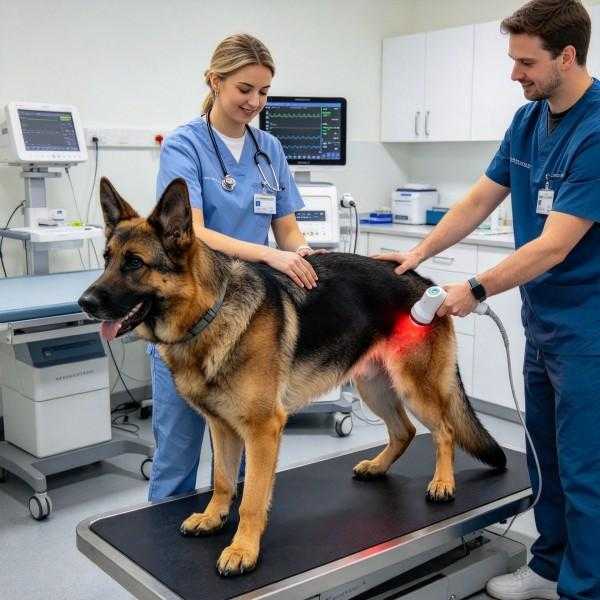
Staged Dosimetry and Mucosal Healing Progression Table
Because treating a black-and-tan German Shepherd’s perineal region requires balancing deep sinus tract penetration through dark tail-base hair with strict thermal protection over raw mucocutaneous ulcers, the veterinary team executed a ten-session protocol over five weeks, advancing from high-frequency Super-Pulsed analgesia to pulsed epithelial remodeling.
| Session Number | Treatment Stage | Wavelength Ratio Configuration | Peak Power (W) | Pulse Frequency (Hz) | Duty Cycle / Mode | Total Energy Delivered (Joules) | Session Duration | Clinical & Perianal Healing Milestones |
| Session 1 | Acute Pudendal Analgesia | 810nm (30%) + 915nm (25%) + 940nm (20%) + 980nm (25%) | 15W | 6000 Hz | Super-Pulse (25% Duty) | 1,800 J | 5.5 min | Dog stood calmly with tail gently elevated during non-contact irradiation; perianal throbbing and self-licking subsided within 12 hours. |
| Session 2 | Acute Analgesia & Exudate Control | 650nm (10%) + 810nm (30%) + 915nm (20%) + 940nm (15%) + 980nm (25%) | 16W | 5000 Hz | Super-Pulse (30% Duty) | 2,100 J | 5.5 min | Owner Dyschezia VAS score plummeted from 8.8 to 4.4/10; first formed bowel movement without vocalization or fresh blood; oral prednisone discontinued. |
| Session 4 | Sinus Granulation & Tract Contraction | 650nm (15%) + 810nm (35%) + 915nm (20%) + 940nm (15%) + 980nm (15%) | 18W | 2500 Hz | Pulsed (45% Duty) | 2,400 J | 6.0 min | Three lateral sinus tracts closed completely; remaining two dorsal tracts contracted by 60% in depth with clean pink granulation beds. |
| Session 6 | Mucocutaneous Epithelial Bridging | 650nm (20%) + 810nm (40%) + 915nm (15%) + 940nm (15%) + 980nm (10%) | 20W | 1200 Hz | Pulsed (55% Duty) | 2,700 J | 6.0 min | Complete 100% epithelial closure across all five tracts; cyclosporine dosage reduced by fifty percent without any inflammatory rebound. |
| Session 8 | Submucosal Scar Remodeling | 650nm (20%) + 810nm (40%) + 915nm (15%) + 940nm (15%) + 980nm (10%) | 22W | CW / 300 Hz Hybrid | 75% Duty Cycle | 3,000 J | 6.0 min | Perianal skin pliable and pale pink with zero induration; unsedated digital palpation tolerated comfortably; Dyschezia VAS score at 0.5/10. |
| Session 10 | Functional Consolidation | 650nm (20%) + 810nm (40%) + 915nm (15%) + 940nm (15%) + 980nm (10%) | 22W | CW (Continuous Scanning) | 100% Scanning CW | 3,000 J | 5.5 min | Perianal Fistula Severity Score fell from 15/18 to 1/18; cyclosporine tapered to minimal twice-weekly maintenance; zero relapse at 4-month recheck. |
Non-Contact Circumferential & Tail-Base Scanning Technique
To bathe both the open mucocutaneous ulcerations and the deeper intersphincteric tract bases without overheating sensitive tissue, the clinician elevated the tail gently and divided each session into two zones. Sixty-five percent of the total joules were delivered via a non-contact circular scanning pattern held two centimeters from the perianal ring at 3 centimeters per second, ensuring uniform coverage across all draining openings. The remaining thirty-five percent was swept gently across the surrounding pigmented perineal skin and ventral tail base to stimulate deep lymphatic drainage and relax pelvic floor muscle guarding.
Scaling Wavelength Precision Across Equine, Human, and Surgical Specialties
The exact optical engineering that makes a 38-watt veterinary platform the best laser therapy device for dogs battling chronic perianal lesions anchors high-performance clinical results across equine sports medicine, human outpatient rehabilitation, and minimally invasive surgery. In equine practices, veterinarians rely on the battery-powered Theralux-Max 38W platform to resolve pastern dermatitis, distal limb wounds, and deep proximal suspensory desmitis trackside without sedation or prohibited competition medications.
In human outpatient clinics, the LaserMedix-Max 30W applies identical five-wavelength synchronization and peak penetration depth maintaining technology to accelerate non-healing pelvic and sacral ulcers and resolve deep lumbar disc herniations in under ten minutes. Meanwhile, in minimally invasive operating rooms, dual-wavelength platforms combining 1470nm and 980nm—such as the SurgMedix-Max—exploit the forty-fold higher water absorption of 1470nm to perform sphincter-sparing human anal fistula closure and bloodless endovenous saphenous ablation without collateral thermal necrosis. Across every species and clinical discipline, matching multi-wavelength physics to target tissue biology replaces toxic systemic medications and radical surgical excision with rapid cellular regeneration.
Comparing Class 4 Canine Photobiomodulation Against Traditional Perianal Care
For veterinary practice owners, internal medicine specialists, and medical equipment distributors evaluating capital investments, comparing a 38-watt multi-wavelength veterinary laser therapy machine against conventional perianal fistula management demonstrates compelling clinical and operational advantages.
| Veterinary Evaluation Metric | High-Intensity Class 4 Veterinary Laser (38W Multi-Wavelength) | Conventional Class 3B Cold Laser (less than 0.5W) | High-Dose Cyclosporine & Oral Prednisone | Radical Surgical Excision & Anoplasty |
| Sinus Tract & Dark Coat Penetration | Penetrates deep draining tracts and pigmented fur via 38W super-pulsed bursts | Attenuated within millimeters by purulent exudate and dark tail-base hair | Systemic oral immune modulation; slow closure of deep fibrotic tracts | Radical surgical removal of diseased perianal tissue under anesthesia |
| Session Time & Patient Acceptance | 5.5 to 6 minutes; non-contact warmth calms anal spasm without sedation | Over 90 minutes to deliver 2,000 Joules (impractical for painful patients) | Daily multi-pill dosing; high owner stress when medicating painful dogs | 90 to 120 minutes surgery plus painful post-op defecation and wound care |
| Biological Healing & Drug-Sparing Effect | Accelerates epithelial bridging and allows rapid steroid/cyclosporine tapering | Negligible deep mucosal bio-stimulation within standard appointment times | Suppresses T-cell inflammation, but leaves tissue fragile and prone to relapse | High risk of wound dehiscence, anal stricture, and scar contracture |
| Systemic & Surgical Complication Risk | Zero hepatic, renal, or endocrine toxicity; thermal safety via Super-Pulse | Safe, but high rate of clinical non-response leaves tracts open and infected | Severe polyuria, gingival hyperplasia, vomiting, and secondary infections | 15% to 30% risk of permanent fecal incontinence from sphincter damage |
| Clinic Economics & Client Retention | High-margin 8-to-10 session medical/derm packages run by technicians | Low client satisfaction due to slow or imperceptible tract healing | Expensive monthly drug refills frequently abandoned due to cost and side effects | High surgical fee, but high owner refusal rate due to incontinence fears |
Relying indefinitely on high-dose systemic steroids and cyclosporine burdens families with steep monthly pharmacy bills and severe metabolic side effects, while surgical resection risks permanent fecal incontinence in beloved family companions. Low-wattage Class 3B devices lack the photon density to penetrate exudative sinus tracts within a realistic appointment window.
Investing in the best laser therapy device for dogs equipped with 38W peak output, five synchronized wavelengths, and intelligent Super-Pulse duty-cycle control empowers veterinary clinics to close refractory perianal fistulas safely and non-invasively. Dogs regain comfortable, pain-free bowel movements and dramatically reduced medication loads within weeks, while veterinary hospitals build a high-retention internal medicine and dermatology service line trusted by grateful pet owners.