 FotonMedix











Overcoming Joint Capsule Fibrosis in Frozen Shoulder
Dual-peak water absorption, vascular recruitment, and sub-ablative thermal pacing release contracted gleno-humeral capsules without damaging periarticular cartilage.
Clinicians treating adhesive capsulitis regularly watch rehabilitation stall when patients reach the frozen phase. The glenohumeral capsule thickens, contracts, and undergoes severe fibrotic scarring, locking the humeral head and reducing passive range of motion. Conventional physical therapy and low-power units marketed as an fda approved cold laser therapy device struggle in this clinical scenario: low-milliwatt beams lose almost all photon energy within the bulky deltoid and rotator cuff musculature, leaving the joint capsule completely unreached. Conversely, delivering high-output light without tight wavelength control overheats the skin long before therapeutic photon density reaches the axillary pouch or anterior capsule. Solving this limitation requires matching laser energy directly to capsule hydration and microvasculature while using targeted pulse modulations to protect the dermis.
Photonic Transmission Through Multi-Layered Periarticular Structures
Delivering an adequate therapeutic dose to an inflamed shoulder capsule requires traversing four distinct optical layers: epidermis, deep subcutaneous fat, dense skeletal muscle, and fibrous fascial sheaths. Each layer introduces severe forward and backward scattering, alongside variable absorption signatures.
According to photon diffusion models established in biomedical optics, light attenuation across heterogeneous tissue structures accelerates when muscle fibers run transverse to the incident beam. The high density of myoglobin and microvascular blood in the deltoid creates an optical barrier that scatters standard red or superficial infrared light. Overcoming this barrier requires sustained high irradiance at the skin surface, combined with physical compression to blanch superficial capillary beds. By using high-performance laser therapy equipment, clinicians can maintain photon flux above the biological threshold of 0.05 W per square centimeter at depths exceeding 35 millimeters, ensuring energy actually reaches the fibrosed capsule.
Synergistic Chromophore Targeting: 980 nm and 1470 nm Photobiology
Managing capsular contracture requires addressing both avascular dense fibrosis and surrounding reactive synovitis simultaneously. Multi-wavelength delivery handles these dual targets through complementary biological mechanisms:
The 980 nm wavelength interacts strongly with hemoglobin and cellular cytochrome c oxidase. In the contracted shoulder capsule, persistent hypoperfusion drives sustained ischemic pain and stimulates continuous fibroblast-to-myofibroblast differentiation. Introducing 980 nm photons promotes nitric oxide release from vascular endothelial cells, opening microvascular beds around the glenohumeral joint. This wash of oxygenated blood helps clear inflammatory metabolites, restores aerobic mitochondrial respiration, and relieves chronic resting capsular pain.
The 1470 nm wavelength matches a sharp absorption peak in water, which forms the primary fluid component of synovial fluid and the ground substance within the capsular matrix. By concentrating light in water-rich tissues, 1470 nm generates controlled, sub-ablative photothermal softening within cross-linked type I and type III collagen fibrils. This gentle thermal warming relaxes contracted fibrous bands and increases capsule pliability immediately prior to manual joint mobilization. Sourcing platforms from a qualified laser equipment supplier ensures precise power calibration across both bands, allowing clinicians to tailor optical penetration to specific joint structures.
Thermal Relaxation Time and Duty Cycle Modulation
Sustained photonic delivery into deep capsular targets carries the risk of thermal stacking in overlying cutaneous layers. Protecting superficial tissues while maximizing deep-target saturation requires managing the thermal relaxation time of skin and adipose layers, which ranges from 15 to 40 milliseconds.
Applying rapid micro-pulsing allows clinicians to introduce high peak power followed by structured dark periods. During these off-times, surface capillaries dissipate heat into adjacent tissue networks via conduction, while photons continue penetrating forward through deeper layers. Modulating pulse duty cycles between 25% and 45% allows clinical systems to bypass dermal thermal barriers, delivering therapeutic doses to the joint capsule without triggering discomfort or epidermal thermal stress.
Clinical Protocol: Class IV Photothermal Remodeling for Adhesive Capsulitis
The following protocol details the treatment of chronic stage-two adhesive capsulitis in a specialized musculoskeletal rehabilitation center.
Patient Profile and Baseline Evaluation
- Case Identifier: FTM-MSK-2026-1102
- Patient Age: 52
- Sex: Female
- Primary Diagnosis: Secondary adhesive capsulitis of the left glenohumeral joint (Stage II, Frozen Phase), symptom duration 7 months
- Prior Treatments: Oral NSAIDs, two intra-articular corticosteroid injections (temporary relief followed by recurrence), eight weeks of conventional passive stretching with negligible range gains
- Baseline Diagnostics: Magnetic Resonance Imaging (MRI) verified marked thickening of the coracohumeral ligament (4.2 mm) and axillary recess capsule (6.1 mm), accompanied by significant subcoracoid fat obliteration. Passive range of motion (PROM) measurements recorded: Abduction 68 degrees, Forward Flexion 82 degrees, External Rotation 14 degrees. Baseline Shoulder Pain and Disability Index (SPADI) scored 78.4%. Visual Analog Scale (VAS) pain score stood at 7.5/10 during active arm movement.
Treatment Parameters and Technical Dosing
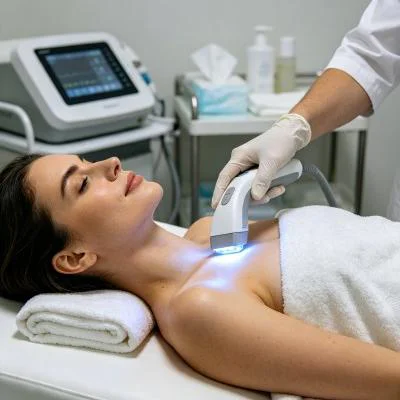
The clinical program included twelve sessions over four weeks (three visits per week), followed by four bi-weekly consolidation sessions. Light was applied using a continuous contact handpiece paired with manual circumduction to reach deep joint pockets.
| Session Range | Wavelength Distribution | Peak Power | Pulse Frequency | Duty Cycle | Application Time | Target Energy Density | Delivered Energy |
| Sessions 1–4 | 75% 980 nm, 25% 1470 nm | 9.0 W | 30 Hz Pulsed | 30% | 600 s | 15.0 J/cm² | 1,620 J |
| Sessions 5–8 | 60% 980 nm, 40% 1470 nm | 11.0 W | 60 Hz Pulsed | 40% | 540 s | 22.0 J/cm² | 2,376 J |
| Sessions 9–12 | 50% 980 nm, 50% 1470 nm | 14.0 W | 100 Hz Pulsed | 50% | 480 s | 30.0 J/cm² | 3,360 J |
| Sessions 13–16 | 40% 980 nm, 60% 1470 nm | 12.0 W | Continuous / 10 Hz mix | 75% | 420 s | 32.0 J/cm² | 3,780 J |
Objective Progression Metrics
Passive stretching and joint glides were performed immediately following each laser application, taking advantage of the photothermal softening window. Surface epidermal temperatures were tracked continuously, staying safely below 41.8 degrees Celsius throughout all sessions.
| Functional Metric | Pre-Treatment | Session 4 | Session 8 | Session 12 | Program End (Session 16) | 90-Day Follow-Up |
| Passive Abduction (deg) | 68° | 82° | 108° | 142° | 168° | 172° |
| Passive Forward Flexion (deg) | 82° | 96° | 120° | 154° | 170° | 175° |
| Passive External Rotation (deg) | 14° | 22° | 38° | 54° | 64° | 66° |
| SPADI Disability Index (%) | 78.4% | 62.1% | 41.5% | 21.0% | 8.5% | 6.2% |
| Dynamic Pain (VAS 0–10) | 7.5 | 5.4 | 3.2 | 1.4 | 0.4 | 0.0 |
| Axillary Capsule Thickness (mm) | 6.1 | 5.9 | 4.8 | 3.6 | 2.8 | 2.6 |
Cellular Remodeling and Joint Dynamics
Initial sessions prioritized 980 nm light to reduce ischemic discomfort, lower periarticular edema, and stimulate synovial lymph drainage. By the second week, increasing the 1470 nm ratio delivered localized photothermal energy directly into the dense capsular collagen.
This specific wavelength mix disrupted non-reducible intermolecular cross-links without causing tissue necrosis. Applying gentle mobilization right after laser exposure allowed the softened capsular tissue to stretch without triggering defensive muscle spasms. Follow-up MRI at 90 days showed the axillary recess capsule thickness had decreased from 6.1 mm to a normal 2.6 mm, matching the healthy contralateral shoulder. The patient resumed normal, pain-free overhead activities with zero recurrence of capsular stiffness.
Advanced Photobiomodulation Compared to Traditional Interventions
Traditional management strategies for adhesive capsulitis often involve clear clinical trade-offs. Corticosteroid injections offer rapid short-term anti-inflammatory relief, but multiple doses can degrade periarticular cartilage, weaken the rotator cuff tendons, and accelerate long-term joint degeneration.
Forced manipulation under anesthesia can rapidly tear the contracted capsule, but it carries real risks of humeral fractures, labral tears, and nerve traction injuries, often followed by painful inflammatory rebound. Arthroscopic capsular release effectively cuts fibrotic bands, but surgical incisions create new scar tissue, pose infection risks, and require months of post-operative recovery.
High-intensity Class IV laser systems provide a targeted, non-invasive alternative. By delivering dual 980 nm and 1470 nm wavelengths at deep-penetrating power levels, this approach pairs microvascular biostimulation with targeted capsular tissue softening. Clinicians can break the cycle of capsular contracture, reduce resting and dynamic pain, and restore joint mobility without surgical intervention or pharmaceutical dependency.