 FotonMedix











Photonic Modulation of Chronic Neuralgic Pathways: Advanced Protocols for Class IV Laser Integration
The clinical efficacy of a class iv therapy laser in managing refractory neuropathic pain and deep-seated musculoskeletal pathologies is contingent upon the strategic manipulation of the “Therapeutic Window.” This analysis examines the transition from standard photobiomodulation to high-irradiance protocols, focusing on the acceleration of axonal regeneration and the management of chronic inflammatory mediators in high-volume B2B clinical environments.
Bio-Optical Engineering: Overcoming the Attenuation Barrier
The primary clinical obstacle in laser therapy is the exponential decay of photon density as light traverses heterogeneous tissue layers. For a therapy laser to affect structures such as the sciatic nerve or deep lumbar facets, it must overcome the combined effects of absorption by melanin and water, as well as the scattering coefficients of adipose and dermal layers.
While 810nm is the gold standard for triggering the Cytochrome c Oxidase (CcO) enzyme, the 1064nm wavelength offers a distinct advantage in penetration depth due to its minimized scattering in collagen-rich tissues. By utilizing a laser therapy device with synchronized multi-wavelength output, clinicians can create a “Photonic Saturation” effect.
The relationship between incident power and depth-specific irradiance is modeled by the diffusion theory of light transport, where the fluence rate ($\Phi$) at depth $z$ is influenced by the transport scattering coefficient ($\mu_s’$):
$$\Phi(z) = \Phi_0 \cdot k \cdot e^{-\mu_{eff} \cdot z}$$
In high-power diode systems, increasing the incident irradiance ($\Phi_0$) allows for the maintenance of a threshold fluence (typically $5-10 \text{ J/cm}^2$) at depths exceeding 6cm, a feat impossible for lower-class devices.
Surgical Precision and Hemostatic Control in Soft Tissue Ablation
Beyond non-invasive protocols, the integration of the 1470nm wavelength transforms the laser therapy device into a high-precision surgical tool. The 1470nm diode exhibits a specific affinity for the water absorption peak, which is approximately 40 times higher than that of the 980nm wavelength. This allows for:
- Water-Targeted Vaporization: Enabling clean incisions with negligible mechanical trauma to surrounding cells.
- Immediate Photo-Coagulation: The secondary 980nm beam targets oxyhemoglobin, ensuring that capillary beds are sealed during the ablation process.
This dual-action approach is particularly beneficial in veterinary and human dental or minor surgical procedures where a bloodless field and minimal post-operative edema are paramount for patient throughput.
Performance Benchmark: Conventional Scalpel vs. Fotonmedix Multi-Wavelength Systems
| Performance Metric | Cold Steel / Electrosurgery | Fotonmedix 1470nm+980nm System |
| Incision Mechanism | Mechanical Tearing / Electrical Arc | Thermal Vaporization (Non-contact) |
| Hemostasis Quality | High bleeding; requires suction | Instantaneous; dry surgical field |
| Post-Op Inflammation | Significant (Pro-inflammatory cytokine surge) | Minimal (Lymphatic and nerve sealing) |
| Wound Recovery Time | 10-14 Days | 5-7 Days |
| Tissue Carbonization | High (with Electrosurgery) | Negligible (Precise TRT modulation) |
Neuro-Regeneration and the Mitigation of Peripheral Sensitization
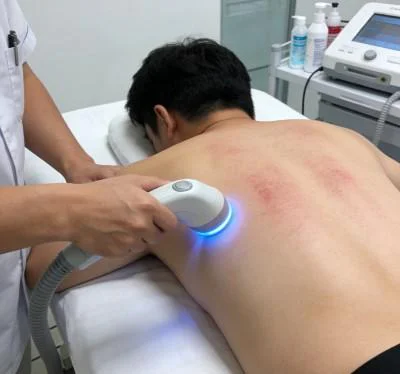
A high-performance class iv therapy laser does not simply “mask” pain; it re-modulates the neural environment. By delivering high peak-power pulses, the system induces a temporary “conduction block” in C-fibers and A-delta fibers, providing immediate analgesic relief. Simultaneously, the increased ATP production facilitates the rapid repair of the myelin sheath.
The metabolic shift is driven by the dissociation of Nitric Oxide (NO) from the mitochondrial chain. Under pathological conditions, NO binds to CcO, halting cellular respiration. The laser photons effectively “bump” the NO molecule, allowing Oxygen to bind and resume efficient energy production.
Clinical Case Study: Management of Chronic Degenerative Myelopathy (CDM) and Associated Radiculopathy
Patient Background:
- Subject: 58-year-old male, chronic lower back pain with radiating numbness in the right lower extremity.
- Diagnosis: L4-L5 Disc Herniation with secondary nerve root compression and localized inflammatory edema.
- History: Failed pharmacological management (Pregalin and NSAIDs). VAS score 9/10.
Initial Assessment:
MRI confirmed a 5mm protrusion. The patient exhibited reduced deep tendon reflexes and significant muscle guarding in the lumbar region.
Treatment Parameters (Fotonmedix Vetmedix/Lasermedix 3000U5):
- Wavelength Blend: 810nm (6W) + 980nm (4W) + 1064nm (5W).
- Mode: Super-Pulsed (to maximize deep penetration while protecting the skin).
- Fluence: $15 \text{ J/cm}^2$ over the nerve root exit zone; $8 \text{ J/cm}^2$ along the sciatic distribution.
- Schedule: 2 sessions per week for 5 weeks.
Clinical Progression:
| Timeline | Symptom Progress | Physiological Correlate |
| Week 1 | VAS reduced to 6/10; improved sleep quality. | Reduction in Substance P and Bradykinin |
| Week 3 | Sensation returning to the foot; gait stabilization. | Acceleration of axonal transport |
| Week 5 | VAS 2/10; patient returned to light exercise. | Resolution of perineural edema |
Final Conclusion:
The ability of the class iv therapy laser to deliver high energy densities to the deep foraminal space allowed for a non-invasive reduction in perineural inflammation. The high-irradiance protocol successfully bypassed the superficial muscle mass to stimulate the compressed nerve root directly.
Risk Mitigation: Safety Compliance and Diode Longevity
In a professional B2B environment, the reliability of medical-grade lasers is tied to rigorous maintenance and safety standards (IEC 60825-1).
- NOHD Calculation: The Nominal Ocular Hazard Distance must be strictly observed. For Class IV systems, this distance can exceed 10 meters, necessitating protective eyewear for all occupants of the laser suite.
- Fiber Optic Maintenance: The SMA-905 connector must be inspected via fiber-scope regularly. Any “pitting” on the fiber face can lead to energy leakage and handpiece overheating.
- Thermal Calibration: High-power diodes require stable current drivers. Annual calibration ensures that the power output remains linear across the entire range of the UI settings, preventing under-dosing or accidental thermal injury.
B2B Strategic Implementation: The Multi-Disciplinary Advantage
For regional distributors and medical facility managers, the integration of a class iv therapy laser provides a unique competitive advantage. Its “Dual-Intent” design—capable of both deep-tissue PBM and micro-surgical ablation—maximizes the utilization rate of the equipment. Whether addressing sports injuries in an orthopedic clinic or managing post-surgical wound care in a general hospital, the versatility of Fotonmedix systems ensures a rapid return on investment through improved patient outcomes and reduced pharmaceutical dependencies.
FAQ
Q: How does a Class IV laser manage “Hot Spots” during treatment?
A: Through the use of advanced pulsing algorithms and “Large-Spot” handpieces. By spreading the energy over a larger surface area and pulsing the beam, the system ensures high total energy delivery without exceeding the tissue’s thermal threshold.
Q: Is the 1064nm wavelength essential for all patients?
A: It is particularly essential for patients with high BMI or thick muscle mass. 1064nm has a lower water absorption than 980nm, allowing it to “slip” through hydrated tissues to reach deep-seated joints and bones.
Q: Can this device be used in conjunction with regenerative medicine like PRP?
A: Yes. Laser therapy is frequently used 24-48 hours after PRP (Platelet-Rich Plasma) injections to further stimulate the metabolic activity of the injected growth factors, creating a synergistic healing environment.