 FotonMedix











Precision Photomedicine: Engineering Thermal Gradients for Advanced Tissue Ablation and Biostimulation
The integration of high-flux laser therapy equipment into modern surgical suites has redefined the “Gold Standard” for minimally invasive interventions. For the medical director or clinical specialist, the transition from traditional mechanical dissection to photonic energy is not merely a technological upgrade but a fundamental shift in fluid dynamics and cellular signaling. By leveraging the specific absorption peaks of water and hemoglobin, clinicians can now execute precise thermo-coagulation with a spatial accuracy previously unattainable by electrocautery or RF-based modalities.
[Image: Interaction of 980nm and 1470nm wavelengths with biological tissue strata]
Hemostatic Efficiency: The Calculus of Photon-Chromophore Interaction
In the deployment of high-tier laser therapy machines, the primary clinical objective is to achieve a controlled “Thermal Damage Zone” (TDZ). This is governed by the absorption coefficient ($\mu_a$) of the target tissue. At 1470nm, the absorption coefficient in water is approximately 40 times higher than at 980nm. This physical property allows for a localized energy deposition that vaporizes intracellular water almost instantaneously, leading to clean cellular disruption with minimal lateral heat spread.
The volumetric heating effect ($Q$) generated within the tissue can be modeled using the Beer-Lambert law principles combined with thermal diffusion:
$$Q = \mu_a \cdot \Phi_0 \cdot e^{-(\mu_a + \mu_s)z}$$
Where:
- $\Phi_0$ represents the incident irradiance ($W/cm^2$).
- $\mu_s$ is the scattering coefficient.
- $z$ is the depth of penetration.
For a B2B procurement specialist, understanding this formula is vital; it explains why a dual-wavelength system provides a wider “Therapeutic Window.” While 1470nm handles surface-level precision and water-rich targets, 980nm penetrates deeper into vascularized structures, ensuring a comprehensive seal of blood vessels up to 7mm in diameter.
Comparative Pathophysiology: Laser Interstitial Thermal Therapy vs. Radiofrequency (RF)
In the context of endovenous or interstitial procedures, the choice of energy source dictates the patient’s inflammatory profile.
| Performance Metric | Radiofrequency Ablation (RFA) | Advanced 1470nm Diode Laser | Clinical Significance |
| Peak Operating Temp | ~120°C (Direct contact required) | ~100°C (Non-contact/Fiber) | Lower risk of carbonization and vessel perforation |
| Energy Delivery | Segmental (Cycles) | Continuous/Linear ($J/cm$) | More uniform closure of the target lumen |
| Post-Op Ecchymosis | Moderate | Minimal to None | Higher patient satisfaction and aesthetics |
| Procedure Versatility | Limited to specific probes | High (Interchangeable fiber sizes) | Ability to treat tortuous veins and smaller orifices |
Clinical Case Study: Canine Intervertebral Disc Disease (IVDD) and Spinal Decompression
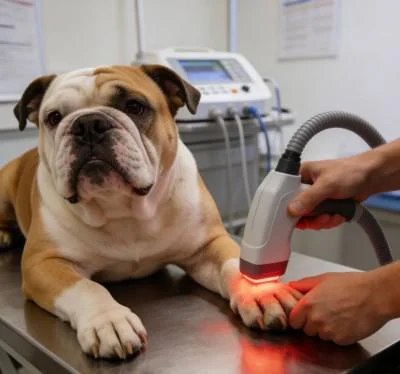
Patient Profile: 7-year-old French Bulldog, presenting with acute Stage 3 IVDD, hind limb paresis, and loss of deep pain sensation. Traditional laminectomy was considered high-risk due to the patient’s pre-existing cardiac murmur.
Diagnosis: L3-L4 disc extrusion with significant spinal cord compression and secondary localized ischemia.
Therapeutic Intervention: A combination of Percutaneous Laser Disc Decompression (PLDD) and high-intensity laser therapy dogs PBM protocol was utilized.
- Surgical Phase: 400$\mu m$ bare fiber introduced under fluoroscopic guidance.
- Wavelength: 1470nm for precise nucleus pulposus vaporization.
- Total Energy: 450 Joules delivered in pulsed bursts (1s ON, 1s OFF) to prevent thermal buildup in the spinal canal.
Post-Surgical PBM Parameters:
| Treatment Day | Wavelength (nm) | Power (W) | Total Dose (J) | Clinical Goal |
| Days 1-3 | 980 | 10W (Pulsed) | 1,500 | Inhibit Pro-inflammatory Cytokines |
| Days 4-10 | 980 + 810 | 15W (CW) | 3,000 | Accelerate Myelin Sheath Repair |
| Weeks 3-5 | 980 | 12W (20Hz) | 2,000 | Neuromuscular Re-education |
Clinical Outcome:
Within 48 hours post-PLDD, the patient regained deep pain sensation. By Day 14, ambulatory function returned with slight ataxia. At the 6-week follow-up, the dog exhibited a normal gait. The integration of high-power diode technology allowed for a “No-Scalpel” decompression, eliminating the need for invasive bone removal and reducing anesthesia time by 55%.
Technical Maintenance: Ensuring System Linearity and Patient Safety
The reliability of laser therapy equipment in a 24/7 hospital environment depends on the stability of the diode stack. Professional-grade units must incorporate:
- Back-Reflection Protection: When using high-power fibers, back-reflection from highly reflective surgical surfaces can damage the diode facet. Advanced systems include optical isolators to shunt reflected energy.
- Adaptive Pulse Shaping: To avoid “Tissue Charring,” the system should utilize a variable square-wave pulse. This ensures the peak power is high enough for ablation but the “OFF” time allows for thermal relaxation.
- Real-time Impedance Monitoring: Especially in surgical fibers, monitoring the feedback ensures the fiber tip has not degraded, which would otherwise result in an unpredictable energy flux.
B2B Strategic Integration: The Future of Multi-Platform Lasers
Regional distributors and hospital groups are increasingly looking for “Convergent Platforms.” A single console capable of driving 15W for PBM (Photobiomodulation) and 30W for surgical ablation represents the pinnacle of capital efficiency. By minimizing the footprint of the laser therapy machine while maximizing the clinical applications—from physical therapy and wound care to complex ENT or urological surgeries—facilities can achieve a faster “Break-even Point” on their investment.
FAQ: Clinical and Operational Insights
Q: Why is 1470nm considered superior for soft tissue vaporization compared to 980nm?
A: Because 1470nm targets water specifically. Since soft tissue is 70-80% water, the energy is absorbed in a very thin layer (shallow penetration depth), allowing the surgeon to “shave” tissue with micron-level precision without affecting underlying structures.
Q: Does the use of high-power lasers in veterinary medicine (for “laser therapy dogs”) require different safety protocols?
A: The safety fundamentals (Goggles, limited access) remain the same. However, due to fur density, skin temperature monitoring is more critical to avoid thermal accumulation in the epidermal layer before the photons reach the target joint or muscle.
Q: How do dual-wavelength outputs affect the speed of healing?
A: Dual-wavelength systems (e.g., 980nm + 1470nm) provide a synergistic effect: one wavelength provides the primary surgical/thermal action, while the other stimulates the micro-circulation and lymphatic drainage, effectively starting the healing process before the patient leaves the operating table.