 FotonMedix












Recuperação de distensões profundas do músculo iliopsoas em cães de agilidade sem períodos de repouso
Synchronized five-wavelength beams penetrate thick pelvic muscle bellies, 810nm energy accelerates tenocyte ATP repair, and super-pulsed duty cycles prevent epidermal overheating.
Step into any canine sports medicine clinic on a Monday morning after a regional agility trial, and you will see a handler staring at a bruised, limping athlete with pure dread. A five-year-old Australian Shepherd pulls up lame after misjudging a weave-pole entry, exhibiting sharp pain on simultaneous hip extension and internal rotation—the classic signature of an acute-on-chronic iliopsoas muscle and tendon strain. Because the iliopsoas sits buried beneath heavy gluteal muscles, dense lumbar fascia, and thick double coats, standard low-wattage therapy devices scatter completely before reaching the lesser trochanter insertion. Meanwhile, prescribing weeks of oral non-steroidal anti-inflammatory drugs (NSAIDs) merely masks discomfort while risking gastrointestinal ulceration, and cranking up continuous wattage on an older single-wavelength unit scorches dark pelvic fur within seconds.
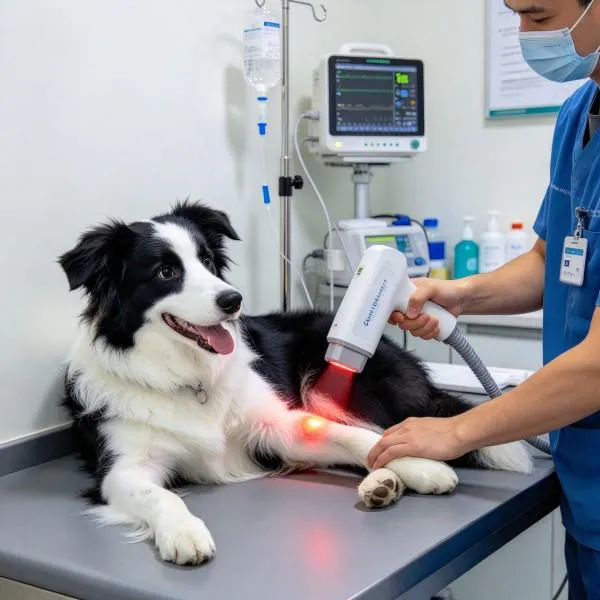
When veterinary sports rehabilitation clinics invest in a high-intensity Class 4 máquina de terapia laser veterinária, that deep-muscle diagnostic and therapeutic standoff changes immediately. Rather than consigning a competitive working dog to six months of crate rest and scarred, inelastic tendon healing, high-power multi-wavelength photobiomodulation drives concentrated photonic energy straight through dense pelvic musculature into the deep musculotendinous junction. Selecting the melhor aparelho de terapia laser para cães recovering from soft-tissue sports trauma means combining 38-watt peak output with five synchronized wavelengths—engineering built directly into the VetMedix-Max platform to suppress myofascial trigger points and accelerate collagen alignment in under eight minutes without shaving coats or risking skin burns.
Pelvic Muscle Attenuation Curves and Deep Myofascial Chromophores
Treating an iliopsoas strain demands overcoming one of the steepest optical attenuation profiles in canine anatomy. Unlike a superficial digital tendon, the iliopsoas originates along the ventral lumbar vertebral bodies and inserts deep onto the lesser trochanter of the femur, shielded externally by thick double-coated fur, pigmented dermis, subcutaneous adipose tissue, and the bulky gluteus medius and tensor fasciae latae muscles. According to Monte Carlo photon transport modeling in mammalian musculoskeletal tissues, dense guard hairs and epidermal melanin scatter and absorb up to seventy percent of incident light at the skin surface. Once inside the muscle belly, myoglobin, capillary hemoglobin, and interstitial water create an exponential energy decay curve governed by the Beer-Lambert law. A conventional Class 3B cold laser emitting less than half a watt loses virtually all photon flux within the first centimeter—never reaching the deep groin and pelvic floor where iliopsoas micro-tears fester.
Utilização do melhor aparelho de terapia laser para cães with deep pelvic injuries requires saturating the near-infrared optical window with enough peak surface irradiance to sustain a bio-stimulatory photon flux down to fifteen centimeters. Synchronizing five distinct wavelengths (650nm, 810nm, 915nm, 940nm, and 980nm) at peak outputs up to 38 watts orchestrates targeted cellular recovery across every anatomical layer:
- 650 nm (preparação da derme superficial e do sistema microvascular): Absorbed within upper epidermal layers to support healthy dermal capillary perfusion and skin barrier integrity without contributing to deep pelvic heat accumulation.
- 810nm (Mitochondrial Cytochrome C Oxidase & Tenocyte ATP Synthesis): Hits the exact absorption peak of cytochrome c oxidase inside damaged myocytes and insertional tenocytes. Photons at 810nm displace inhibitory nitric oxide from the mitochondrial respiratory chain, restoring electron transport and accelerating adenosine triphosphate (ATP) production required for organized Type I collagen synthesis rather than brittle fibrotic scar tissue.
- 915nm and 940nm (Melanin Bypass & Myoglobin Oxygen Offloading): Positioned beyond the steepest epidermal melanin absorption slope, these wavelengths traverse dense pelvic fur and adipose pads cleanly while stimulating oxygen dissociation from oxyhemoglobin and oxymyoglobin into hypoxic, spasmodic muscle bellies.
- 980nm (Intramuscular Edema Drainage & Trigger-Point Analgesia): Exhibits targeted affinity for interstitial water molecules, establishing gentle micro-thermal gradients that lower inflammatory fluid viscosity, clear accumulated lactic acid and bradykinin, and slow nociceptive signaling along irritated femoral nerve branches.
Estudos experimentais e clínicos submetidos a revisão por pares publicados em Cirurgia veterinária e o Revista Americana de Investigação Veterinária confirm that high-fluence near-infrared photobiomodulation significantly increases parallel collagen fiber alignment, boosts tensile tendon strength, and reduces inflammatory cytokine concentrations in canine musculotendinous strains.
“Before we started treatment, Toby couldn’t even step up onto the curb without tucking his pelvis and yelping, and two weeks of strict crate rest with anti-inflammatory pills barely touched the deep groin tightness,” recalls Hannah Gallagher, handler of a five-year-old Australian Shepherd treated for a Grade II iliopsoas strain. “By the fourth session on the high-power máquina de terapia laser veterinária, that rock-hard muscle spasm in his flank had completely softened—he stretched out comfortably on the mat during every visit, and six weeks later he was back running clean weave poles without a single limp or relapse.”
Super-Pulsed Duty Cycle Engineering Across Thick Pelvic Coats
Transmitting thirty-eight watts of optical power across the flank, lumbar spine, and inguinal region of a heavily coated herding dog demands exact thermal discipline. Holding an uninterrupted continuous 38W beam stationary over dark tricolored fur or sensitive inguinal skin would rapidly elevate epidermal temperatures past the forty-three-degree Celsius thermal pain threshold, causing immediate flinching and guarding. Experienced veterinary rehabilitation clinicians eliminate this hazard not by dialing down peak power—which would collapse penetration into the deep iliopsoas belly—but by regulating pulse frequency, duty cycle, and continuous scanning geometry.
During a structured Class 4 photobiomodulation session, Super-Pulse gating fires ultra-short, high-intensity bursts at 38W peak output—providing the photon momentum required to penetrate fifteen centimeters deep into the pelvic floor—separated by calibrated millisecond dark intervals matching the thermal relaxation time of pigmented canine hair follicles and inguinal skin.
| Modo de emissão | Potência de pico de saída | Ciclo de funcionamento e dinâmica térmica | Mecanismo fisiológico primário | Target Canine Musculotendinous Stage |
| Modo Super-Pulse | Até 38 W de potência máxima | Baixa carga térmica média (25 %–35 % de utilização) | Deep trans-gluteal and inguinal penetration without coat or skin heating | Acute Grade II iliopsoas strain, deep psoas hematoma, femoral nerve irritation |
| Modo pulsado | 18 W – 30 W | Controlo de ativação/desativação equilibrado (50 % de ciclo de trabalho) | Tenocyte ATP acceleration, myoglobin oxygenation, and edema drainage | Sub-acute musculotendinous repair (Weeks 2–4), insertional tendinopathy |
| Onda contínua (CW) | 12W – 24W | Emissão constante (100 % de capacidade com varredura rápida) | Deep myofascial spasm release and pre-exercise muscular elasticity | Late-stage scar remodeling, compensatory lumbar and quadriceps guarding |
Pairing Super-Pulse modulation with a smooth massage-ball optical handpiece allows the clinician to part thick double coats and apply firm tissue compression over the paralumbar and inguinal portals. Pressing the quartz lens into soft tissue blanches superficial dermal capillaries, removing competing hemoglobin absorption and boosting deep photon delivery to the iliopsoas insertion by up to thirty percent while keeping the coat completely unclipped.
Clinical Case Study: Grade II Iliopsoas Strain in a Competitive Agility Dog
To evaluate how 38-watt multi-wavelength dosimetry restores elastic tendon integrity and prevents chronic recurrence in a high-drive canine athlete, examine the documented clinical record of an orthopedic sports medicine patient managed at a specialty rehabilitation hospital using the VetMedix-Max protocol.
Patient Presentation and Musculoskeletal Ultrasound Baseline
- N.º de referência do processo: VET-SPORT-2026-1518-ILIO
- Dados demográficos dos doentes: 5-year-old neutered male black-tricolor Australian Shepherd, weighing 23.4 kg, competing in Masters-level agility
- Diagnóstico: Diagnostic musculoskeletal ultrasound confirmed a Grade II partial musculotendinous strain of the right iliopsoas near its insertion on the lesser trochanter, demonstrating hypoechoic fiber disruption across 22% of cross-sectional area, surrounding hyperechoic myofascial edema, and secondary right lumbar epaxial trigger points
- Classificação patológica: Canine Brief Pain Inventory (CBPI) Pain Severity Score of 7.9/10 and Pain Interference Score of 8.3/10; Orthopedic Lameness Grade 3/5 (shortened right hind cranial stride phase, reluctance to jump or ascend stairs); acute vocalization and spasm upon simultaneous right hip extension and internal rotation (positive iliopsoas stretch test)
- Intervenções anteriores: Fourteen days of strict crate rest and oral carprofen (4.4 mg/kg/day); lameness immediately returned upon light leash walking, and owner sought an active regenerative protocol to avoid chronic career-ending scar fibrosis
Staged Dosimetry and Ultrasonographic Recovery Table
Because treating a tricolored double coat over both the deep dorsal lumbar origin and the sensitive ventral inguinal insertion requires balancing high deep-tissue fluence with strict epidermal thermal safety, the veterinary team structured a ten-session protocol over five weeks, advancing from high-frequency Super-Pulsed analgesia to continuous scanning collagen remodeling.
| Número da sessão | Fase do tratamento | Configuração da relação de comprimentos de onda | Potência de pico (W) | Frequência de impulsos (Hz) | Ciclo de trabalho / Modo | Energia total fornecida (joules) | Duração da sessão | Functional & Ultrasonographic Milestones |
| Sessão 1 | Acute Myofascial Analgesia | 810 nm (30 %) + 915 nm (25 %) + 940 nm (20 %) + 980 nm (25 %) | 20W | 6000 Hz | Super-Pulse (25 % de ciclo de trabalho) | 4,500 J | 7,5 min | Dog relaxed calmly in lateral recumbency within 90 seconds; immediate post-session walk showed noticeably longer right hind stride reach. |
| Sessão 2 | Acute Analgesia & Edema Clearance | 650 nm (5 %) + 810 nm (30 %) + 915 nm (25 %) + 940 nm (15 %) + 980 nm (25 %) | 22 W | 5000 Hz | Super-Pulse (30 % de ciclo de trabalho) | 5,000 J | 7,5 min | Palpable softening of taut right psoas belly; CBPI Pain Severity Score dropped from 7.9 to 5.2/10; oral carprofen discontinued completely. |
| Sessão 4 | Tenocyte ATP & Oxygenation | 650 nm (5 %) + 810 nm (35 %) + 915 nm (25 %) + 940 nm (15 %) + 980 nm (20 %) | 26 W | 2500 Hz | Pulsado (45 % de ciclo de trabalho) | 5 800 J | 8,0 min | Lameness improved to Grade 1/5 at a trot; mild discomfort only at end-range hip extension; initiated controlled cavaletti pole walking. |
| Sessão 6 | Parallel Collagen Alignment | 650 nm (10 %) + 810 nm (40 %) + 915 nm (20 %) + 940 nm (15 %) + 980 nm (15 %) | 30W | 1200 Hz | Pulsado (55 % de ciclo de trabalho) | 6,600 J | 8,0 min | Follow-up ultrasound showed 65% filling of hypoechoic fiber defect with organized longitudinal striations; zero pain on iliopsoas stretch test. |
| Sessão 8 | Tensile Elastic Remodeling | 650 nm (10 %) + 810 nm (40 %) + 915 nm (20 %) + 940 nm (15 %) + 980 nm (15 %) | 34 W | Híbrido CW / 300 Hz | Ciclo de trabalho de 75% | 7,400 J | 7,5 min | Dog completed low-impact straight-line recall sprints and gentle weave-pole entries with zero post-exercise stiffness; CBPI Interference Score at 1.4/10. |
| Sessão 10 | Athletic Consolidation | 650 nm (10 %) + 810 nm (40 %) + 915 nm (20 %) + 940 nm (15 %) + 980 nm (15 %) | 38 W | CW (Varredura Contínua) | Varredura a 100 % em CW | 8,000 J | 7,5 min | Repeat ultrasound confirmed 94% echogenic fiber continuity and normalized tendon thickness; returned to full competition at Week 7 with zero relapse. |
Dual-Portal Paralumbar & Inguinal Scanning Technique
To saturate the entire anatomical path of the iliopsoas without overheating sensitive inguinal skin, the clinician divided each session across two complementary portals. Fifty-five percent of the total joules were delivered through the dorsal-lateral paralumbar groove from L3 to L7 using firm massage-ball compression angled ventromedially at 3 centimeters per second. The remaining forty-five percent was swept gently across the ventral inguinal triangle and medial proximal femur—with the hip held in neutral flexion to relax the pectineus and sartorius muscles—using non-contact passes over thin groin skin.
Aplicação da precisão do comprimento de onda em especialidades equinas, humanas e cirúrgicas
A engenharia ótica específica que torna uma plataforma veterinária de 38 watts a melhor aparelho de terapia laser para cães recovering from deep pelvic injuries anchors high-performance clinical results across equine sports medicine, human outpatient rehabilitation, and minimally invasive surgery. In equine practices, veterinarians rely on the battery-powered Theralux-Max 38W platform to penetrate dense metacarpal fascia and heavy gluteal musculature, treating proximal suspensory desmitis and sacroiliac strain trackside without sedation or prohibited competition medications.
In human outpatient clinics, the LaserMedix-Max 30W applies identical five-wavelength synchronization and peak penetration depth maintaining technology to resolve deep lumbar disc herniations and iliopsoas tendinopathy in under ten minutes. Meanwhile, in minimally invasive operating rooms, dual-wavelength platforms combining 1470nm and 980nm—such as the SurgMedix-Max—exploit the forty-fold higher water absorption of 1470nm to perform bloodless endovenous saphenous ablation, sphincter-sparing anal fistula closure, and precision veterinary oral surgery without collateral thermal necrosis. Across every species and clinical discipline, matching multi-wavelength physics to target tissue biology replaces prolonged drug regimens and surgical trauma with rapid cellular regeneration.
Comparing Class 4 Canine Photobiomodulation Against Traditional Strain Care
For veterinary practice owners, sports rehabilitation directors, and medical equipment distributors evaluating capital investments, comparing a 38-watt multi-wavelength máquina de terapia laser veterinária against conventional soft-tissue strain management reveals decisive clinical and operational advantages.
| Métrica de Avaliação Veterinária | Laser veterinário de alta intensidade, Classe 4 (38 W, múltiplos comprimentos de onda) | Laser frio convencional de Classe 3B (menos de 0,5 W) | Prolonged Crate Rest & Oral NSAIDs | Terapia por ondas de choque extracorporal (ESWT) |
| Pelvic Muscle & Coat Penetration | Penetrates unclipped double coats and gluteals down to 15cm via 38W bursts | Scattered within 1cm by thick fur and bulky pelvic musculature | Absorção oral sistémica; não é afetada pela espessura do pêlo | High acoustic penetration, but causes sharp pain over lumbar spine |
| Duração da sessão e aceitação do doente | 7 to 8 minutes; soothing warmth relaxes muscle spasm without sedation | Over 150 minutes to deliver 5,000 Joules (impractical in active dogs) | Weeks of frustrating crate confinement; high risk of premature re-injury | 15 minutes; loud acoustic pulses often require standing sedation |
| Tendon & Muscle Healing Quality | Stimulates tenocyte ATP, parallel Type I collagen, and myoglobin oxygenation | Minimal deep cellular bio-stimulation; primarily superficial warmth | Masks pain while muscle atrophies and brittle Type III scar tissue forms | Induces controlled micro-trauma; requires strict post-shockwave rest |
| Organ & Procedural Safety Profile | Ausência de toxicidade hepática, renal ou gastrointestinal; segurança térmica regulada pela tecnologia Super-Pulse | Safe, but high rate of clinical non-response in deep iliopsoas strains | Risk of gastric ulcers and hepatorenal strain during multi-week dosing | Risk of local bruising and sedation complications in sporting dogs |
| Receitas da clínica e fidelização de clientes | High-margin 8-to-10 session sports rehab packages run by technicians | Baixa satisfação dos clientes devido a uma melhoria lenta ou impercetível na marcha | As renovações de receitas farmacêuticas com margens reduzidas perdem-se facilmente para os retalhistas online de medicamentos para animais de estimação | High consumable handpiece replacement costs every few thousand pulses |
Relying solely on weeks of strict crate rest and daily NSAIDs leaves sporting and active companion dogs with weak, disorganized scar tissue that tears again the moment they sprint across the yard. Low-wattage Class 3B devices lack the photon density to cross dense double coats and heavy gluteal muscles within a realistic appointment slot, while shockwave therapy requires painful acoustic pulses and sedation.
Investir no melhor aparelho de terapia laser para cães equipped with 38W peak output, five synchronized wavelengths, and intelligent Super-Pulse duty-cycle control empowers veterinary clinics to heal deep musculotendinous injuries cleanly. Canine athletes return to peak agility and pain-free movement in weeks rather than months, while veterinary hospitals build a high-retention sports rehabilitation service line trusted by dedicated pet owners.