 FotonMedix












A desmite do ligamento suspensório recupera sem fibrose crónica
Dual-chromophore photon flux accelerates extracellular matrix remodeling while synchronized pulse gating eliminates subcutaneous heat entrapment in dense equine ligaments.
Training yards routinely face the devastating diagnosis of proximal suspensory desmitis. A promising eventer suddenly shows a shortened stride, drops behind the vertical, or resists engaging the hindquarters on hard ground. Palpating the high plantar or palmar aspect reveals deep-seated tension, yet the thick overlying flexor tendons, heavy fascia, and splint bones shield the lesion from superficial interventions. Routine care—months of confinement, ice water boots, and systemic flunixin meglumine—leaves the core ligament starving for vascular perfusion. When horses eventually return to work after standard stall rest, the ligament bed is packed with fragile, disorganized scar tissue that breaks down during the very first collection or extended trot.
Clinicians and equine rehabilitation directors face an anatomical barrier: the proximal suspensory insertion lies buried beneath dense connective structures where common physical modalities lose their drive. Without sufficient irradiance reaching into the interosseous muscle tissue, fibroblasts fail to switch from inflammatory catabolism into regenerative anabolism. Achieving genuine structural repair demands targeted Class IV photon energy capable of penetrating multi-layered fibrous tissue, restoring cellular respiration, and laying down parallel collagen bundles without thermal irritation.
Photonic Transport Mechanics Through Deep Plantar Fascia
Targeting deep suspensory branches requires precise calculation of optical transport inside layered biological media. Equine skin possesses high melanin concentration and a coarse hair coat, both of which scatter and absorb incoming light. Beneath the dermis, dense regular connective tissue in the superficial and deep digital flexor tendons further attenuates collimated energy through multiple refraction events.
Standard continuous-wave irradiation scatters prematurely, diffusing photon density into surrounding superficial tissue while failing to achieve therapeutic thresholds at the ligament insertion point four to five centimeters deep. Clinically validated equine laser therapy relies on massive peak irradiance delivered through wide-aperture optical handpieces. According to the Kubelka-Munk optical model adapted for multi-layered mammalian tissue, photon density must reach a threshold of 6 to 10 Joules per square centimeter directly within the target hypocellular core to trigger meaningful bio-activation. Photons must penetrate the avascular fascial envelope, strike the primary mitochondrial chromophores, and elevate electron transfer rates along the respiratory chain without dissipating energy as unmanaged surface heat.
Dual-Band Chromophore Engagement at 980nm and 1470nm
Optimum tissue response depends on matching output wavelengths to the specific chromophore absorption spectrum of equine soft tissue. The extracellular matrix surrounding suspensory lesions is characterized by heavy lymphatic stasis, localized ischemia, and extracellular fluid pooling. Integrating complementary wavelengths addresses both vascular and structural repair simultaneously.
The 980nm wavelength demonstrates high affinity for oxygenated and deoxygenated hemoglobin. When directed into the deep periligamentous space, it induces immediate photo-dissociation of nitric oxide from cytochrome c oxidase. This enzymatic trigger causes microvascular vasodilation, increasing local perfusion in tissues notorious for poor blood supply. Accelerated capillary flow brings nutrient-rich plasma to hypoxic fibroblasts and flushes out inflammatory bradykinins and prostaglandins.
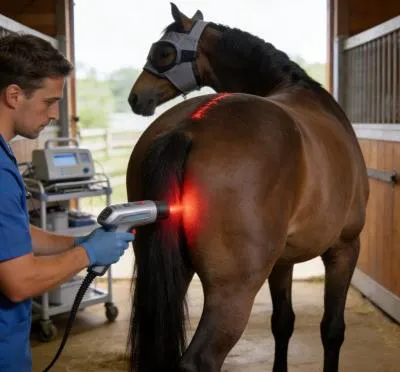
The 1470nm wavelength targets biological water with an absorption coefficient roughly forty times higher than near-infrared wavelengths below 1000nm. In dense, thickened ligament lesions, excess fluid trapped in the interstitial spaces restricts cellular migration. Photons at 1470nm interact directly with free and bound water molecules within the collagen framework, creating targeted vibrational resonance that loosens dense, stagnant exudate. This localized fluid mobilization eases interstitial pressure, improves membrane transport, and accelerates the synthesis of procollagen precursors necessary for matrix reorganization. When incorporated into a dedicated equine laser, this dual-frequency approach treats both the vascular deficit and the structural collagen collapse in a synchronized protocol.
+-----------------------------------------------------------------------------+
| Tissue Depth & Target | Primary Chromophore | Biological Mechanism          |
+=======================+=====================+===============================+
| Overlying Flexor Coat | Melanin / Keratin   | Controlled Scatter Bypass     |
+----------------------+---------------------+-------------------------------+
| Microcapillary Beds  | Hemoglobin (980nm)  | Nitric Oxide & Revascularize  |
+----------------------+---------------------+-------------------------------+
| Interstitial Fluid   | Water (1470nm)      | Fluid Drainage & Matrix Shift |
+----------------------+---------------------+-------------------------------+
| Deep Desmocytes      | Cytochrome c Ox.    | ATP Synthesis & Type I Matrix |
+----------------------+---------------------+-------------------------------+
Microsecond Pulse Width Gating and Thermal Dissipation
Applying high optical power to a confined anatomical space introduces the danger of cumulative thermal injury. The equine lower leg possesses minimal adipose tissue and restricted collateral circulation, meaning heat absorbed by fibrous layers cannot dissipate rapidly through blood flow. Continuous irradiation causes rapid temperature spikes in the periosteum and fascia, prompting horse resistance, localized skin burns, and paradoxically triggering heat-shock apoptosis in vulnerable desmocytes.
Precision duty cycle modulation neutralizes this thermal hazard. By pulsing the laser beam with microsecond pulse widths and duty cycles maintained between 20% and 40%, the emission delivers high peak power bursts followed by an off-period that respects tissue thermal relaxation time. Heat generated within the ligament fibers diffuses harmlessly into surrounding extracellular fluids before the next optical pulse arrives. Clinicians evaluating an equine laser therapy machine for sale must confirm that the equipment supports flexible Hertz modulation up to 20,000 Hz, allowing the beam to drive therapeutic energy deep into dense ligaments while keeping surface temperatures well below sensory pain limits.
Registo de Caso Clínico de Medicina Desportiva Equina
The following clinical rehabilitation protocol was performed at the High-Performance Equine Sports Clinic, tracking an elite competition horse through full recovery.
Case Identifier: EQ-CLINIC-2026-1193
Subject: 7-year-old Dutch Warmblood Mare, Three-Day Eventing (CCI3* level)
Clinical Diagnosis: Chronic Proximal Suspensory Desmitis of the Right Hindlimb, Grade 2B lesion with marked ligament enlargement (cross-sectional area 2.4 cm²) and avulsion-type enthesopathy at the third metatarsal bone
Baseline Metrics: Lameness Grade 3/5 on a straight trot, Grade 4/5 on a clockwise circle on hard ground; pronounced sensitivity upon deep thumb pressure over the proximal plantar metatarsus; diagnostic analgesia of the deep branch of the lateral plantar nerve resolved lameness by 85%
| Grupo de sessões | Dia após a lesão | Relação de comprimento de onda | Potência de pico (W) | Frequência (Hz) | Ciclo de trabalho | Fluência (J/cm²) | Energia acumulada |
| Fase 1: Sessões 1 a 4 | Dia 1 a Dia 8 | 980 nm 65 % / 1470 nm 35 % | 16 W | 800 Hz | 25% | 7,5 J/cm² | 3.000 Joules |
| Fase 2: Sessões 5 a 9 | Do 11.º ao 22.º dia | 980 nm 45 % / 1470 nm 55 % | 22 W | 1 500 Hz | 35% | 10,0 J/cm² | 4 400 joules |
| Fase 3: Sessões 10 a 15 | Do dia 26 ao dia 40 | 980 nm 30 % / 1470 nm 70 % | 26 W | 4 000 Hz | 45% | 13,5 J/cm² | 5 400 joules |
| Fase 4: Sessões 16 a 20 | Dia 45 a Dia 60 | 980 nm 50 % / 1470 nm 50 % | 20 W | 250 Hz | 30% | 8,0 J/cm² | 3 200 joules |
Ultrasonic monitoring at day 45 demonstrated substantial internal fiber consolidation, with the ligament cross-sectional area shrinking from 2.4 cm² back to a physiological 1.6 cm². The hypoechoic pocket at the bone-ligament junction filled with organized linear tissue. Plantar palpation elicited zero pain response by session 8. Under saddle walk-trot evaluations at day 75 showed total resolution of lameness on both firm and soft footing.
High-Fluence Coherence Outperforms Traditional Management
Conventional therapies for proximal suspensory desmitis carry major clinical and performance compromises. Platelet-rich plasma and stem cell injections require invasive needle insertions directly through inflamed fascia, creating secondary puncture trauma and carrying dangerous risks of deep joint sepsis. Radial shockwave therapy provides intense mechanical percussion, but the resultant acoustic bruising frequently leads to temporary neurovascular numbness, hiding structural weakness while the horse continues to stress damaged fibers. Systemic phenylbutazone relieves lameness scores superficially, yet it induces gastric ulceration and suppresses matrix metalloproteinases required for proper tissue remodeling.
Targeted Class IV photon therapy transforms this therapeutic paradigm into a non-invasive, regenerative standard. Monochromatic laser light penetrates deep into the proximal ligament bed without needle trauma or systemic toxicity. Rather than producing random scar tissue, photobiomodulation prompts desmocytes to generate highly organized, parallel-aligned Type I collagen with superior tensile strength and elasticity. Riders and trainers see significantly reduced rehabilitation times, structural integrity verified on ultrasound, and an enduring return to top-level competition without the chronic relapse patterns common to traditional stall rest.