 FotonMedix











Quantum Bioenergetics and Meniscal Chondroprotection: Advanced Photon Delivery in Degenerative Knee Pathologies
The clinical integration of a high-power laser knee therapy platform represents a move toward “Molecular Orthopedics.” By precisely engineering the energy flux to penetrate the dense fibrocartilage of the meniscus and the subchondral bone, practitioners can induce a state of chondroprotection. This process, facilitated by a laser therapy for knee pain, utilizes the 980nm and 1470nm wavelengths to optimize the “Photo-Thermal Gradient,” effectively downregulating pro-inflammatory metalloproteinases and upregulating type II collagen synthesis, offering a superior trajectory for patients where pharmacological management has reached a plateau.
The Physics of Intracapsular Fluence: Navigating the Synovial Environment
In professional laser light pain therapy, the primary technical hurdle is the “Optical Extinction” of photons within the synovial fluid and dense ligamentous structures. To achieve a therapeutic effect at the cruciate ligaments or the deep articular cartilage, the system must deliver a high incident irradiance ($W/cm^2$) to compensate for the scattering and absorption losses.
The energy deposition ($Q$) within the knee tissue volume is modeled using the Beer-Lambert law combined with the diffusion approximation for turbid media:
$$Q(z) = \mu_a \cdot \Phi_0 \cdot \exp(-\mu_{eff} \cdot z)$$
Where:
- $\mu_a$ is the absorption coefficient (specifically of water and hemoglobin in the knee).
- $\Phi_0$ is the incident photon flux.
- $\mu_{eff}$ is the effective attenuation coefficient.
By utilizing a 1470nm diode, which aligns with the absorption peak of water, the system can specifically target the interstitial fluid of a swollen joint (synovial effusion). This induces a “Hydro-Dynamic” effect, increasing the permeability of the lymphatic vessels and accelerating the reabsorption of inflammatory exudate. Simultaneously, the 980nm component penetrates deeper into the vascularized subchondral bone to stimulate angiogenesis, providing the nutritional support necessary for long-term cartilage stability.
Comparative ROI: High-Intensity Diode Laser vs. Conventional Viscosupplementation
For B2B stakeholders and clinic directors, the transition to high intensity laser therapy (HILT) is justified by the “Longevity of Analgesia” and the reduction in consumable-heavy procedures like Hyaluronic Acid (HA) injections.
| Performance Metric | Viscosupplementation (HA) | Platelet-Rich Plasma (PRP) | Fotonmedix Class 4 Diode |
| Mechanism | Mechanical Lubrication | Growth Factor Delivery | Photobiomodulation (PBM) |
| Invasiveness | Minimally Invasive (Needle) | Invasive (Blood Draw/Needle) | Non-Invasive |
| Onset of Action | 2-4 Weeks | 4-6 Weeks | Immediate (Thermal Analgesia) |
| Risk Profile | Septic Arthritis / Flare-ups | Infection / Injection Pain | Zero Infection Risk |
| Treatment Frequency | Every 6-12 Months | 3-5 Sessions | 6-10 Sessions (Fast ROI) |
| Patient Comfort | Moderate | Low (Post-injection pain) | Very High (Soothing heat) |
The capability for laser knee therapy to be applied in a “Contact-Scanning” mode allows for the treatment of the entire kinetic chain—including the quadriceps tendon and the popliteal space—in a single 10-minute session, maximizing the procedural revenue for the orthopedic practice.
Clinical Case Study: Management of Recalcitrant Patellar Tendinopathy and Hoffa’s Fat Pad Impingement
Patient Profile: 29-year-old female, professional volleyball player, presenting with “Jumper’s Knee” (Grade II patellar tendinosis) and severe Hoffa’s fat pad syndrome. The patient had undergone three rounds of ESWT (Shockwave therapy) with minimal improvement and was unable to perform vertical jumps.
Diagnosis: Chronic infrapatellar tendinopathy with localized neovascularization and fat pad inflammation.
Treatment Protocol: A dual-action approach was implemented. Stage one used a focused 1470nm delivery to “cauterize” the painful neovascularization, followed by a wide-area 980nm PBM protocol to stimulate tenocyte proliferation.
- Surgical Precision Mode: 1470nm, 8W (Pulsed), focused fiber for the fat pad margins.
- Biostimulation Mode: 980nm, 20W (CW), large-area scanning handpiece for the patellar tendon.
Treatment Parameters Table:
| Phase | Target Area | Wavelength | Power (W) | Frequency | Dose (J/cm2) |
| Ablative PBM | Hoffa’s Fat Pad | 1470nm | 8W | 20Hz | 12 |
| Deep Healing | Patellar Tendon | 980nm | 20W | CW | 15 |
| Neural Block | Femoral Nerve | 980nm | 15W | 500Hz | 8 |
Clinical Outcome:
Intra-operative thermal imaging confirmed a localized temperature rise within the therapeutic window ($40-42^\circ C$). By the third session of laser therapy for knee pain, the patient reported a 60% reduction in “loading pain.” At the 8-week mark, ultrasound evaluation showed a resolution of the neovascularization and a 25% increase in tendon thickness (collagen density). The patient returned to competitive play within 12 weeks, with zero recurrence at the 6-month follow-up.
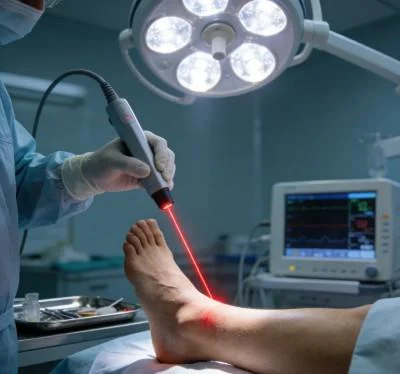
Hardware Integrity and Risk Mitigation in Global Medical Distribution
For international medical agents, the value of laser light pain therapy equipment is defined by its “Calibration Stability.” High-power diodes must maintain their spectral purity to ensure consistent clinical outcomes across different patient demographics (BMI, skin tone, etc.).
- Divergence Angle Control: The handpiece optics must ensure a “Flat-Top” beam profile. If the energy is concentrated in a “Gaussian” peak, the center of the spot may exceed the ablation threshold while the periphery remains sub-therapeutic, risking epidermal burns.
- Back-Reflection Protection (BRP): In high-power orthopedic applications, the laser often encounters reflective surfaces (e.g., surgical equipment or metallic implants). The system must include an optical isolator to shunt reflected energy away from the diode stack, ensuring a $>15,000$ hour operational lifespan.
- Real-Time Impedance Monitoring: The system monitors the “Fiber-Tissue Coupling.” If the fiber tip becomes contaminated with tissue debris, the system should automatically throttle power to prevent “Carbonization” and ensure the sterility of the surgical field.
- Regulatory Documentation: Every Fotonmedix unit is shipped with an IEC 60601-1 test report, ensuring electromagnetic compatibility and electrical safety for integration into high-tech hospital environments.
B2B Strategic Integration: The Future of PBM-Surgical Hybrids
Regional distributors should market the laser knee therapy platform as a “Consumable-Independent Asset.” Unlike PRP or HA, where every treatment incurs a high variable cost, the diode laser offers a fixed-cost solution with high margins. By positioning the device in both the “Pain Management” and “Surgical Decompression” departments, hospitals can amortize the initial CAPEX (Capital Expenditure) significantly faster, often achieving full ROI within 200 clinical sessions.
FAQ: Clinical and Operational Excellence
Q: How does the 980nm wavelength specifically assist in collagen remodeling?
A: 980nm energy is absorbed by the oxygenated hemoglobin and water in the tendon matrix. This increases the local temperature just enough to stimulate the “Heat Shock Proteins,” which act as chaperones for the synthesis of new, organized collagen fibers, replacing the disorganized scar tissue common in chronic tendinosis.
Q: Is “laser therapy for knee pain” contraindicated for patients with pacemakers?
A: No. Because the energy is photonic and non-ionizing, it does not interfere with the electromagnetic frequency of a pacemaker, provided the laser is not aimed directly at the device or its leads. This makes it a safer alternative to TENS or certain E-stim modalities for geriatric patients.
Q: What is the primary maintenance requirement for the therapeutic handpieces?
A: Aside from disinfecting the contact surface, the primary maintenance is the inspection of the protective lens. Any dust or “pitting” on the lens can scatter the laser light, reducing the effective fluence and increasing the risk of surface heating.