 FotonMedix











Rapid Equine Suspensory Recovery Without Stall Rest Burnout
38W super-pulsed multi-wavelength output penetrates dense metacarpal fascia, battery-powered portability enables trackside treatment, and duty-cycle gating prevents coat scorching on performance horses.
Walk down the shedrow of any competitive show jumping barn at five in the morning, and you will find the most expensive heartbreak in equine sports medicine. A twelve-year-old Dutch Warmblood gelding steps out of its stall with subtle heat and thickening along the proximal palmar metacarpus, diagnosed via ultrasound with a core lesion in the proximal suspensory ligament. Traditional veterinary protocols prescribe six to nine months of strict stall rest, controlled hand-walking, and repeated shockwave sessions—a grueling timeline that ruins an entire competition season, triggers severe behavioral stall vices, and often leaves behind brittle, disorganized scar tissue prone to catastrophic re-injury the moment full galloping resumes. Meanwhile, conventional low-power therapy units bounce harmlessly off dense equine skin, coarse winter coats, and thick palmar flexor tendons, while continuous high-wattage single-wavelength beams risk blistering dark cannon bone skin within seconds.
When equine veterinarians and sports rehabilitation specialists deploy a high-intensity Class 4 laser therapy machine, that prolonged rehabilitation stalemate changes completely. Rather than waiting months for avascular ligament fibers to remodel sluggishly under systemic phenylbutazone, high-power multi-wavelength photobiomodulation drives concentrated photonic energy directly through thick superficial and deep digital flexor tendons straight into the proximal suspensory origin. Selecting the best laser therapy device for trackside equine care requires combining high peak wattage with cordless lithium-battery portability—capabilities engineered directly into the Theralux-Max 38W platform to saturate deep palmar structures in eight minutes without sedating the horse or scorching pigmented skin.
Navigating Dense Equine Fascia and Melanin Attenuation Curves
Treating a 560-kilogram performance horse presents an optical challenge far more demanding than human physical therapy. Equine skin is roughly three times thicker than human epidermis, covered by dense guard hairs and heavily pigmented dermal layers that aggressively scatter and absorb incoming light. According to optical transport models in large-animal tissues, up to seventy percent of incident photons from standard low-wattage units are lost within the first five millimeters of skin and superficial fascia, long before reaching the deep suspensory ligament tucked tightly against the palmar cortex of the third metacarpal bone.
Overcoming this steep attenuation curve requires synchronized multi-wavelength deep tissue laser therapy treatment capable of bypassing superficial melanin traps while stimulating cellular repair across multiple anatomical layers simultaneously. Combining five distinct wavelengths (650nm, 810nm, 915nm, 940nm, and 980nm) at peak outputs up to 38 watts ensures that an active therapeutic photon density reaches up to fifteen centimeters deep:
- 650nm (Dermal Micro-Circulation & Coronet Repair): Absorbed within superficial epidermal layers to accelerate surface capillary perfusion and resolve minor pastern or fetlock abrasions without wasting energy on deep transmission.
- 810nm (Cytochrome C Oxidase & Tenocyte ATP Synthesis): Hits the exact absorption peak of mitochondrial cytochrome c oxidase inside damaged ligamentous fibroblasts and tenocytes. By dissociating inhibitory nitric oxide from the respiratory chain, 810nm energy surges adenosine triphosphate (ATP) production, driving organized Type I collagen synthesis rather than disorganized Type III fibrotic scar tissue.
- 915nm and 940nm (Melanin Bypass & Hemoglobin Oxygen Offloading): Positioned beyond the sharpest epidermal melanin absorption slope, these wavelengths traverse dense tendon sheaths cleanly while stimulating oxygen release from oxyhemoglobin into notoriously hypoxic ligament core lesions.
- 980nm (Interstitial Water Absorption & Periligamentous Edema Drainage): Exhibits high affinity for interstitial water molecules, creating controlled micro-thermal gradients that lower inflammatory fluid viscosity, accelerate lymphatic drainage around the check ligament, and desensitize nociceptive nerve fibers.
Clinical studies published in the Equine Veterinary Journal and Veterinary Clinics of North America: Equine Practice confirm that high-fluence near-infrared photobiomodulation significantly increases vascular endothelial growth factor (VEGF) expression and parallel collagen fiber alignment in equine tendon and ligament injuries, directly reducing lesion cross-sectional area on follow-up ultrasonography.
Thermal Relaxation and Super-Pulsed Gating on Pigmented Coats
Delivering thirty-eight watts of optical power over the distal equine limb—an area with minimal subcutaneous fat and tight skin stretched directly over bone and tendon—demands precision thermal engineering. Holding a continuous 38W beam stationary over a dark bay or black cannon bone would rapidly elevate skin temperature past the thermal pain threshold, causing the horse to stomp or pull away. Experienced equine practitioners eliminate this hazard not by sacrificing power—which would collapse deep ligament penetration—but by regulating pulse frequency, duty cycle, and scanning velocity.
During a structured deep tissue laser therapy treatment, alternating between super-pulsed, pulsed, and continuous wave modes allows 38W peak bursts to penetrate beneath the deep digital flexor tendon while giving pigmented skin millisecond thermal relaxation intervals.
| Emission Mode | Peak Power Output | Duty Cycle & Thermal Dynamics | Primary Physiological Action | Ideal Equine Anatomical Target |
| Super-Pulsed Mode | Up to 38W peak | Low average thermal load (25%–35% duty) | Maximum penetration depth without epidermal heat accumulation | Proximal suspensory ligament, deep digital flexor tendon core lesions, sacroiliac joint |
| Pulsed Mode | 20W – 32W | Balanced on/off gating (50% duty) | Rapid periligamentous edema clearance and prostaglandin suppression | Sub-acute bowed tendons, fetlock synovitis, splint bone periostitis |
| Continuous Wave (CW) | 15W – 30W | Steady emission (100% duty with brisk scanning) | Deep myofascial relaxation and pre-competition muscular warm-up | Longissimus dorsi back spasms, gluteal tightness, hamstring preconditioning |
Pairing Super-Pulse gating with therapeutic temperature indication sensors and a non-contact optical lens lets veterinarians treat sensitive distal limbs without clipping hair coats or administering standing sedation—preserving the horse’s natural calm and keeping daily barn workflows moving smoothly.
Clinical Case Study: Proximal Suspensory Desmitis in a Show Jumper
To evaluate how 38-watt multi-wavelength dosimetry accelerates structural ligament healing and shortens return-to-sport timelines, examine the documented clinical record of a competitive show jumper treated at a private equine sports medicine practice using the Theralux-Max 38W portable protocol.
Patient Presentation and Diagnostic Ultrasonography
- Case Reference ID: EQ-SPORTS-2026-0614-PSD
- Patient Demographics: 12-year-old bay Dutch Warmblood (KWPN) gelding, weighing 565 kg, competing at 1.40m Grand Prix show jumping level
- Diagnosis: Acute-on-chronic proximal suspensory desmitis (PSD) of the left forelimb confirmed via high-frequency musculoskeletal ultrasound, revealing a central hypoechoic core lesion measuring 18% of total ligament cross-sectional area (CSA) with periligamentous edema
- Pathological Grading: AAEP Lameness Scale Grade 3/5 (consistently lame at a trot on soft footing, exacerbated on left circle); Ultrasonographic Echogenicity Score 3/4 (predominantly anechoic fiber disruption); marked pain response to direct digital palpation of the proximal palmar metacarpus
- Prior Interventions: Seven days of cold-water hosing, compression bandaging, and oral phenylbutazone (2g twice daily); trainer sought an aggressive, drug-free regenerative protocol to avoid a nine-month competitive layoff
Staged Dosimetry and Ultrasonographic Progression Table
Because treating a dark bay forelimb requires balancing high deep-tissue fluence with strict epidermal thermal safety, the equine veterinarian divided the twelve-session protocol over five weeks into acute anti-inflammatory, proliferative collagen-alignment, and biomechanical remodeling phases.
| Session Number | Treatment Phase | Wavelength Ratio Configuration | Peak Power (W) | Pulse Frequency (Hz) | Duty Cycle / Mode | Total Energy Delivered (Joules) | Session Duration | Clinical & Ultrasonographic Milestones |
| Session 1 | Acute Edema & Pain Control | 810nm (30%) + 915nm (25%) + 940nm (20%) + 980nm (25%) | 24W | 6000 Hz | Super-Pulse (25% Duty) | 4,800 J | 8.0 min | Horse stood calmly un-sedated in cross-ties; palpable reduction in superficial metacarpal heat within 12 hours post-session. |
| Session 2 | Acute Edema & Pain Control | 810nm (30%) + 915nm (25%) + 940nm (20%) + 980nm (25%) | 26W | 5000 Hz | Super-Pulse (30% Duty) | 5,200 J | 8.0 min | Discontinued oral phenylbutazone; periligamentous fluid pocket visibly reduced on preliminary scan. |
| Session 4 | Tenocyte ATP & Neovascularization | 650nm (5%) + 810nm (35%) + 915nm (25%) + 940nm (15%) + 980nm (20%) | 30W | 2000 Hz | Pulsed (45% Duty) | 6,600 J | 8.5 min | AAEP Lameness improved from Grade 3/5 to Grade 1/5 at a straight trot; minimal sensitivity to proximal palmar palpation. |
| Session 6 | Parallel Collagen Fiber Alignment | 650nm (5%) + 810nm (40%) + 915nm (25%) + 940nm (15%) + 980nm (15%) | 34W | 1000 Hz | Pulsed (55% Duty) | 7,800 J | 8.5 min | Follow-up ultrasound showed 60% filling of central hypoechoic core lesion with organized longitudinal striations; began 15-minute tack walking. |
| Session 9 | Structural Tensile Remodeling | 650nm (10%) + 810nm (40%) + 915nm (20%) + 940nm (15%) + 980nm (15%) | 38W | CW / 300 Hz Hybrid | 75% Duty Cycle | 8,800 J | 8.0 min | AAEP Lameness Grade 0/5 on firm and soft circles; cleared for controlled trotting sets in arena. |
| Session 12 | Biomechanical Consolidation | 650nm (10%) + 810nm (40%) + 915nm (20%) + 940nm (15%) + 980nm (15%) | 38W | CW (Continuous Scanning) | 100% Scanning CW | 9,500 J | 8.0 min | Repeat ultrasound confirmed 92% echogenic fiber continuity and normalized CSA; returned to full gymnastic jumping at Week 10 with zero relapse. |
Dual-Portal Distal Limb Scanning Technique
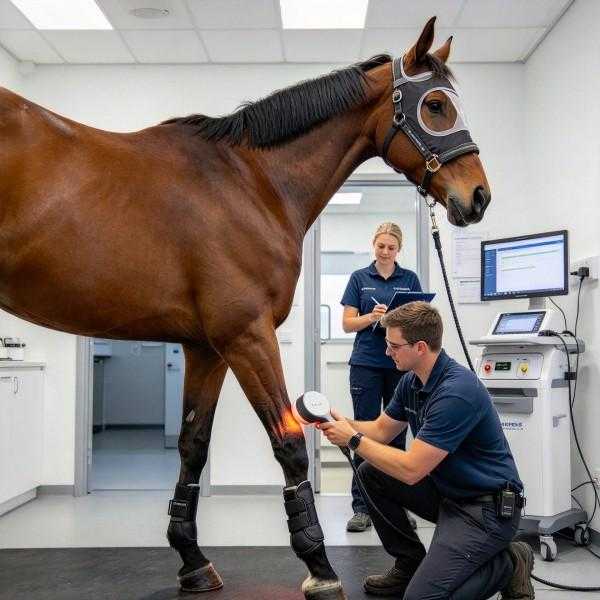
To saturate the deep proximal suspensory origin without shadowing from the dense superficial and deep digital flexor tendons, the veterinarian treated the limb while slightly flexed at the carpus to relax the palmar flexor tendons. Sixty-five percent of the total joules were delivered through medial and lateral palmar portals angled obliquely toward the third metacarpal cortex using a brisk 3-centimeter-per-second scanning motion. The remaining thirty-five percent was swept along the ipsilateral forearm extensors and dorsal metacarpal region to relieve secondary compensatory muscular tension.
Scaling Wavelength Precision Across Veterinary and Human Medicine
The exact optical engineering that enables a portable 38-watt equine laser to repair a deep suspensory core lesion anchors high-performance outcomes across companion animal and human clinical settings. In small-animal orthopedic and dental surgery, veterinary hospitals deploy the VetMedix-Max 38W system to resolve canine cranial cruciate ligament tears and hip dysplasia without shaving thick coats, while utilizing surgical fiber kits for feline chronic gingivostomatitis vaporization and glaucoma cyclophotocoagulation.
In human outpatient rehabilitation, the LaserMedix-Max 30W applies identical five-wavelength synchronization and peak penetration depth maintaining technology to saturate deep lumbar nerve roots and hip joint capsules in under ten minutes. Meanwhile, in minimally invasive human surgical suites, dual-wavelength platforms combining 1470nm and 980nm—such as the SurgMedix-Max—exploit the massive absorption peak of 1470nm in intracellular water to perform bloodless endovenous saphenous ablation and sphincter-sparing anal fistula closure with sub-millimeter thermal precision. Across every clinical specialty, matching multi-wavelength photonics to target tissue biology replaces invasive trauma with rapid cellular regeneration.
Comparing Class 4 Equine Photobiomodulation Against Traditional Therapies
For equine veterinary practices, racing syndicates, and rehabilitation centers evaluating capital equipment investments, comparing a 38-watt portable laser therapy machine against traditional tendon and ligament modalities demonstrates unmistakable clinical and operational superiority.
| Equine Clinical Metric | High-Intensity Class 4 Equine Laser (38W Portable) | Conventional Class 3B Cold Laser (less than 0.5W) | Extracorporeal Shockwave Therapy (ESWT) | Platelet-Rich Plasma (PRP) / Stem Cell Injections |
| Coat & Tendon Penetration Depth | Reaches 15cm through unclipped coats and flexor tendons via 38W bursts | Blocked within 5mm by pigmented equine hair and thick skin | High acoustic penetration, but causes sharp periosteal pain | Direct needle placement into core lesion under ultrasound guidance |
| Sedation & FEI/Competition Compliance | Zero sedation required; zero prohibited drug withdrawal period | Zero sedation, but clinically ineffective for deep suspensory lesions | Often requires standing sedation; strict pre-competition withdrawal rules | Requires heavy sedation, surgical scrub, and 48-hour stall confinement |
| Tissue Repair Quality | Stimulates organized Type I collagen cross-linking and angiogenesis | Minimal deep tenocyte ATP stimulation; superficial warmth only | Induces controlled micro-trauma and transient analgesia | Delivers growth factors, but carries risk of needle-tract fiber disruption |
| Treatment Time & Barn Mobility | 6 to 9 minutes per limb; built-in lithium battery works trackside | Over 180 minutes to deliver 5,000 Joules (impractical for horses) | 15 to 20 minutes; noisy compressor startles nervous horses | 45 to 60 minutes including blood draw, centrifuge prep, and injection |
| Practice Return on Investment | High-frequency 10-to-12 session packages with rapid barn turnover | Low client retention due to slow or imperceptible lameness improvement | High consumable handpiece replacement costs every few thousand pulses | High per-procedure kit cost; limited to single or staged injections |
Extracorporeal shockwave therapy relies on loud, painful acoustic pressure waves that routinely require standing sedation and carry strict regulatory withdrawal windows before sanctioned competitions. Low-level Class 3B devices lack the photon density to cross dense equine skin and flexor sheaths, wasting valuable weeks while chronic scar tissue forms. Meanwhile, intralesional biologic injections carry procedural infection risks and still leave the horse confined to a stall for months without active cellular bio-stimulation.
Investing in the best laser therapy device engineered with 38W peak output, five synchronized wavelengths, and cordless lithium-battery mobility empowers equine veterinarians to treat performance horses directly at the barn. Horses return to training with stronger, more elastic ligament fibers in half the traditional timeframe, while equine practices build a high-margin, non-invasive sports medicine service line.