 FotonMedix











news
Company News丨Industry News丨Products News
Search the whole station
Company News丨Industry News丨Products News
The promise of “instant mobility” for a 12-year-old dog with chronic osteoarthritis often sounds like marketing hyperbole. However, as veterinary medicine shifts toward biological regeneration, we must ask: Is photobiomodulation (PBM) actually healing tissue, or is it merely a temporary analgesic? By examining the mitochondrial response to specific laser wavelengths, we can move beyond “cold laser” myths and understand why high-power Class IV systems have become the gold standard for canine pain management in 2025.
To understand the efficacy of a canine laser therapy machine, one must first look at the Cytochrome C Oxidase (CCO) enzyme.
When a dog suffers from chronic inflammation, nitric oxide (NO) binds to CCO, effectively “suffocating” the mitochondria and halting ATP production. This leads to cellular fatigue and chronic pain. Laser therapy for dogs works by using near-infrared photons to displace nitric oxide from the CCO.
The Result: * ATP Surge: Cellular energy increases, allowing for rapid ion pump function and tissue repair.
A common question in the industry is: If a 500mW laser and a 15W laser use the same wavelength, aren’t they equally effective? Following the principle of “Ask if it is so”: It is NOT so. The “Depth of Penetration” is governed by the Power Density (Irradiance). To reach a hip joint in a large breed dog (like a German Shepherd), the photons must pass through skin, dense fur, and several centimeters of muscle. A low-power canine laser therapy machine will have its energy absorbed by the melanin and hemoglobin in the superficial layers, never reaching the target joint capsule.
A high-power Class IV system (like those engineered by FotonMedix) provides the “photonic pressure” required to deliver a therapeutic dose (typically 8–10 Joules/cm²) to deep tissues within a 5-to-10-minute treatment window.
Patient Profile: * Name: “Buster”
Clinical Assessment: Physical examination revealed significant muscle atrophy of the left gluteal and quadriceps groups. Radiographs confirmed severe Osteoarthritis (OA) of the coxofemoral joint with significant osteophyte formation and narrowed joint space. Buster was previously managed on 75mg Carprofen BID, but liver enzyme elevations (ALT/ALP) necessitated a reduction in pharmaceutical load.
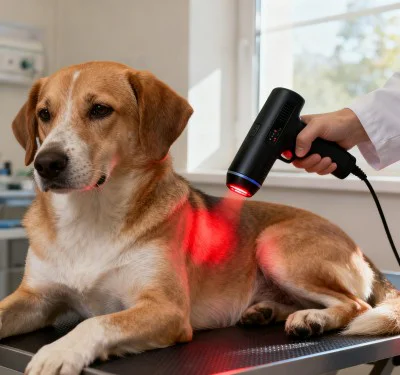
Treatment Protocol (FotonMedix 15W Class IV System):
Clinical Progress:
Clinician’s Note: The success in this case was not just the laser itself, but the delivery of sufficient energy to a deep-seated joint in a large, thick-coated breed.
When operating a canine laser therapy machine, safety protocols are dictated by the “Maximum Permissible Exposure” (MPE).
Beyond the clinical benefits, laser therapy for dogs is a cornerstone of “Passive Revenue” for modern clinics.
As we move into 2026, the discussion around canine laser therapy machines is moving away from “Does it work?” to “How do we optimize the dose?