 FotonMedix



Reversing Chronic Canine Bicipital Tenosynovitis
Targeted Class IV photon delivery penetrates dense bicipital tendon sheaths, clears hypovascular synovial adhesions, and prevents epidermal thermal injury through calibrated microsecond duty cycle pulsing.
An 8-year-old Labrador Retriever limps into the consulting room with chronic weight-bearing lameness of the right thoracic limb that has worsened over four months. When you extend the shoulder while applying direct digital pressure over the bicipital groove on the craniomedial humeral head, the dog winces, pulls the limb away, and attempts to snap. Diagnostic musculoskeletal ultrasound confirms severe chronic bicipital tenosynovitis with marked synovial effusion, extensive circumferential sheath thickening, and calcifying enthesophytes at the supraglenoid tubercle insertion. Oral carprofen, gabapentin, and intra-articular corticosteroid injections offered transient comfort before the pain rebounded, leaving the owner frustrated by the pet’s persistent limp and inability to tolerate casual walks.
Chronic bicipital tenosynovitis presents a difficult therapeutic challenge in veterinary rehabilitation. The bicipital tendon is dense, hypovascular, and encased within a rigid fibro-osseous groove beneath heavy brachiocephalicus and pectoral musculature. Low-energy handheld units and low-output veterinary cold laser equipment cannot deliver sufficient energy through this anatomical bottleneck: the incident photons scatter extensively within the thick muscular coat, failing to reach the ischemic tendon core. Resolving chronic recalcitrant tendon sheath inflammation requires upgrading clinical protocols to a high-density class 4 veterinary therapeutic laser that can drive sufficient therapeutic fluence into the intertubercular groove.
Deep Tissue Photonic Attenuation in Thoracic Limb Pathology
Photons directed at the canine shoulder encounter strong physical attenuation. The overlying muscular mantle, containing high concentrations of light-absorbing myoglobin, combined with dense subcutaneous collagen fibers, creates an optical barrier. Under standard tissue attenuation dynamics, low-power continuous light experiences over eighty-five percent loss of energy within the first fifteen millimeters of tissue depth, leaving the deeper tendon sheath untreated.
Reaching therapeutic thresholds within deep synovial sheaths requires precise wavelength targeting across distinct biological absorption bands:
- 980 nm Microvascular Stimulation: Chronic tenosynovitis causes localized microcirculatory constriction and poor venous drainage, trapping inflammatory metabolites within the tendon sheath. Light at 980 nm matches the absorption peaks of oxyhemoglobin and deoxyhemoglobin, creating controlled, localized photothermal expansion within microcapillaries. This process re-establishes capillary blood flow, accelerates lymphatic drainage of joint effusion, and relieves internal synovial pressure.
- 1064 nm Deep Fibrocartilage Penetration: Due to minimal scattering and low water absorption, 1064 nm light penetrates through thick muscular layers and dense fibrous sheaths. It delivers direct photon energy into hypovascular tenocytes and synovial lining cells, stimulating mitochondrial cytochrome c oxidase activity and restoring baseline adenosine triphosphate production.
- 1470 nm Synovial Fluid Hydrodynamics: Chronic tenosynovitis produces excessive, stagnant synovial effusion that distends the sheath and compresses nociceptive nerve terminals. Light at 1470 nm exhibits strong affinity for water molecules, mobilizing stagnant interstitial fluid pockets and rapidly reducing intra-sheath pressure without invasive needle arthrocentesis.
Delivering this targeted multi-wavelength output quickly explains why leading practices invest in the best veterinary laser therapy equipment for rehabilitation. Instead of spending half an hour holding a low-output probe with questionable penetration, clinicians can flood the entire bicipital groove and supraspinatus insertion with high-density photonic energy in an eight-minute workflow.
Duty Cycle Modulation to Prevent Periosteal and Dermal Hotspots
Delivering high-power Class IV photon energy over the craniomedial shoulder carries thermal management challenges. The bicipital tendon lies close to the humeral cortex within the bicipital groove. Exposing this bony landscape to uncalibrated continuous wave emission risks elevating periosteal temperatures, which triggers acute patient discomfort and sudden withdrawal reflexes.
Active duty cycle pulsing eliminates this thermal buildup by interleaving high-intensity bursts with thermal relaxation intervals:
Continuous Wave: [================ Cumulative Thermal Buildup ================] -> Periosteal Hotspot Risk
Pulsed 50% Duty: [== Pulse ON ==] [ Thermal Relaxation ] [== Pulse ON ==]      -> Deep Tendon Sheath Saturation
During the active pulse, high peak power drives photons deep into the tendon sheath and surrounding myofascial layers. During the dark phase, capillary blood flow in the overlying dermis dissipates surface heat. Because the deep fibro-osseous canal cools more slowly than vascularized skin, therapeutic photon density accumulates within the tendon sheath while epidermal temperatures remain safe and comfortable.
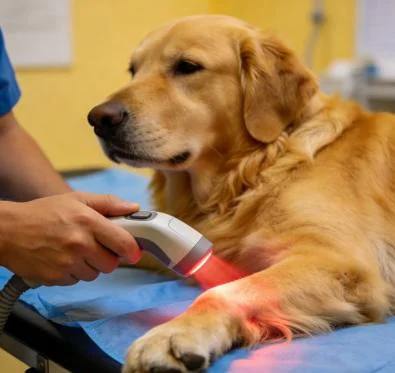
This thermal safety profile is why these platforms remain the most used veterinary laser therapy devices in advanced orthopedic and rehabilitation hospitals. Clinicians can adjust pulse profiles to deliver comfortable treatments that relax surrounding muscle tissue while treating the underlying pathology.
Objective Clinical Case and Locomotor Recovery Metrics
According to clinical photomedicine frameworks published by Alves and confirmed in canine orthopedic rehabilitation studies from the American College of Veterinary Sports Medicine and Rehabilitation, near-infrared photobiomodulation reduces inflammatory cytokine expression (such as prostaglandin E2 and interleukin-1 beta) while accelerating tenocyte proliferation and physiological collagen cross-linking.
The following case record details this multi-wavelength protocol in a working canine with severe, refractory bicipital tenosynovitis.
Case Record: Chronic Canine Bicipital Tenosynovitis
- Case Identifier: ORTHO-2026-CANINE-1298
- Patient Profile: 8-year-old male neutered Labrador Retriever, active field retriever
- Body Mass: 34.6 kg
- Diagnosis: Chronic refractory right bicipital tenosynovitis; Grade 3 lameness with prominent head bob at trot; marked synovial effusion and hyperechoic fibrillar disruption on musculoskeletal ultrasound; positive biceps retraction test; moderate disuse atrophy of the right supraspinatus and infraspinatus muscles
- Prior Conservative Therapy: Carprofen at 4.4 mg/kg orally once daily for six weeks, joint supplements, and a single intra-articular methylprednisolone injection; transient improvement for two weeks followed by relapse of Grade 3 lameness and severe shoulder extension pain
Comprehensive Treatment Protocol Parameters
| Session Number | Clinical Healing Stage | Output Power (W) | Operating Mode & Duty Cycle | Targeted Spectral Distribution | Frequency (Hz) | Total Energy (Joules) | Fluence (J/cm²) |
| 01 | Acute Nociceptive Dampening | 10.0 W | Pulsed (40% Duty Cycle) | High 980 nm / Capillary Focus | 3,000 Hz | 3,200 J | 8.0 J/cm² |
| 02 | Synovial Effusion Clearance | 12.0 W | Pulsed (45% Duty Cycle) | High 1470 nm / Interstitial Water Focus | 1,800 Hz | 4,200 J | 10.5 J/cm² |
| 03 | Peri-Tendon Decongestion | 15.0 W | Pulsed (50% Duty Cycle) | Balanced 980 nm / 1064 nm Mix | 1,000 Hz | 5,400 J | 13.5 J/cm² |
| 04 | Tenocyte Energy Saturation | 18.0 W | Superpulsed (50% Duty Cycle) | Penetration Dominant (1064 nm) | 500 Hz | 6,500 J | 16.2 J/cm² |
| 05 | Fibrocartilage Matrix Remodeling | 20.0 W | Pulsed (50% Duty Cycle) | Quad-wavelength balanced array | 250 Hz | 7,200 J | 18.0 J/cm² |
| 06 | Longitudinal Fibril Realignment | 22.0 W | Pulsed (50% Duty Cycle) | Deep Collagen Matrix Focus | 100 Hz | 7,800 J | 19.5 J/cm² |
| 07 | Functional Joint Consolidation | 20.0 W | Continuous Dynamic Sweep | Multi-spectral Regenerative Mix | CW / Dynamic | 6,000 J | 15.0 J/cm² |
| 08 | Biomechanical Stabilization | 16.0 W | Pulsed (50% Duty Cycle) | Mixed Maintenance Profile | 30 Hz | 4,800 J | 12.0 J/cm² |
Longitudinal Kinetic and Structural Ultrasound Evolution
Lameness Grade at Trot (0 to 5 Scale):
Pre-Treatment: [==============================] Grade 3
Session 03:    [====================] Grade 2
Session 05:    [==========] Grade 1
Session 08:    [] Grade 0 (Sound gait)

Biceps Tendon Sheath Effusion Diameter (mm on transverse ultrasound):
Pre-Treatment: [==============================] 6.8 mm
Session 03:    [==================] 4.1 mm
Session 05:    [=========] 2.0 mm
Session 08:    [==] 0.6 mm (Normal physiological fluid cuff)
By the third session, the patient allowed firm palpation over the bicipital groove without vocalization or limb withdrawal. Transverse ultrasound imaging at session five confirmed that fluid distension within the tendon sheath had decreased from 6.8 mm to 2.0 mm, with clearer linear tendon fiber alignment. At the conclusion of eight treatments, the dog demonstrated sound bilateral forelimb mechanics, shoulder extension was fully restored, and carprofen was discontinued without symptom recurrence.
Transforming Clinic Economics and Treatment Durability
Managing chronic soft tissue lameness often leaves veterinary practices trapped between repeated drug prescriptions and complex surgical interventions. Arthroscopic bicipital tenotomy or tenodesis involves high capital expenditure, general anesthesia risks, and prolonged post-operative confinement that can trigger muscle atrophy in older dogs. Conversely, relying solely on non-steroidal anti-inflammatory drugs risks hepatic or renal toxicity while leaving the underlying hypovascular tendon degeneration untreated.
Deploying a high-power Class IV therapeutic system establishes concrete clinical advantages:
1. Direct Resolution of Structural Pathology
Rather than temporarily suppressing pain signals, targeted multi-wavelength phototherapy addresses the underlying pathology: resolving hypovascular stasis, clearing trapped effusion, and stimulating collagen realignment within the tendon sheath.
2. Streamlined Clinical Staff Workflows
Low-power therapy units tie up skilled personnel for twenty to thirty minutes per patient to deliver minimal therapeutic doses. High-power systems deliver robust, therapeutic energy profiles in six to eight minutes of continuous, comfortable sweeping application, allowing one veterinary rehabilitation technician to manage multiple recovery programs per shift.
3. Tangible Clinical Value for Clients
Owners of working and athletic dogs pay close attention to gait quality, stride length, and recovery times. Observing noticeable improvements in shoulder mobility and pain reduction within three treatment sessions builds client trust, reinforcing long-term compliance with therapeutic exercise and weight-management recommendations.
Class IV photomedicine offers a practical, high-throughput solution for stubborn orthopedic and soft tissue conditions. By projecting targeted multi-wavelength light past heavy musculature directly into ischemic tendon sheaths, veterinary teams can resolve chronic lameness, minimize reliance on pharmaceuticals, and return patients to sound, active lives.