 FotonMedix












Препятствия для проникновения фотонов при фиброзе коленного сустава у собак
Synchronized water resonance and hemoglobin targeting channels mobilize chronic intracapsular edema while microsecond duty cycle modulation eliminates patellar thermal accumulation.
An eight-year-old Saint Bernard is led into the rehabilitation ward with severe unilateral right pelvic limb weight-bearing lameness, stepping solely on its cranial claws while keeping the right stifle locked in continuous 110-degree flexion. Palpation over the medial and lateral joint margins triggers violent quadriceps spasms, loud groaning, and immediate limb retraction. Chronic bilateral stifle osteoarthrosis, aggravated by historical cranial cruciate ligament rupture and extensive periarticular fibrous scarring, has produced massive medial buttress enlargement, synovial proliferation, and severe joint effusion. The attending clinician halted all oral NSAIDs and corticosteroids following repeated bouts of hemorrhagic gastritis and progressive elevations in serum creatinine. The hospital faces an immobile, 71-kilogram patient whose owners cannot consider total knee arthroplasty due to financial limitations and anesthesia risks. When non-invasive photobiomodulation is proposed, clinical concerns center on whether deploying laser therapy for dogs with arthritis can deliver therapeutic fluence through dense water-resistant fur, heavily pigmented skin, thick collateral ligaments, and sclerotic subchondral margins without burning the patient.
Overcoming chronic stifle capsule fibrosis requires calculating the optical attenuation curve across dense fibrous and osseous tissue boundaries. When high-intensity photons pass into the canine knee, light encounters surface keratin, melanin, dense patellar tendon fibers, fibrous joint capsules, and hypertrophied synovial folds. In giant-breed dogs, intra-articular nociceptors and degraded cartilage sit four to six centimeters beneath the cutaneous barrier. Low-level modalities lose coherent energy within the first four millimeters of soft tissue, converting light into shallow warmth instead of achieving deep biological stimulation. Clinical directors evaluating the best laser therapy device for dogs recognize that clinical outcomes depend on matching tissue-specific chromophore affinities to depth challenges, moving past the low penetration depth associated with the best cold laser therapy device for dogs on the market. Applying high-intensity Class 4 multi-wavelength protocols resolves this physical delivery bottleneck, delivering adequate fluence directly to inflamed intra-capsular structures.
Stratified Optical Decay Across The Canine Knee Joint
Photon transmission through the canine stifle faces dense physical filters compared to flatter muscle regions. The joint is encased in dense connective structures: thick outer skin with deep follicle beds, followed by the fascia lata, the dense patellar ligament, lateral and medial collateral ligaments, and hypertrophied synovial envelopes filled with stagnant effusion.
[Incident High-Intensity Dual Photon Beam]
                     │
                     ▼ (Melanin Absorption & Fur Follicle Scatter)
        [Dense Dermal & Subdermal Fascia]
                     │
                     ▼ (Mie Scattering in Thick Collateral Ligaments)
        [Hyperplastic Fibrotic Joint Capsule]
                     │
                     ▼ (Water Extinction in Stagnant Synovial Effusion)
        [Periarticular Osteophytes & Sclerotic Bone]
                     │
                     ▼ (Target Fluence > Chondrocyte Biological Threshold)
        [Cruciate Insertion Remnants & Subchondral Pain Fibers]
Low-level modalities disperse within superficial connective fibers, lacking the beam intensity needed to reach deep into narrow joint margins. To stimulate cellular repair, photon density must remain above the biological threshold across the femoral condyles, tibial plateau, and meniscal remnants. Achieving consistent clinical outcomes with laser therapy for dogs with arthritis requires matching tissue-specific chromophores to deep joint targets rather than relying on unfocused surface illumination.
Для преодоления этих многоуровневых барьеров требуется одновременное воздействие в нескольких взаимодополняющих спектральных диапазонах. Синхронизация этих длин волн позволяет врачам устранять сужение сосудов, спазм мягких тканей и внутрикапсулярный выпот в ходе одного сеанса лечения.
Target Tissue Stratum          Optimal Spectrum Band      Primary Physiological Dynamic
-----------------------------------------------------------------------------------------
Spastic Quadriceps Muscle Beds 980 nm                     Microvascular dilation, NO induction
Effusive Joint Capsule Hydrops 1470 nm                    Selective water drainage, decompression
Deep Subchondral Chondrocytes  980 nm / 1470 nm Ratio     Mitochondrial ATP synthesis, pain block
Профиль гемоглобина при длине волны 980 нм и периартикулярная реперфузия
The 980nm wavelength matches the peak absorption profiles of oxygenated and deoxygenated hemoglobin within the periarticular microvasculature. In chronic stifle osteoarthritis, sustained joint instability and compensatory muscle splinting constrict local capillary loops, starving articular tissues of oxygen and trapping lactic acid within the quadriceps and hamstring muscle groups.
Поглощение фотонов с длиной волны 980 нм вызывает локальное фототермическое расширение сосудов в глубоких капиллярных сетях, окружающих сустав. Эндотелиальные клетки выделяют оксид азота, что приводит к расслаблению сфинктеров гладких мышц и восстановлению микрососудистой перфузии. Этот приток насыщенной кислородом крови вымывает медиаторы воспаления из околосуставных тканей, стимулируя цитохром-С-оксидазу в митохондриях хондроцитов и теноцитов. Восстановление синтеза аденозинтрифосфата обеспечивает метаболическую энергию, необходимую для устранения ишемических мышечных спазмов и содействия реорганизации коллагена в поврежденных структурах сустава.
The 1470nm Water Absorption Pathway In Stifle Joint Capsule Hydrops
Chronic stifle arthrosis leads to persistent synovial fluid pooling within the joint capsule, generating hydrostatic pressure that compresses sensory nerve endings against osteophytic margins. The 1470nm spectrum specifically targets free and bound water molecules in this inflammatory fluid, providing an absorption coefficient significantly higher than standard near-infrared bands.
Когда фотоны длиной волны 1470 нм попадают на отечные ткани суставной капсулы, целенаправленное поглощение энергии изменяет градиенты давления интерстициальной жидкости. Застрявшая жидкость отводится в коллатеральные лимфатические сети, что приводит к декомпрессии суставной капсулы. Сочетание мобилизации жидкости с длиной волны 1470 нм и стимуляции микрососудов с длиной волны 980 нм обеспечивает быстрое облегчение боли. Такое скоординированное действие делает высокоинтенсивную терапию надежным методом лечения, сокращая общее количество клинических сеансов, необходимых для восстановления функциональной подвижности конечности.
Duty Cycle Engineering For Bony Landmark Thermal Safety
Delivering high-power photons through thin soft tissue over the stifle carries a real risk of thermal buildup. Cortical bone on the patella, tibial tuberosity, and femoral condyles absorbs continuous wave energy rapidly. If an unmodulated beam stays focused over these bony landmarks, thermal accumulation triggers periosteal pain and potential tissue irritation, forcing clinicians to stop treatment before delivering an effective dose to the joint core.
Динамические рабочие циклы с ограничением мощности предотвращают такие тепловые всплески. Модуляция пучка заключается в чередовании микросекундных импульсных серий с откалиброванными интервалами тепловой релаксации.
Continuous Wave (Thermal Runaway Over Stifle Prominences):
Power ────────────────────────────────────────── (Periosteal Thermal Risk & Pain)

Gated Dynamic Duty Cycle (Structured Thermal Dissipation):
Power ┌───┐    ┌───┐    ┌───┐    ┌───┐    ┌───┐
      │   │    │   │    │   │    │   │    │   │   (Deep Articular Penetration / Zero Burn)
Base  ┘   └────┘   └────┘   └────┘   └────┘   └────
      |Ton|    Toff     |
Because dense fibrous collateral ligaments and bone dissipate heat faster than they absorb peak energy pulses, dynamic duty cycles let clinicians deploy high peak irradiance through the joint capsule while maintaining safe surface temperatures. Operating between 35 percent and 45 percent duty cycles enables safe, comfortable treatment directly over the medial and lateral stifle margins.
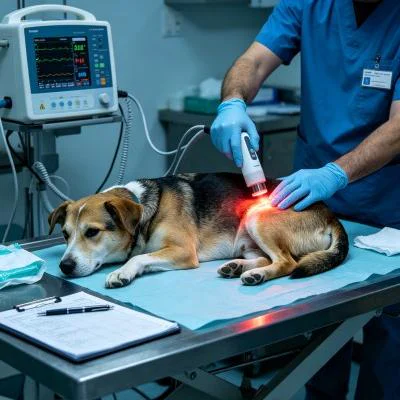
Регулируя частоту импульсов в диапазоне от 15 до 800 герц, можно добиться нужного биологического эффекта: низкие частоты подавляют передачу вещества P, что способствует облегчению боли в суставах, тогда как более высокие частоты стимулируют организацию теноцитов и синтез хрящевой внеклеточной матрицы на поздних этапах реабилитации.
Отчет о клиническом случае
The data below comes from Veterinary Orthopedic and Mobility Rehabilitation unit records, documenting non-surgical recovery metrics in a giant-breed canine with severe unilateral stifle osteoarthrosis.
Характеристика пациента и определение стадии заболевания
Case File Number: VOM-2026-6301
Subject: Canine, Saint Bernard
Age: 8 Years 9 Months
Пол: Самец (кастрированный)
Weight: 71.2 Kilograms
Presenting Complaint: Non-weight-bearing right pelvic limb lameness, inability to rise without two handlers, refusal to navigate threshold ramps, continuous whining during posture adjustments.
Orthopedic Examination: Marked crepitus and rigid resistance during passive right stifle flexion and extension; right stifle extension limited to 112 degrees (normal: 160 degrees); extensive circumferential medial buttress enlargement measuring 4.5 cm in width; intense compensatory spasm throughout the right quadriceps femoris and lumbar epaxials.
Radiographic Findings: Severe end-stage right stifle osteoarthritis secondary to historical cranial cruciate tear, osteophytic shelves exceeding 7 mm on the distal patellar pole and proximal tibial plateau, marked joint capsule distension, and prominent subchondral bone sclerosis. Staged at COAST Stage 4. Pre-treatment Canine Brief Pain Inventory Pain Severity Score: 8.8 out of 10. Pain Interference Score: 9.3 out of 10.
| Идентификатор сеанса | День | Место лечения | Распределение длин волн | Пиковая мощность (Вт) | Рабочий цикл (%) | Частота импульсов (Гц) | Общая энергия (Дж) | Клинические наблюдения |
| S-01 | D-01 | Right Stifle & Quadriceps | 80% 980 нм / 20% 1470 нм | 12.0 | 35% | 15 | 3,800 | Severe guarding; slow contact sweeping applied across medial and lateral capsule. |
| S-02 | D-03 | Stifle Capsule & Hamstrings | 75% 980 нм / 25% 1470 нм | 14.0 | 35% | 30 | 4,600 | Quadriceps spasms soften; patient tolerates lateral recumbency without vocalizing. |
| S-03 | D-06 | Patellar Poles & Joint Margin | 70% 980 нм / 30% 1470 нм | 16.0 | 40% | 60 | 5,400 | Sternal rising latency drops by 7 seconds; dog stands with one-person assistance. |
| S-04 | D-09 | Medial Buttress & Tibial Head | 65% 980 нм / 35% 1470 нм | 18.0 | 40% | 120 | 6,400 | Passive stifle extension gains 16 degrees; weight-bearing centers during stance. |
| S-05 | D-13 | Тазовый комплекс и задние мышцы бедра | 60% 980 нм / 40% 1470 нм | 20.0 | 45% | 250 | 7,400 | Dog navigates low entry ramps unassisted; compensatory lumbar spasms clear. |
| S-06 | D-17 | Целая кинематическая цепь таза | 50% 980 нм / 50% 1470 нм | 22.0 | 45% | 500 | 8,200 | Пассивный объем движения увеличился в целом на 32 градуса; крепитация в суставе заметно ослабла. |
| S-07 | D-22 | Региональные заболевания мышц и суставов | 50% 980 нм / 50% 1470 нм | 20.0 | 40% | Динамический | 7,600 | Симметрия походки полностью нормализовалась; показатели по шкале Canine Brief Pain Inventory резко снизились. |
| S-08 | D-28 | Зона биомеханической поддержки | 50% 980 нм / 50% 1470 нм | 18.0 | 35% | Динамический | 6,800 | Полностью восстановлена функциональная подвижность; пациент ежедневно ходит по 30 минут без хромоты. |
Объективные показатели функционального восстановления
Day 1 (Intake Baseline)
[Pain Severity: 8.8/10]      █████████████████░░░
[Stifle Extension: 112°]     ███████████░░░░░░░░░

Day 13 (Midway Status)
[Pain Severity: 4.1/10]      ████████░░░░░░░░░░░░
[Stifle Extension: 136°]     █████████████░░░░░░░

Day 28 (Protocol Completion)
[Pain Severity: 1.3/10]      ██░░░░░░░░░░░░░░░░░░
[Stifle Extension: 154°]     ███████████████░░░░░
By session eight on Day 28, the patient achieved sustained functional recovery. The Canine Brief Pain Inventory Pain Severity Score dropped from an intake baseline of 8.8 down to 1.3, while the Pain Interference Score fell from 9.3 to 1.5. Total stifle extension range of motion expanded by 42 degrees, restoring normal limb extension during the swing phase of gait.
Circumferential joint measurements around the right stifle decreased by 2.2 centimeters, confirming the drainage of chronic synovial hydrops and reduction of soft tissue edema. Follow-up blood chemistry confirmed normal hepatic and renal values with no gastrointestinal recurrence, verifying that non-invasive photobiomodulation successfully relieved end-stage joint pain without relying on systemic pharmaceuticals.
Практические преимущества по сравнению с традиционными методами
Managing severe canine stifle osteoarthritis presents ongoing operational and therapeutic hurdles in veterinary practice. Long-term administration of systemic NSAIDs or corticosteroids carries high risks of renal and hepatic toxicity, especially in older giant-breed dogs, requiring recurring blood panels that increase client expenses and force sudden medication stops. Surgical options, including total knee replacement or arthrodesis, require invasive bone resection, high financial commitments, and prolonged post-operative rehabilitation that can be difficult for aging dogs.
Недостаточно мощные аппараты для низкоинтенсивной фототерапии усугубляют эти задержки в лечении. Оборудование с низкой мощностью требует длительных сеансов — от тридцати до сорока минут — для доставки минимального количества фотонов через толстые суставные капсулы и плотную мускулатуру. Такая необходимость ручного участия занимает время технических специалистов и обследовательные кабинеты, что приводит к увеличению трудозатрат клиники при одновременном медленном и нестабильном клиническом прогрессе.
High-power Class 4 multi-wavelength protocols eliminate these clinical bottlenecks. Delivering up to twenty-two watts of peak power through balanced 980nm and 1470nm wavelengths cuts hands-on treatment times down to under ten minutes per joint. This delivery speed allows veterinary practices to treat deep periarticular structures efficiently, tripling daily room capacity while keeping giant-breed patients relaxed on the treatment mat.
Dynamic duty cycle pulsing protects sensitive tissues over the patella and tibial crest, preventing thermal spikes on dense, dark-coated limbs. Pet owners see noticeable reductions in lameness and stiffness within the first three visits, validating their commitment and keeping compliance high across the complete rehabilitation plan. For veterinary practices, combining deep intra-capsular penetration with rapid treatment times turns complex canine osteoarthritis cases into a dependable, non-invasive clinical service.