 フォトンメディックス












犬の膝関節線維症における光子の透過に関する課題
Synchronized water resonance and hemoglobin targeting channels mobilize chronic intracapsular edema while microsecond duty cycle modulation eliminates patellar thermal accumulation.
An eight-year-old Saint Bernard is led into the rehabilitation ward with severe unilateral right pelvic limb weight-bearing lameness, stepping solely on its cranial claws while keeping the right stifle locked in continuous 110-degree flexion. Palpation over the medial and lateral joint margins triggers violent quadriceps spasms, loud groaning, and immediate limb retraction. Chronic bilateral stifle osteoarthrosis, aggravated by historical cranial cruciate ligament rupture and extensive periarticular fibrous scarring, has produced massive medial buttress enlargement, synovial proliferation, and severe joint effusion. The attending clinician halted all oral NSAIDs and corticosteroids following repeated bouts of hemorrhagic gastritis and progressive elevations in serum creatinine. The hospital faces an immobile, 71-kilogram patient whose owners cannot consider total knee arthroplasty due to financial limitations and anesthesia risks. When non-invasive photobiomodulation is proposed, clinical concerns center on whether deploying laser therapy for dogs with arthritis can deliver therapeutic fluence through dense water-resistant fur, heavily pigmented skin, thick collateral ligaments, and sclerotic subchondral margins without burning the patient.
Overcoming chronic stifle capsule fibrosis requires calculating the optical attenuation curve across dense fibrous and osseous tissue boundaries. When high-intensity photons pass into the canine knee, light encounters surface keratin, melanin, dense patellar tendon fibers, fibrous joint capsules, and hypertrophied synovial folds. In giant-breed dogs, intra-articular nociceptors and degraded cartilage sit four to six centimeters beneath the cutaneous barrier. Low-level modalities lose coherent energy within the first four millimeters of soft tissue, converting light into shallow warmth instead of achieving deep biological stimulation. Clinical directors evaluating the best laser therapy device for dogs recognize that clinical outcomes depend on matching tissue-specific chromophore affinities to depth challenges, moving past the low penetration depth associated with the best cold laser therapy device for dogs on the market. Applying high-intensity Class 4 multi-wavelength protocols resolves this physical delivery bottleneck, delivering adequate fluence directly to inflamed intra-capsular structures.
Stratified Optical Decay Across The Canine Knee Joint
Photon transmission through the canine stifle faces dense physical filters compared to flatter muscle regions. The joint is encased in dense connective structures: thick outer skin with deep follicle beds, followed by the fascia lata, the dense patellar ligament, lateral and medial collateral ligaments, and hypertrophied synovial envelopes filled with stagnant effusion.
[Incident High-Intensity Dual Photon Beam]
                     │
                     ▼ (Melanin Absorption & Fur Follicle Scatter)
        [Dense Dermal & Subdermal Fascia]
                     │
                     ▼ (Mie Scattering in Thick Collateral Ligaments)
        [Hyperplastic Fibrotic Joint Capsule]
                     │
                     ▼ (Water Extinction in Stagnant Synovial Effusion)
        [Periarticular Osteophytes & Sclerotic Bone]
                     │
                     ▼ (Target Fluence > Chondrocyte Biological Threshold)
        [Cruciate Insertion Remnants & Subchondral Pain Fibers]
Low-level modalities disperse within superficial connective fibers, lacking the beam intensity needed to reach deep into narrow joint margins. To stimulate cellular repair, photon density must remain above the biological threshold across the femoral condyles, tibial plateau, and meniscal remnants. Achieving consistent clinical outcomes with laser therapy for dogs with arthritis requires matching tissue-specific chromophores to deep joint targets rather than relying on unfocused surface illumination.
こうした多層的な障壁を克服するには、相互に補完し合うスペクトルピークを同時に照射する必要があります。これらの波長を同期させることで、臨床医は1回の治療セッション内で、血管収縮、軟部組織の痙攣、および被膜内滲出液に対処することが可能になります。.
Target Tissue Stratum          Optimal Spectrum Band      Primary Physiological Dynamic
-----------------------------------------------------------------------------------------
Spastic Quadriceps Muscle Beds 980 nm                     Microvascular dilation, NO induction
Effusive Joint Capsule Hydrops 1470 nm                    Selective water drainage, decompression
Deep Subchondral Chondrocytes  980 nm / 1470 nm Ratio     Mitochondrial ATP synthesis, pain block
980nmにおけるヘモグロビンプロファイルと関節周囲の再灌流
The 980nm wavelength matches the peak absorption profiles of oxygenated and deoxygenated hemoglobin within the periarticular microvasculature. In chronic stifle osteoarthritis, sustained joint instability and compensatory muscle splinting constrict local capillary loops, starving articular tissues of oxygen and trapping lactic acid within the quadriceps and hamstring muscle groups.
980nmの光子を吸収すると、関節周囲の深部毛細血管床内で局所的な光熱性拡張が引き起こされます。内皮細胞が一酸化窒素を放出することで、平滑筋の括約筋が弛緩し、微小血管の血流が回復します。 この酸素を豊富に含んだ血液の流入により、関節周囲組織から炎症性メディエーターが洗い流され、軟骨細胞および腱細胞のミトコンドリア内のシトクロムcオキシダーゼが活性化される。アデノシン三リン酸(ATP)の生成が回復することで、虚血性筋痙攣を解消し、損傷した関節構造全体にわたるコラーゲンの再配列を促進するために必要な代謝エネルギーが供給される。.
The 1470nm Water Absorption Pathway In Stifle Joint Capsule Hydrops
Chronic stifle arthrosis leads to persistent synovial fluid pooling within the joint capsule, generating hydrostatic pressure that compresses sensory nerve endings against osteophytic margins. The 1470nm spectrum specifically targets free and bound water molecules in this inflammatory fluid, providing an absorption coefficient significantly higher than standard near-infrared bands.
1470nmの光子が浮腫をきたした関節包組織に当たると、標的部位でのエネルギー吸収により間質液の圧力勾配が変化します。 閉じ込められていた体液が側副リンパ管網へと排出され、関節包の圧力が低下する。1470nmによる体液の動員と980nmによる微小血管刺激を組み合わせることで、迅速な痛みの緩和が得られる。この協調的な作用により、高強度治療は信頼性の高い治療法となり、四肢の機能的な動きを回復するために必要な総治療回数を削減する。.
Duty Cycle Engineering For Bony Landmark Thermal Safety
Delivering high-power photons through thin soft tissue over the stifle carries a real risk of thermal buildup. Cortical bone on the patella, tibial tuberosity, and femoral condyles absorbs continuous wave energy rapidly. If an unmodulated beam stays focused over these bony landmarks, thermal accumulation triggers periosteal pain and potential tissue irritation, forcing clinicians to stop treatment before delivering an effective dose to the joint core.
ゲート制御された動的デューティサイクルにより、こうした熱スパイクが防止されます。ビームを変調することで、マイクロ秒単位のパルスバーストと、校正済みの熱緩和間隔を交互に織り交ぜています。.
Continuous Wave (Thermal Runaway Over Stifle Prominences):
Power ────────────────────────────────────────── (Periosteal Thermal Risk & Pain)

Gated Dynamic Duty Cycle (Structured Thermal Dissipation):
Power ┌───┐    ┌───┐    ┌───┐    ┌───┐    ┌───┐
      │   │    │   │    │   │    │   │    │   │   (Deep Articular Penetration / Zero Burn)
Base  ┘   └────┘   └────┘   └────┘   └────┘   └────
      |Ton|    Toff     |
Because dense fibrous collateral ligaments and bone dissipate heat faster than they absorb peak energy pulses, dynamic duty cycles let clinicians deploy high peak irradiance through the joint capsule while maintaining safe surface temperatures. Operating between 35 percent and 45 percent duty cycles enables safe, comfortable treatment directly over the medial and lateral stifle margins.
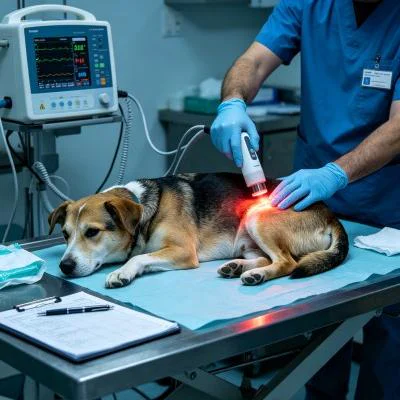
パルス周波数を15ヘルツから800ヘルツの範囲で調整することで、生物学的効果を調整することができます。低周波数はサブスタンスPの伝達を抑制して関節痛を緩和する一方、高周波数はリハビリテーションの後期段階において、腱細胞の組織化や軟骨の細胞外マトリックスの合成を促進します。.
臨床現場の症例報告
The data below comes from Veterinary Orthopedic and Mobility Rehabilitation unit records, documenting non-surgical recovery metrics in a giant-breed canine with severe unilateral stifle osteoarthrosis.
患者のプロファイルと病期分類
Case File Number: VOM-2026-6301
Subject: Canine, Saint Bernard
Age: 8 Years 9 Months
性別オス(去勢済み)
Weight: 71.2 Kilograms
Presenting Complaint: Non-weight-bearing right pelvic limb lameness, inability to rise without two handlers, refusal to navigate threshold ramps, continuous whining during posture adjustments.
Orthopedic Examination: Marked crepitus and rigid resistance during passive right stifle flexion and extension; right stifle extension limited to 112 degrees (normal: 160 degrees); extensive circumferential medial buttress enlargement measuring 4.5 cm in width; intense compensatory spasm throughout the right quadriceps femoris and lumbar epaxials.
Radiographic Findings: Severe end-stage right stifle osteoarthritis secondary to historical cranial cruciate tear, osteophytic shelves exceeding 7 mm on the distal patellar pole and proximal tibial plateau, marked joint capsule distension, and prominent subchondral bone sclerosis. Staged at COAST Stage 4. Pre-treatment Canine Brief Pain Inventory Pain Severity Score: 8.8 out of 10. Pain Interference Score: 9.3 out of 10.
| セッションID | 日 | トリートメント・サイト | 波長分布 | ピーク出力 (W) | デューティ・サイクル(%) | パルス周波数 (Hz) | 総エネルギー(J) | 臨床観察 |
| S-01 | D-01 | Right Stifle & Quadriceps | 80% 980nm / 20% 1470nm | 12.0 | 35% | 15 | 3,800 | Severe guarding; slow contact sweeping applied across medial and lateral capsule. |
| S-02 | D-03 | Stifle Capsule & Hamstrings | 75% 980nm / 25% 1470nm | 14.0 | 35% | 30 | 4,600 | Quadriceps spasms soften; patient tolerates lateral recumbency without vocalizing. |
| S-03 | D-06 | Patellar Poles & Joint Margin | 70% 980nm / 30% 1470nm | 16.0 | 40% | 60 | 5,400 | Sternal rising latency drops by 7 seconds; dog stands with one-person assistance. |
| S-04 | D-09 | Medial Buttress & Tibial Head | 65% 980nm / 35% 1470nm | 18.0 | 40% | 120 | 6,400 | Passive stifle extension gains 16 degrees; weight-bearing centers during stance. |
| S-05 | D-13 | 骨盤複合体とハムストリングス | 60% 980nm / 40% 1470nm | 20.0 | 45% | 250 | 7,400 | Dog navigates low entry ramps unassisted; compensatory lumbar spasms clear. |
| S-06 | D-17 | 骨盤全体の運動連鎖 | 50% 980nm / 50% 1470nm | 22.0 | 45% | 500 | 8,200 | 受動的可動域は全体で32度拡大し、関節の轢音は著しく軽減した。. |
| S-07 | D-22 | 地域別 筋肉・関節の病態 | 50% 980nm / 50% 1470nm | 20.0 | 40% | ダイナミック | 7,600 | 歩行の対称性が完全に正常化され、犬用簡易疼痛評価尺度(Canine Brief Pain Inventory)のスコアが急激に低下した。. |
| S-08 | D-28 | 生体力学的メンテナンスゾーン | 50% 980nm / 50% 1470nm | 18.0 | 35% | ダイナミック | 6,800 | 完全な歩行機能が回復し、患者は跛行することなく毎日30分間歩行している。. |
客観的な機能回復指標
Day 1 (Intake Baseline)
[Pain Severity: 8.8/10]      █████████████████░░░
[Stifle Extension: 112°]     ███████████░░░░░░░░░

Day 13 (Midway Status)
[Pain Severity: 4.1/10]      ████████░░░░░░░░░░░░
[Stifle Extension: 136°]     █████████████░░░░░░░

Day 28 (Protocol Completion)
[Pain Severity: 1.3/10]      ██░░░░░░░░░░░░░░░░░░
[Stifle Extension: 154°]     ███████████████░░░░░
By session eight on Day 28, the patient achieved sustained functional recovery. The Canine Brief Pain Inventory Pain Severity Score dropped from an intake baseline of 8.8 down to 1.3, while the Pain Interference Score fell from 9.3 to 1.5. Total stifle extension range of motion expanded by 42 degrees, restoring normal limb extension during the swing phase of gait.
Circumferential joint measurements around the right stifle decreased by 2.2 centimeters, confirming the drainage of chronic synovial hydrops and reduction of soft tissue edema. Follow-up blood chemistry confirmed normal hepatic and renal values with no gastrointestinal recurrence, verifying that non-invasive photobiomodulation successfully relieved end-stage joint pain without relying on systemic pharmaceuticals.
従来の治療法に比べて実用的な利点
Managing severe canine stifle osteoarthritis presents ongoing operational and therapeutic hurdles in veterinary practice. Long-term administration of systemic NSAIDs or corticosteroids carries high risks of renal and hepatic toxicity, especially in older giant-breed dogs, requiring recurring blood panels that increase client expenses and force sudden medication stops. Surgical options, including total knee replacement or arthrodesis, require invasive bone resection, high financial commitments, and prolonged post-operative rehabilitation that can be difficult for aging dogs.
Underpowered low-level phototherapy units worsen these clinical delays. Low-wattage hardware requires prolonged session times of thirty to forty minutes to deliver minimal photon quantities through thick joint capsules and dense musculature. This hands-on demand ties up technicians and examination suites, driving up clinic labor overhead while delivering slow, inconsistent clinical progress.
High-power Class 4 multi-wavelength protocols eliminate these clinical bottlenecks. Delivering up to twenty-two watts of peak power through balanced 980nm and 1470nm wavelengths cuts hands-on treatment times down to under ten minutes per joint. This delivery speed allows veterinary practices to treat deep periarticular structures efficiently, tripling daily room capacity while keeping giant-breed patients relaxed on the treatment mat.
Dynamic duty cycle pulsing protects sensitive tissues over the patella and tibial crest, preventing thermal spikes on dense, dark-coated limbs. Pet owners see noticeable reductions in lameness and stiffness within the first three visits, validating their commitment and keeping compliance high across the complete rehabilitation plan. For veterinary practices, combining deep intra-capsular penetration with rapid treatment times turns complex canine osteoarthritis cases into a dependable, non-invasive clinical service.