 FotonMedix


Overcoming Canine Coxofemoral Cartilage Extinction
Coordinated water and hemoglobin resonance bands eliminate deep joint hydrops while microsecond duty cycle pulsing prevents thermal accumulation over the femoral head.
An eleven-year-old Golden Retriever lies flattened on the rubber mat of the consultation room, hind limbs splayed laterally, panting heavily after walking fewer than twenty paces from the parking lot. Digital palpation around the hip joint triggers violent tremors across the biceps femoris, sharp vocalization, and rigid guarding across the gluteal muscle complex. The owner reveals that liver enzymes and renal parameters surged following six months of daily firocoxib and tramadol therapy, forcing complete cessation of oral pharmaceuticals. The clinic is left with an immobilized large-breed patient whose degenerative joint disease has led to secondary periarticular fibrosis, osteophytic rim remodeling, and profound synovial effusion. When discussing non-pharmacological care, the primary friction point centers on whether laser therapy for dogs arthritis can penetrate thick double coats, pigmented skin, heavy gluteal muscles, and calcified acetabular margins without causing thermal burns on vulnerable tissue.
Treating deep coxofemoral degeneration requires analyzing the optical attenuation curve across layered biological filters. When high-intensity photons enter canine tissue, light encounters epidermal eumelanin, subcutaneous lipid layers, dense gluteal fascial sheaths, and hypertrophied synovial capsules. In large breeds, the coxofemoral articular gap sits four to seven centimeters beneath the skin surface. Standard low-level units lose their intensity within the outer five millimeters of soft tissue, failing to achieve therapeutic photon density at the deep chondral interface. Applying high-intensity Class 4 multi-wavelength protocols resolves this physical delivery bottleneck, transforming laser therapy for canine arthritis into a targeted, non-invasive protocol that delivers adequate fluence to subchondral nociceptive networks.
Optical Extinction Across Deep Canine Pelvic Anatomy
Photon transmission through the canine pelvic girdle faces severe physical challenges compared to distal extremities. The coxofemoral joint is surrounded by massive muscle groups: the superficial, middle, and deep gluteals, along with the dense fascia lata and thick adipose tissue.
[Incident High-Intensity Dual Photon Beam]
                     │
                     ▼ (Epidermal Melanin & Dense Coat Scatter)
        [Subcutaneous Adipose Tissue Matrix]
                     │
                     ▼ (Mie Scattering in Deep Gluteal Fascia)
        [Heavy Gluteal Musculature Layer]
                     │
                     ▼ (Hemoglobin Stripping & Blood Volume Absorption)
        [Fibrosed Coxofemoral Joint Capsule]
                     │
                     ▼ (Delivered Fluence > Articular Activation Threshold)
        [Femoral Head Chondrocytes & Subchondral Nociceptors]
Low-level modalities disperse within the superficial muscle layers, losing coherence before reaching the joint cavity. To stimulate cellular healing, photon density must remain above the biological threshold at the level of the femoral head and acetabulum. Deploying effective dog laser therapy for arthritis requires matching tissue-specific chromophores to deep joint targets rather than relying on unfocused surface illumination.
Для преодоления этих многоуровневых барьеров требуется одновременное воздействие в нескольких взаимодополняющих спектральных диапазонах. Синхронизация этих длин волн позволяет врачам устранять сужение сосудов, спазм мягких тканей и внутрикапсулярный выпот в ходе одного сеанса лечения.
Целевой слой ткани Оптимальный спектральный диапазон Основная физиологическая динамика
-----------------------------------------------------------------------------------------
Спастическая ягодичная мускулатура    980 нм Расширение микрососудов, индукция NO
Эффузивный гидропсу суставной капсулы 1470 нм Селективное удаление воды, декомпрессия
Глубокие субхондральные хондроциты  Соотношение 980 нм / 1470 нм     Митохондриальный синтез АТФ, блокировка боли
Профиль гемоглобина при длине волны 980 нм и реперфузия тазовых органов
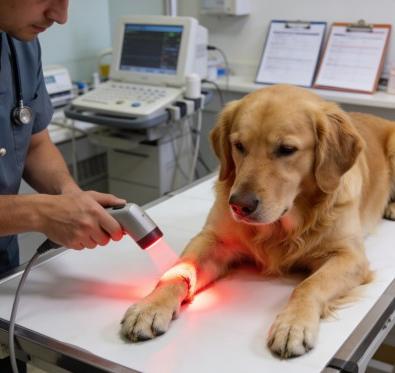
Длина волны 980 нм соответствует пиковым профилям поглощения оксигенированного и деоксигенированного гемоглобина в микрососудах тазовой области. При хроническом коксофеморальном остеоартрозе длительная нестабильность сустава и компенсаторное ригидизирование мышц сужают местные капиллярные петли, что приводит к кислородному голоданию суставных тканей и задержке молочной кислоты в ягодичных и подколенных мышцах.
Поглощение фотонов с длиной волны 980 нм вызывает локальное фототермическое расширение сосудов в глубоких капиллярных сетях, окружающих сустав. Эндотелиальные клетки выделяют оксид азота, что приводит к расслаблению сфинктеров гладких мышц и восстановлению микрососудистой перфузии. Этот приток насыщенной кислородом крови вымывает медиаторы воспаления из околосуставных тканей, стимулируя цитохром-С-оксидазу в митохондриях хондроцитов и теноцитов. Восстановление синтеза аденозинтрифосфата обеспечивает метаболическую энергию, необходимую для устранения ишемических мышечных спазмов и содействия реорганизации коллагена в поврежденных структурах сустава.
The 1470nm Water Absorption Pathway In Joint Capsule Hydrops
Хронический артроз тазобедренного сустава приводит к постоянному скоплению синовиальной жидкости внутри суставной капсулы, что вызывает гидростатическое давление, сдавливающее сенсорные нервные окончания остеофитными краями. Спектр с длиной волны 1470 нм специфически воздействует на свободные и связанные молекулы воды в этой воспалительной жидкости, обеспечивая коэффициент поглощения, значительно превышающий показатели стандартных полос ближнего инфракрасного диапазона.
When 1470nm photons strike edematous capsular tissues, targeted energy absorption alters interstitial fluid pressure gradients. Trapped fluid drains into collateral lymphatic networks, decompressing the articular capsule. Combining 1470nm fluid mobilization with 980nm microvascular stimulation delivers rapid pain relief. This coordinated action makes laser therapy for dogs arthritis a dependable modality, cutting the total number of clinical sessions needed to restore functional limb movement.
Разработка режима работы для обеспечения термической безопасности глубоких мышечных систем
Прохождение фотонов высокой мощности через плотные мягкие ткани в области бедра сопряжено с реальным риском накопления тепла. Густая тёмная шерсть и поверхностная фасция ягодичных мышц быстро поглощают энергию непрерывного излучения. Если немодулированный луч остаётся сфокусированным на этих плотных мышечных слоях, накопление тепла вызывает ожоги кожи и раздражение тканей, что вынуждает врачей прервать процедуру до того, как будет доставлена эффективная доза в центр сустава.
Динамические рабочие циклы с ограничением мощности предотвращают такие тепловые всплески. Модуляция пучка заключается в чередовании микросекундных импульсных серий с откалиброванными интервалами тепловой релаксации.
Непрерывная волна (тепловой разгон в плотной мышечной ткани):
Мощность ────────────────────────────────────────── (риск перегрева кожи и боль)

Динамический рабочий цикл с импульсами (структурированное рассеивание тепла):
Мощность ┌───┐    ┌───┐    ┌───┐    ┌───┐    ┌───┐
      │   │    │   │    │   │    │   │    │   │   (Глубокое проникновение в сустав / Отсутствие ожогов)
Основание  ┘   └────┘   └────┘   └────┘   └────┘   └────
 |Тон|    Toff     |
Поскольку плотные мышечные и фасциальные ткани рассеивают тепло быстрее, чем поглощают импульсы пиковой энергии, динамические рабочие циклы позволяют врачам воздействовать на ягодичные слои с высокой пиковой интенсивностью излучения, сохраняя при этом безопасную температуру поверхности. Работа с рабочими циклами в диапазоне от 35 до 50 процентов обеспечивает безопасное и комфортное лечение непосредственно над большим вертелом бедра и дорсальным краем вертлужной впадины.
Регулируя частоту импульсов в диапазоне от 15 до 800 герц, можно добиться нужного биологического эффекта: низкие частоты подавляют передачу вещества P, что способствует облегчению боли в суставах, тогда как более высокие частоты стимулируют организацию теноцитов и синтез хрящевой внеклеточной матрицы на поздних этапах реабилитации.
Отчет о клиническом случае
The data below comes from Veterinary Orthopedic and Mobility Rehabilitation unit records, documenting non-surgical recovery metrics in a large-breed canine with severe bilateral hip osteoarthritis.
Характеристика пациента и определение стадии заболевания
Case File Number: VOM-2026-6712
Тема: Собака, золотистый ретривер
Age: 11 Years 2 Months
Пол: Самец (кастрированный)
Weight: 38.6 Kilograms
Presenting Complaint: Severe non-weight-bearing reluctance on bilateral pelvic limbs, inability to rise without sling support, constant vocalization upon hip extension, complete loss of exercise tolerance.
Orthopedic Examination: Marked bilateral crepitus on passive hip extension; right hip extension restricted to 110 degrees; left hip extension restricted to 115 degrees (normal: 160 degrees); intense compensatory lumbar spasm; atrophy of the gluteus medius and semimembranosus muscles.
Radiographic Findings: Severe bilateral coxofemoral osteoarthritis secondary to hip dysplasia, extensive circumferential osteophytes along the femoral neck exceeding 5 mm, acetabular rim flattening, and severe subchondral sclerosis. Staged at COAST Stage 4. Pre-treatment Canine Brief Pain Inventory Pain Severity Score: 8.5 out of 10. Pain Interference Score: 8.9 out of 10.
| Идентификатор сеанса | День | Место лечения | Распределение длин волн | Пиковая мощность (Вт) | Рабочий цикл (%) | Частота импульсов (Гц) | Общая энергия (Дж) | Клинические наблюдения |
| S-01 | D-01 | Обе стороны: тазобедренные суставы и поясничный отдел позвоночника | 80% 980 нм / 20% 1470 нм | 12.0 | 35% | 15 | 3,600 | Intense pelvic guarding; contact sweeping technique applied across gluteal margins. |
| S-02 | D-03 | Greater Trochanter & Pelvis | 75% 980 нм / 25% 1470 нм | 14.0 | 35% | 30 | 4,200 | Gluteal spasms soften; patient permits lateral recumbency without vocalizing. |
| S-03 | D-06 | Края вертлужной впадины и поясничная цепь | 70% 980 нм / 30% 1470 нм | 16.0 | 40% | 60 | 5,000 | Rising latency drops by 6 seconds; patient stands unassisted on carpeted floors. |
| S-04 | D-09 | Обе тазобедренные суставы | 65% 980 нм / 35% 1470 нм | 18.0 | 40% | 120 | 5,800 | Passive hip extension gains 16 degrees bilaterally; weight distribution centers. |
| S-05 | D-13 | Тазовый комплекс и задние мышцы бедра | 60% 980 нм / 40% 1470 нм | 20.0 | 45% | 250 | 6,800 | Patient navigates short garden walks; compensatory epaxial tension clears. |
| S-06 | D-17 | Целая кинематическая цепь таза | 50% 980 нм / 50% 1470 нм | 22.0 | 45% | 500 | 7,600 | Passive range of motion gains 32 degrees overall; joint crepitus softens noticeably. |
| S-07 | D-22 | Региональные заболевания мышц и суставов | 50% 980 нм / 50% 1470 нм | 20.0 | 40% | Динамический | 7,000 | Симметрия походки полностью нормализовалась; показатели по шкале Canine Brief Pain Inventory резко снизились. |
| S-08 | D-28 | Зона биомеханической поддержки | 50% 980 нм / 50% 1470 нм | 18.0 | 35% | Динамический | 6,200 | Полностью восстановлена функциональная подвижность; пациент ежедневно ходит по 30 минут без хромоты. |
Объективные показатели функционального восстановления
Day 1 (Intake Baseline)
[Pain Severity: 8.5/10]      █████████████████░░░
[Hip Extension Arc: 110°]    ███████████░░░░░░░░░

Day 13 (Midway Status)
[Pain Severity: 3.9/10]      ████████░░░░░░░░░░░░
[Hip Extension Arc: 132°]    █████████████░░░░░░░

Day 28 (Protocol Completion)
[Pain Severity: 1.1/10]      ██░░░░░░░░░░░░░░░░░░
[Hip Extension Arc: 154°]    ███████████████░░░░░
By session eight on Day 28, the patient achieved sustained functional recovery. The Canine Brief Pain Inventory Pain Severity Score dropped from an intake baseline of 8.5 down to 1.1, while the Pain Interference Score fell from 8.9 to 1.4. Total hip extension range of motion expanded by 44 degrees on the right and 40 degrees on the left, bringing limb movement back toward functional physiological baselines.
Circumferential thigh measurements increased by 1.8 centimeters bilaterally, confirming reversal of disuse atrophy across the quadriceps and hamstring groups. Follow-up blood chemistry confirmed normal hepatic and renal parameters, validating that non-invasive photobiomodulation successfully resolved end-stage pain without relying on systemic pharmaceuticals.
Практические преимущества по сравнению с традиционными методами
Managing severe canine hip osteoarthritis presents ongoing operational and therapeutic hurdles in veterinary practice. Long-term administration of systemic NSAIDs or corticosteroids carries high risks of renal and hepatic toxicity, especially in older large-breed dogs, requiring recurring blood panels that increase client expenses and force sudden medication stops. Surgical options, including total hip replacement or femoral head ostectomy, require invasive bone resection, high financial commitments, and prolonged post-operative rehabilitation that can be difficult for aging dogs.
Аппараты для низкоинтенсивной фототерапии с недостаточной мощностью усугубляют эти задержки в лечении. Оборудование с низкой мощностью требует длительных сеансов — от тридцати до сорока минут — для доставки минимального количества фотонов через толстую ягодичную мускулатуру. Такая необходимость ручного вмешательства занимает время технических специалистов и обременяет кабинеты для обследований, что приводит к росту затрат на оплату труда в клинике при одновременном медленном и нестабильном прогрессе в лечении.
High-power Class 4 multi-wavelength protocols eliminate these clinical bottlenecks. Delivering up to twenty-two watts of peak power through balanced 980nm and 1470nm wavelengths cuts hands-on treatment times down to under ten minutes per hip. This delivery speed allows veterinary practices to treat deep periarticular structures efficiently, tripling daily room capacity while keeping large-breed patients relaxed on the treatment mat.
Dynamic duty cycle pulsing protects sensitive skin over the greater trochanter and spine, preventing thermal spikes on dense, dark-coated limbs. Pet owners see noticeable reductions in lameness and stiffness within the first three visits, validating their commitment and keeping compliance high across the complete rehabilitation plan. For veterinary practices, combining deep intra-capsular penetration with rapid treatment times turns complex canine osteoarthritis cases into a dependable, non-invasive clinical service.