 FotonMedix


Overcoming Canine Coxofemoral Cartilage Extinction
Coordinated water and hemoglobin resonance bands eliminate deep joint hydrops while microsecond duty cycle pulsing prevents thermal accumulation over the femoral head.
An eleven-year-old Golden Retriever lies flattened on the rubber mat of the consultation room, hind limbs splayed laterally, panting heavily after walking fewer than twenty paces from the parking lot. Digital palpation around the hip joint triggers violent tremors across the biceps femoris, sharp vocalization, and rigid guarding across the gluteal muscle complex. The owner reveals that liver enzymes and renal parameters surged following six months of daily firocoxib and tramadol therapy, forcing complete cessation of oral pharmaceuticals. The clinic is left with an immobilized large-breed patient whose degenerative joint disease has led to secondary periarticular fibrosis, osteophytic rim remodeling, and profound synovial effusion. When discussing non-pharmacological care, the primary friction point centers on whether laser therapy for dogs arthritis can penetrate thick double coats, pigmented skin, heavy gluteal muscles, and calcified acetabular margins without causing thermal burns on vulnerable tissue.
Treating deep coxofemoral degeneration requires analyzing the optical attenuation curve across layered biological filters. When high-intensity photons enter canine tissue, light encounters epidermal eumelanin, subcutaneous lipid layers, dense gluteal fascial sheaths, and hypertrophied synovial capsules. In large breeds, the coxofemoral articular gap sits four to seven centimeters beneath the skin surface. Standard low-level units lose their intensity within the outer five millimeters of soft tissue, failing to achieve therapeutic photon density at the deep chondral interface. Applying high-intensity Class 4 multi-wavelength protocols resolves this physical delivery bottleneck, transforming laser therapy for canine arthritis into a targeted, non-invasive protocol that delivers adequate fluence to subchondral nociceptive networks.
Optical Extinction Across Deep Canine Pelvic Anatomy
Photon transmission through the canine pelvic girdle faces severe physical challenges compared to distal extremities. The coxofemoral joint is surrounded by massive muscle groups: the superficial, middle, and deep gluteals, along with the dense fascia lata and thick adipose tissue.
[Incident High-Intensity Dual Photon Beam]
                     │
                     ▼ (Epidermal Melanin & Dense Coat Scatter)
        [Subcutaneous Adipose Tissue Matrix]
                     │
                     ▼ (Mie Scattering in Deep Gluteal Fascia)
        [Heavy Gluteal Musculature Layer]
                     │
                     ▼ (Hemoglobin Stripping & Blood Volume Absorption)
        [Fibrosed Coxofemoral Joint Capsule]
                     │
                     ▼ (Delivered Fluence > Articular Activation Threshold)
        [Femoral Head Chondrocytes & Subchondral Nociceptors]
Low-level modalities disperse within the superficial muscle layers, losing coherence before reaching the joint cavity. To stimulate cellular healing, photon density must remain above the biological threshold at the level of the femoral head and acetabulum. Deploying effective dog laser therapy for arthritis requires matching tissue-specific chromophores to deep joint targets rather than relying on unfocused surface illumination.
要克服这些分层障碍,必须在互补的光谱峰值上同时进行治疗。通过同步这些波长,临床医生可以在同一治疗过程中解决血管收缩、软组织痉挛和囊内积液等问题。.
靶向组织层 最佳光谱波段 主要生理动态
-----------------------------------------------------------------------------------------
痉挛性臀部肌肉    980 nm 微血管扩张,一氧化氮诱导
关节囊积液    1470 nm 选择性引流,减压
深层软骨下软骨细胞  980 nm / 1470 nm 比例     线粒体ATP合成,镇痛
980nm血红蛋白谱与盆腔再灌注
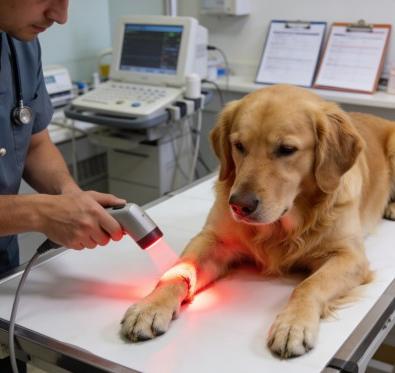
980纳米波长与骨盆微循环中氧合血红蛋白和脱氧血红蛋白的峰值吸收谱相吻合。 在慢性髋关节骨关节炎中,持续的关节不稳和代偿性肌肉痉挛会压迫局部毛细血管环,导致关节组织缺氧,并使乳酸滞留在臀肌和腘绳肌群内。.
吸收980nm光子会触发关节周围深层毛细血管网内的局部光热扩张。内皮细胞释放一氧化氮,使平滑肌括约肌松弛,并恢复微血管灌注。 这股富氧血液的涌入将炎症介质从关节周围组织中冲走,从而刺激软骨细胞和肌腱细胞线粒体内的细胞色素c氧化酶。恢复三磷酸腺苷(ATP)的生成,为消除缺血性肌肉痉挛并促进受损关节结构中胶原蛋白的重新排列提供了所需的代谢能量。.
The 1470nm Water Absorption Pathway In Joint Capsule Hydrops
慢性髋关节骨关节炎会导致关节囊内持续积聚滑液,产生静水压,将感觉神经末梢压向骨赘边缘。1470 nm波段的光谱专门针对该炎症液体中的游离水分子和结合水分子,其吸收系数显著高于标准近红外波段。.
当1470nm光子照射到水肿的关节囊组织时,定向能量吸收会改变间质液的压力梯度。 滞留的体液流入侧支淋巴网络,从而减轻关节囊的压力。将1470nm的体液 mobilization 与980nm的微血管刺激相结合,可迅速缓解疼痛。这种协同作用使激光疗法成为治疗犬类关节炎的一种可靠疗法,并减少了恢复肢体功能性运动所需的总治疗次数。.
用于深度肌肉热安全的工作周期设计
通过髋部上方的致密软组织传输高功率光子,存在热量积聚的实际风险。 浓密的深色体毛和臀肌的浅层筋膜会迅速吸收连续波能量。如果未调制的光束持续聚焦在这些致密的肌肉层上,热量积聚会引发皮肤灼伤和组织刺激,迫使临床医生在向关节核心输送有效剂量之前就停止治疗。.
带门控的动态占空比可防止这些热峰值。通过调制光束,将微秒级脉冲群与经过校准的热松弛间隔交替进行。.
连续波(致密肌肉组织中的热失控):
功率 ──────────────────────────────────────────(皮肤热风险与疼痛)

门控动态占空比(结构化散热):
功率 ┌───┐    ┌───┐    ┌───┐    ┌───┐    ┌───┐
      │   │    │   │    │   │    │   │    │   │   (深层关节穿透 / 零灼伤)
基体  ┘   └────┘   └────┘   └────┘   └────┘   └────
 |吨|    Toff     |
由于致密的肌肉和筋膜组织散热速度快于吸收峰值能量脉冲的速度,动态占空比使临床医生能够在保持安全表面温度的同时,通过臀部组织层施加高峰值辐照度。在35%至50%的占空比范围内操作,可直接对股骨大转子及髋臼背缘进行安全、舒适的治疗。.
通过将脉冲频率调节在15赫兹至800赫兹之间,可以针对性地调控生物效应:低频可抑制物质P的传递,从而缓解关节疼痛;而在康复后期,较高频率则能刺激肌腱细胞的重组以及软骨细胞外基质的合成。.
临床案例报告
The data below comes from Veterinary Orthopedic and Mobility Rehabilitation unit records, documenting non-surgical recovery metrics in a large-breed canine with severe bilateral hip osteoarthritis.
患者概况与诊断分期
Case File Number: VOM-2026-6712
Subject: Canine, Golden Retriever
Age: 11 Years 2 Months
性别雄性(绝育)
Weight: 38.6 Kilograms
Presenting Complaint: Severe non-weight-bearing reluctance on bilateral pelvic limbs, inability to rise without sling support, constant vocalization upon hip extension, complete loss of exercise tolerance.
Orthopedic Examination: Marked bilateral crepitus on passive hip extension; right hip extension restricted to 110 degrees; left hip extension restricted to 115 degrees (normal: 160 degrees); intense compensatory lumbar spasm; atrophy of the gluteus medius and semimembranosus muscles.
Radiographic Findings: Severe bilateral coxofemoral osteoarthritis secondary to hip dysplasia, extensive circumferential osteophytes along the femoral neck exceeding 5 mm, acetabular rim flattening, and severe subchondral sclerosis. Staged at COAST Stage 4. Pre-treatment Canine Brief Pain Inventory Pain Severity Score: 8.5 out of 10. Pain Interference Score: 8.9 out of 10.
| 会话 ID | 日 | 治疗场所 | 波长分布 | 峰值功率(瓦) | 占空比 (%) | 脉冲频率(赫兹) | 总能量(焦耳) | 临床观察 |
| S-01 | D-01 | 双侧髋关节与腰椎 | 80% 980nm / 20% 1470nm | 12.0 | 35% | 15 | 3,600 | Intense pelvic guarding; contact sweeping technique applied across gluteal margins. |
| S-02 | D-03 | Greater Trochanter & Pelvis | 75% 980纳米 / 25% 1470纳米 | 14.0 | 35% | 30 | 4,200 | Gluteal spasms soften; patient permits lateral recumbency without vocalizing. |
| S-03 | D-06 | 髋臼缘与腰部链条 | 70% 980nm / 30% 1470nm | 16.0 | 40% | 60 | 5,000 | Rising latency drops by 6 seconds; patient stands unassisted on carpeted floors. |
| S-04 | D-09 | 双侧髋关节 | 65% 980纳米 / 35% 1470纳米 | 18.0 | 40% | 120 | 5,800 | Passive hip extension gains 16 degrees bilaterally; weight distribution centers. |
| S-05 | D-13 | 骨盆复合体与腘绳肌 | 60% 980nm / 40% 1470nm | 20.0 | 45% | 250 | 6,800 | Patient navigates short garden walks; compensatory epaxial tension clears. |
| S-06 | D-17 | 整个骨盆运动链 | 50% 980nm / 50% 1470nm | 22.0 | 45% | 500 | 7,600 | Passive range of motion gains 32 degrees overall; joint crepitus softens noticeably. |
| S-07 | D-22 | 区域性肌肉与关节病理 | 50% 980nm / 50% 1470nm | 20.0 | 40% | 动态 | 7,000 | 步态对称性已完全恢复;犬类简明疼痛量表评分大幅下降。. |
| S-08 | D-28 | 生物力学维护区 | 50% 980nm / 50% 1470nm | 18.0 | 35% | 动态 | 6,200 | 已完全恢复正常活动能力;患者每天可步行30分钟,且无跛行。. |
客观功能恢复指标
Day 1 (Intake Baseline)
[Pain Severity: 8.5/10]      █████████████████░░░
[Hip Extension Arc: 110°]    ███████████░░░░░░░░░

Day 13 (Midway Status)
[Pain Severity: 3.9/10]      ████████░░░░░░░░░░░░
[Hip Extension Arc: 132°]    █████████████░░░░░░░

Day 28 (Protocol Completion)
[Pain Severity: 1.1/10]      ██░░░░░░░░░░░░░░░░░░
[Hip Extension Arc: 154°]    ███████████████░░░░░
By session eight on Day 28, the patient achieved sustained functional recovery. The Canine Brief Pain Inventory Pain Severity Score dropped from an intake baseline of 8.5 down to 1.1, while the Pain Interference Score fell from 8.9 to 1.4. Total hip extension range of motion expanded by 44 degrees on the right and 40 degrees on the left, bringing limb movement back toward functional physiological baselines.
Circumferential thigh measurements increased by 1.8 centimeters bilaterally, confirming reversal of disuse atrophy across the quadriceps and hamstring groups. Follow-up blood chemistry confirmed normal hepatic and renal parameters, validating that non-invasive photobiomodulation successfully resolved end-stage pain without relying on systemic pharmaceuticals.
相较于传统治疗方式的实际优势
Managing severe canine hip osteoarthritis presents ongoing operational and therapeutic hurdles in veterinary practice. Long-term administration of systemic NSAIDs or corticosteroids carries high risks of renal and hepatic toxicity, especially in older large-breed dogs, requiring recurring blood panels that increase client expenses and force sudden medication stops. Surgical options, including total hip replacement or femoral head ostectomy, require invasive bone resection, high financial commitments, and prolonged post-operative rehabilitation that can be difficult for aging dogs.
功率不足的低强度光疗设备进一步加剧了这些临床延误。低瓦数的设备需要延长单次治疗时间至三十分钟至四十分钟,才能穿透厚实的臀部肌肉组织输送微量的光子。这种需要人工操作的要求占用了技术人员和检查室的资源,不仅推高了诊所的人力成本,而且治疗进展缓慢且效果不稳定。.
High-power Class 4 multi-wavelength protocols eliminate these clinical bottlenecks. Delivering up to twenty-two watts of peak power through balanced 980nm and 1470nm wavelengths cuts hands-on treatment times down to under ten minutes per hip. This delivery speed allows veterinary practices to treat deep periarticular structures efficiently, tripling daily room capacity while keeping large-breed patients relaxed on the treatment mat.
Dynamic duty cycle pulsing protects sensitive skin over the greater trochanter and spine, preventing thermal spikes on dense, dark-coated limbs. Pet owners see noticeable reductions in lameness and stiffness within the first three visits, validating their commitment and keeping compliance high across the complete rehabilitation plan. For veterinary practices, combining deep intra-capsular penetration with rapid treatment times turns complex canine osteoarthritis cases into a dependable, non-invasive clinical service.