 FotonMedix



Solving Deep Tissue Stagnation Across Diverse Pet Sizes
Quad-wavelength Class IV photonic delivery targets deep ischemic pathology, evacuates interstitial capsular edema via selective water absorption, and prevents epidermal thermal accumulation through microsecond duty cycle pulsing.
A frantic veterinary assistant tries to hold down a 4 kg domestic cat that is hissing, panting, and clawing at the examination towel. The feline patient suffers from severe chronic bilateral stifle osteoarthritis, but thirty seconds into treatment with an uncalibrated high-intensity emitter, the surface hair and thin dermis become uncomfortably hot, triggering intense fear responses. Ten minutes later in the adjoining ward, the same technician faces the opposite dilemma: an 82 kg English Mastiff with severe bilateral hip dysplasia and massive gluteal muscling lies motionless on the orthopedic mattress. Applying the same treatment head yields zero clinical response because the scattered photons fail to reach the femoral neck beneath six centimeters of dense, pigmented soft tissue.
This daily clinical conflict illustrates why so many clinics struggle with cross-species rehabilitation protocols. Today’s global veterinary laser market is crowded with single-tier equipment that either overheats delicate feline skin or lacks the raw photonic depth needed for giant canine frames. Practices end up juggling multiple handheld gadgets or abandoning photomedicine altogether because their hardware cannot adapt safely to anatomical extremes. Delivering consistent outcomes across diverse clinical caseloads requires genuine multi-wavelength, high-throughput systems capable of delivering laser therapy for pets of all sizes without compromising safety or workflow speed.
Optical Attenuation Curves and Cross-Species Chromophore Targeting
Photons traveling through biological tissue encounter radically different physical barriers depending on patient size, coat density, and tissue composition. A small feline limb presents thin skin, minimal subcutaneous fat, and tightly packed superficial nerves, where uncalibrated light risks rapid epidermal thermal spikes. Conversely, a giant-breed canine presents dense myoglobin-rich muscle bundles, thick fascial sheaths, and heavy pigmentation that scatter up to ninety percent of incident energy before it reaches deep joint capsules.
Navigating these anatomical extremes requires precise wavelength allocation across established biological optical windows:
- 980 nm Hemoglobin Resonance and Microvascular Recanalization: Chronic joint degeneration and myofascial spasm restrict local microcirculation. Photons at 980 nm match the natural absorption peak of oxygenated and deoxygenated hemoglobin, generating subtle, non-ablative photothermal expansion within spastic microcapillaries. This process re-establishes capillary blood flow, clears trapped inflammatory byproducts, and accelerates retrograde lymphatic drainage without inducing systemic cardiovascular stress.
- 1064 nm Deep Parenchymal Penetration: Exhibiting minimal scattering and very low absorption across both water and melanin, the 1064 nm wavelength penetrates straight through thick fascial sheaths and heavy muscle bellies. It delivers photon energy directly to dormant chondrocytes, deep tenocytes, and periosteal margins to stimulate mitochondrial cytochrome c oxidase activity and cellular adenosine triphosphate production.
- 1470 nm High-Affinity Water Modulation: Degenerative joint fluid and peri-articular inflammatory edema trap free water molecules that expand the joint capsule and compress sensory nociceptors. Light at 1470 nm exhibits strong affinity for water, mobilizing stagnant interstitial fluid pockets and rapidly decreasing mechanical joint pressure without invasive arthrocentesis.
Deploying this multi-spectral approach allows practitioners to customize energy delivery to specific anatomical depths. When administering laser therapy cat protocols, clinicians can leverage lower total power with rapid microvascular decongestion, while instantly scaling up to deep-penetrating spectral profiles when treating working canines or giant breeds on the same schedule.
Preventing Thermal Damage via Microsecond Duty Cycle Modulation
The primary barrier in multi-species Class IV photomedicine is managing thermal accumulation. While continuous-wave delivery can build excessive heat on thin feline ears, paws, and stifles within seconds, simply lowering continuous wattage leaves giant canine pathologies underdosed.
Microsecond duty cycle regulation resolves this issue by dividing continuous light emission into controlled micro-bursts separated by thermal relaxation intervals:
Continuous Wave: [================ Cumulative Thermal Buildup ================] -> High Burn Risk in Cats
Pulsed 40% Duty: [== Pulse ON ==] [ Thermal Relaxation ] [== Pulse ON ==]      -> Deep Penetration in Mastiffs
During the active pulse phase, high peak irradiance drives photons deep into the joint capsule, overcoming tissue scatter barriers. During the dark phase, capillary blood flow in the skin and subcutaneous tissue dissipates surface heat. Because deep articular pathology cools more slowly than vascularized surface skin, therapeutic energy accumulates at the lesion site while the epidermal surface remains safe and comfortable.
This precise thermal management allows veterinary teams to treat diverse patients without causing fear or discomfort. Clinicians can safely switch between rapid desensitization frequencies for sensitive feline patients and deep structural remodeling pulses for dense canine joints, keeping daily appointments running smoothly.
Clinical Protocol and Objective Functional Recovery
According to connective tissue photobiomodulation frameworks documented by Chow and validated in multi-species orthopedic research published in the Journal of Feline Medicine and Surgery, coherent near-infrared light downregulates pro-inflammatory cytokines such as tumor necrosis factor-alpha and interleukin-1 beta, while enhancing endogenous opioid peptide release.
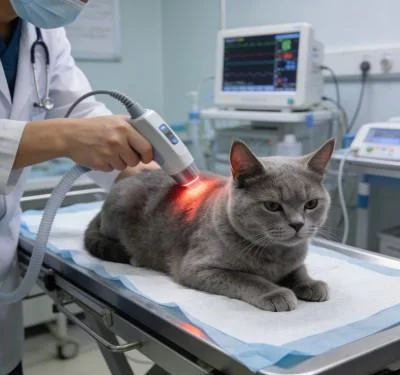
The following case record details this multi-wavelength protocol in a geriatric feline patient with severe chronic bilateral stifle osteoarthritis and secondary lumbar myofascial pain.
Case Record: Geriatric Feline Bilateral Stifle Osteoarthritis and Spinal Spondylosis
- Case Identifier: FELINE-2026-ORTHO-0884
- Patient Profile: 12-year-old female spayed Domestic Shorthair
- Body Mass: 3.8 kg
- Diagnosis: Severe bilateral stifle osteoarthritis (Grade 3 secondary to chronic cranial cruciate ligament laxity), marked peri-articular osteophytosis, and concurrent L4-S1 spondylosis deformans; Feline Musculoskeletal Pain Index (FMPI) score: 38/68; persistent reluctance to jump, severe grooming neglect over the hindquarters, and defensive aggression during hip and knee palpation
- Prior Conservative Therapy: Oral meloxicam at 0.05 mg/kg every 48 hours for three months, discontinued due to rising serum creatinine (IRIS Stage 2 CKD); gabapentin at 10 mg/kg twice daily caused excessive sedation and ataxia without fully restoring comfortable mobility
Comprehensive Treatment Protocol Parameters
| Session Number | Phase of Tissue Rehabilitation | Output Power (W) | Operating Mode & Duty Cycle | Targeted Spectral Distribution | Frequency (Hz) | Total Energy (Joules) | Fluence (J/cm²) |
| 01 | Acute Nociceptive Dampening | 4.0 W | Pulsed (30% Duty Cycle) | High 980 nm / Capillary Focus | 3,500 Hz | 480 J | 4.0 J/cm² |
| 02 | Interstitial Edema Clearance | 5.0 W | Pulsed (35% Duty Cycle) | High 1470 nm / Water Focus | 2,000 Hz | 650 J | 5.4 J/cm² |
| 03 | Synovial Decongestion | 6.0 W | Pulsed (35% Duty Cycle) | Balanced 980 nm / 1064 nm Mix | 1,200 Hz | 840 J | 7.0 J/cm² |
| 04 | Chondral Metabolic Saturation | 7.0 W | Superpulsed (40% Duty Cycle) | Penetration Dominant (1064 nm) | 500 Hz | 1,050 J | 8.7 J/cm² |
| 05 | Deep Collagen Matrix Remodeling | 7.5 W | Pulsed (40% Duty Cycle) | Quad-wavelength balanced array | 200 Hz | 1,200 J | 10.0 J/cm² |
| 06 | Spinal Myofascial Release | 8.0 W | Pulsed (45% Duty Cycle) | Deep Extracellular Matrix Focus | 100 Hz | 1,440 J | 12.0 J/cm² |
| 07 | Functional Kinetic Mobilization | 6.5 W | Continuous Dynamic Sweep | Multi-spectral Regenerative Mix | CW / Dynamic | 1,170 J | 9.7 J/cm² |
| 08 | Long-Term Mobility Maintenance | 5.0 W | Pulsed (35% Duty Cycle) | Balanced Maintenance Profile | 30 Hz | 800 J | 6.6 J/cm² |
Longitudinal Pain Index Evolution and Jumping Height Trajectory
Feline Musculoskeletal Pain Index (FMPI, Lower Score = Less Pain):
Pre-Treatment: [==================================] 38
Session 03:    [==========================] 26
Session 05:    [================] 15
Session 08:    [=======] 7 (Near-complete pain resolution)

Vertical Jumping Capability to Favorite Perch (cm):
Pre-Treatment: [=======] 15 cm (Hesitant, missed landings)
Session 03:    [=============] 30 cm
Session 05:    [====================] 50 cm
Session 08:    [===========================] 75 cm (Effortless vertical ascent)
By the third session, the cat ceased growling during pelvic limb palpation and began purring on the treatment mat. By session five, hindquarter grooming resumed, clearing matted fur along the dorsal flanks, while vertical jumping reach increased from fifteen to fifty centimeters. At the conclusion of eight treatments over four weeks, the FMPI score plummeted from thirty-eight to seven, daily gabapentin was discontinued, and the patient maintained active, playful household interaction without renal strain.
Clinical Advantages Over Traditional Pharmacotherapy
Managing chronic degenerative joint disease across diverse species frequently traps veterinary teams in clinical compromises. Long-term non-steroidal anti-inflammatory therapy carries severe nephrotoxic and hepatotoxic risks in senior cats and compromised dogs, while sedatives such as gabapentin often leave geriatric pets lethargic and uncoordinated. Conversely, surgical arthroplasty carries high financial entry points and anesthesia risks that many pet owners cannot accept.
Implementing high-power Class IV technology delivers distinct clinical and operational advantages:
1. Drug-Free Management for Medically Fragile Pets
Rather than relying on systemic pharmaceuticals that strain vulnerable kidneys and livers, targeted photobiomodulation treats local joint inflammation directly, stimulating cellular repair pathways without systemic side effects.
2. High Patient Throughput Across Species
Underpowered units require lengthy treatment times that stress anxious feline patients and strain staff schedules. A high-output platform delivers complete, deep therapeutic doses in three to five minutes for cats and six to eight minutes for giant dogs, allowing busy clinics to manage varied patient loads efficiently.
3. Clear Visual Recovery That Reassures Pet Owners
Pet owners track tangible signs of comfort: whether their cat climbs stairs smoothly, uses the litter box without accidents, and jumps onto favorite perches. Achieving noticeable functional improvements within the first three treatments gives clients confidence in the recovery plan, improving compliance with long-term lifestyle and weight-management recommendations.
High-power Class IV photomedicine offers a reliable, high-throughput solution for chronic mobility conditions in pets of every size. By delivering balanced multi-wavelength photon energy past dense anatomical barriers directly into deep degenerative joints, veterinary practices can resolve chronic stiffness, reduce pharmaceutical reliance, and help aging pets enjoy comfortable, active lives.