 FotonMedix











news
Company News丨Industry News丨Products News
Search the whole station
Company News丨Industry News丨Products News
In the trajectory of vascular surgery, few innovations have displaced a century-old standard of care as rapidly as Endovenous Laser Ablation (EVLT). For decades, highligation and stripping were the brutal necessities for treating Chronic Venous Insufficiency (CVI). Today, the paradigm has shifted entirely to thermal ablation. As clinical engineers and medical laser specialists, we recognize that the efficacy of EVLT is no longer a question of “if” it works, but “how” to optimize it. The conversation has moved from simple occlusion to the nuanced physics of water absorption coefficients, specifically the dominance of the 1470nm laser vein treatment combined with radial emission technology. This article serves as a technical dossier for vascular surgeons and clinic directors aiming to upgrade their phlebology protocols.
The fundamental goal of EVLT is to deliver sufficient thermal energy to the vein wall to cause irreversible collagen contraction and endothelial destruction, leading to fibrosis and eventual absorption of the vein. However, the target chromophore determines the side effect profile.
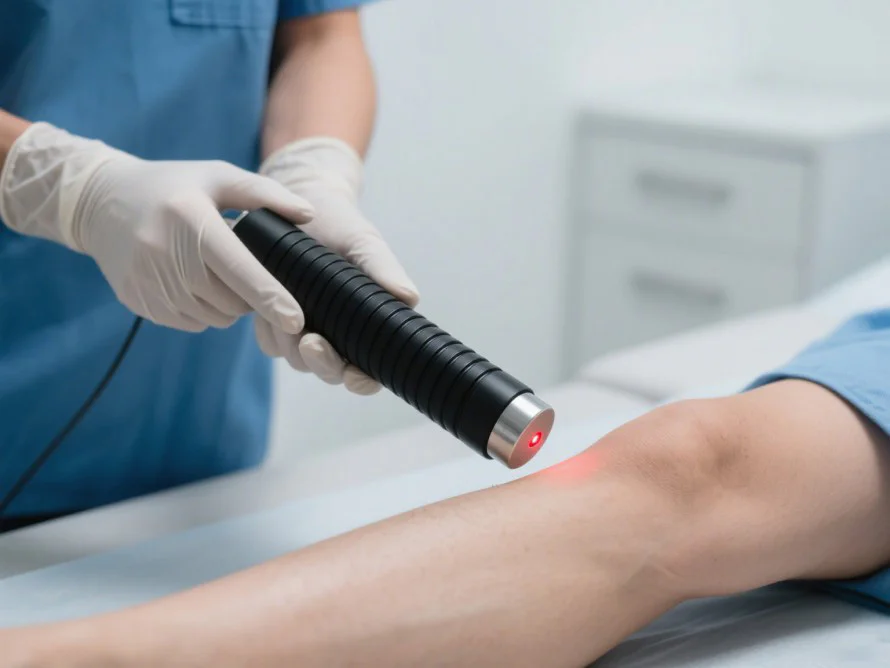
Early generations of EVLT utilized 810nm, 940nm, or 980nm wavelengths. These targeted hemoglobin.
Modern protocols champion the 1470nm wavelength.
The laser device is the engine, but the fiber is the tires—it determines how power hits the road.
To illustrate the procedural precision of modern diode laser systems, we present a case involving a standard yet symptomatic presentation of venous insufficiency.
Patient Profile:
Treatment Strategy:
Endovenous Laser Ablation (EVLT) using a 1470nm Diode Laser with a 600-micron Radial Fiber under Tumescent Anesthesia.
Procedural Parameters:
| Parameter | Setting / Value | Rationale |
| Wavelength | 1470 nm | Targets water in the vein wall for gentle coagulation. |
| Power | 6 Watts (Continuous Wave) | Lower power is sufficient for 1470nm compared to 12-15W used in 980nm. |
| Pull-back Speed | 1 mm per second | Crucial for consistent energy delivery. |
| LEED (Linear Endovenous Energy Density) | 70 Joules/cm | Calculated based on vein diameter (approx. 8-10 J/cm per mm of diameter). |
| Total Energy | ~2800 Joules | For a treated length of 40cm. |
| Anesthesia | Tumescent (Saline + Lidocaine + Epinephrine) | Creates a “heat sink” to protect surrounding tissue and compresses the vein onto the fiber. |
Intra-operative Steps:
Post-operative Recovery:
Clinical Conclusion:
The use of 1470nm prevented the “cording” and bruising typically associated with older high-temperature ablation. The patient experienced zero downtime, highlighting the endovenous laser ablation benefits over surgical stripping.
For a vascular center, the transition to office-based EVLT is one of the most profitable strategic moves available.
In the US market, the reimbursement or cash price for 1470nm laser vein treatment ranges significantly but maintains high margins.
If a clinic performs just 2 procedures per week, the device capital investment is often recouped within 2 months. Furthermore, the high patient satisfaction rate generates robust word-of-mouth referrals, reducing marketing spend.
When procuring a laser for phlebology, specifications are critical.
The era of vein stripping is effectively over. Endovenous Laser Ablation represents the pinnacle of minimally invasive surgery—where physics meets physiology to solve a mechanical problem with thermal precision. For the clinician, the combination of 1470nm technology and radial fibers offers a procedure that is reproducible, safe, and highly profitable. For the patient, it offers a walk-in, walk-out cure for a debilitating chronic condition. At Fotonmedix, we engineer our systems to bridge this gap, ensuring that the technology in your hand matches the skill in your fingers.
Q1: How does EVLT compare to Sclerotherapy?
EVLT is the gold standard for treating the underlying trunk veins (like the GSV) that cause varicosities. Sclerotherapy (chemical injection) is generally used for the visible, superficial tributary veins or spider veins after the main trunk has been closed with laser. They are complementary, not mutually exclusive.
Q2: Is the 1470nm laser only for veins?
While 1470nm is the “vein specialist,” its high water absorption also makes it excellent for other soft tissue surgeries, such as PLDD (Percutaneous Laser Disc Decompression) in the spine or ENT procedures, as it vaporizes tissue with minimal bleeding.
Q3: What is the risk of DVT with laser treatment?
The risk is extremely low (<1%) when proper protocols are followed. To mitigate this, patients are encouraged to walk immediately after the procedure to stimulate blood flow in the deep veins, and the laser tip is kept at a safe distance from the deep vein junction.
Q4: Can the treated vein grow back?
No. The treated segment of the vein is permanently fibrosed and absorbed by the body. However, because venous disease is chronic, new veins may become incompetent over time (recurrence), requiring future assessment.