 FotonMedix











The Neurological and Microsurgical Frontier: Integrating Advanced Photonics into Clinical Practice
The evolution of medical laser technology over the past two decades has fundamentally restructured the approach to both human rehabilitation and specialized veterinary surgery. In the current clinical landscape, the transition from palliative care to regenerative intervention is driven by our ability to manipulate coherent light at the cellular level. This analysis moves beyond the elementary concepts of biostimulation to explore the high-level applications of physical therapy laser treatment and the micro-precision required in canine laser eye surgery.
For the modern practitioner, the challenge lies in differentiating between various light-based modalities and understanding the specific physics that govern photon-tissue interaction. Whether we are treating a professional athlete for chronic radiculopathy or a canine patient for intractable glaucoma, the success of the intervention is predicated on the mastery of irradiance, fluence, and wavelength specificity.
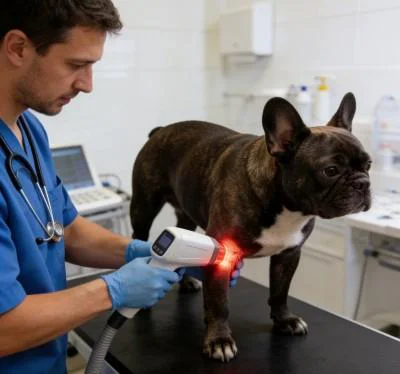
The Biophysics of Deep Tissue Modulation: Physical Therapy Laser Treatment
The primary goal of physical therapy laser treatment is the induction of photobiomodulation (PBM) within deep-seated musculoskeletal and neurological structures. Unlike surgical applications that rely on photothermal ablation, therapeutic applications utilize the “Optical Window” (650nm to 1100nm) to deliver non-ionizing radiation to the mitochondria.
Mitochondrial Bioenergetics and the Cytochrome c Oxidase Response
The fundamental mechanism of PBM involves the absorption of photons by Cytochrome c Oxidase (CcO), the terminal enzyme in the mitochondrial respiratory chain. In a state of injury or chronic inflammation, the production of Adenosine Triphosphate (ATP) is compromised due to the inhibitory binding of nitric oxide (NO) to CcO. Laser irradiation facilitates the dissociation of NO, thereby restoring oxygen consumption and accelerating ATP synthesis.
This surge in cellular energy triggers a cascade of secondary effects:
- Neural Analgesia: High-intensity lasers modulate the “Gate Control” mechanism of pain by increasing the threshold for nociceptive firing in C-fibers and A-delta fibers.
- Anti-Edema Response: Enhanced lymphatic drainage and localized vasodilation facilitate the removal of pro-inflammatory cytokines such as IL-6 and TNF-alpha.
- Angiogenesis: Stimulation of vascular endothelial growth factor (VEGF) promotes the formation of new micro-vasculature in ischemic tissues.
Critical Distinctions: Red Light Therapy vs Laser Therapy
A common point of clinical confusion involves the comparison of red light therapy vs laser therapy. While both utilize the visible red and near-infrared spectrum, their physical properties and clinical utility are separated by several orders of magnitude.
Coherence, Collimation, and the “Photon Hammer”
Red light therapy typically utilizes Light Emitting Diodes (LEDs), which produce non-coherent, highly divergent light. While effective for superficial dermatological conditions—such as wound healing or skin rejuvenation—LEDs lack the “photon density” required to penetrate the dermal and fascial barriers of the human body.
In contrast, physical therapy laser treatment utilizes Class 4 laser systems that produce coherent and collimated light. The coherence of the laser beam allows it to maintain a high power density even as it travels through several centimeters of tissue. For a clinician treating a deep-seated pathology like a lumbar disc protrusion or a canine hip joint, the laser acts as a “photon hammer,” delivering a therapeutic dose to the target tissue that LED panels simply cannot reach.
Irradiance and the Law of Scattering
The law of scattering dictates that as photons enter biological tissue, they are diverted by collagen fibers and cellular structures. To reach a depth of 5 to 10 centimeters, the initial irradiance at the skin’s surface must be sufficiently high to account for a 90% loss of energy. High-intensity laser therapy (HILT) provides the 15-30 Watts of power necessary to ensure that the remaining 10% of photons still constitute a therapeutic dose at the target site.
Ophthalmic Precision: Canine Laser Eye Surgery
While the application of lasers in physical therapy relies on scattering and volume saturation, canine laser eye surgery represents the apex of micro-optical precision. The eye is a unique surgical site because its anterior structures—the cornea and the aqueous humor—are transparent to certain wavelengths, particularly the 810nm diode laser.
Transscleral Cyclophotocoagulation (TSCPC) in Veterinary Medicine
The most technically demanding application of the diode laser in veterinary ophthalmology is the management of primary and secondary glaucoma. Glaucoma in dogs is a rapidly progressive and painful condition characterized by an increase in intraocular pressure (IOP). When medical management fails, canine laser eye surgery via TSCPC becomes the definitive treatment for preserving the globe and alleviating pain.
In this procedure, the laser energy is delivered through the sclera to the underlying ciliary body. The ciliary body is responsible for the production of aqueous humor. By selectively photocoagulating a portion of the secretory epithelium, the surgeon reduces the fluid production within the eye, thereby lowering the IOP. This requires a “thermal mode” of laser application, which is distinct from the non-thermal “biostimulation mode” used in rehabilitation.
Addressing Distichiasis and Intraocular Tumors
Beyond glaucoma, lasers are utilized for the treatment of distichiasis (extra eyelashes growing inward) and the excision of eyelid tumors. In these cases, the laser provides a bloodless surgical field and immediate sterilization of the tissue. The 810nm wavelength is particularly effective because it is highly absorbed by melanin, allowing for the precise targeting of pigmented hair follicles or tumor cells with minimal collateral damage to the surrounding healthy tissue.
Clinical Case Study: Management of Intractable Secondary Glaucoma in a Canine Patient
The following case demonstrates the clinical application of an 810nm diode laser in a complex veterinary ophthalmic setting where standard pharmacological intervention had reached its limit.
Patient Background
- Subject: “Buster,” an 8-year-old male Beagle.
- Condition: Secondary Glaucoma OD (Right Eye) following chronic pigmentary uveitis.
- History: Buster had been managed with topical Latanoprost and Dorzolamide for six months. However, the intraocular pressure (IOP) had spiked to 52 mmHg, resulting in acute corneal edema and significant ocular pain (blepharospasm).
Preliminary Diagnosis
Examination revealed diffuse corneal edema, a mid-dilated non-responsive pupil, and deep episcleral injection in the OD. The OS (Left Eye) remained within normal limits (IOP 16 mmHg). Buster was vocalizing and pawing at the eye, indicating severe distress. The diagnosis was Secondary Closed-Angle Glaucoma refractory to medical management.
Surgical Intervention: Canine Laser Eye Surgery (TSCPC)
The surgical team decided to proceed with Transscleral Cyclophotocoagulation to reduce aqueous humor production and permanently lower the IOP.
Treatment Parameters and Technical Configuration
| Parameter | Setting / Value | Clinical Objective |
| Wavelength | 810 nm | Targeting pigmented ciliary epithelium. |
| Delivery System | G-Probe (Contact Transscleral) | Precision placement 1.5mm from the limbus. |
| Power Output | 1800 mW (1.8 Watts) | Achieving focal photocoagulation. |
| Pulse Duration | 1500 ms (1.5 Seconds) | Controlled thermal delivery. |
| Total Spots Applied | 22 spots (360 degrees) | Comprehensive secretory inhibition. |
| Total Energy | 2.7 Joules per spot | Standardized dose for canine sclera. |
| Anesthesia | General + Topical Proparacaine | Ensuring patient immobility and comfort. |
Surgical Procedure
Buster was placed under general anesthesia. The G-Probe was positioned 1.5mm posterior to the limbus. The surgeon delivered 22 individual spots of energy around the circumference of the globe, specifically avoiding the 3 o’clock and 9 o’clock positions to spare the long posterior ciliary arteries. The procedure was completed in approximately 12 minutes.
Post-Operative Recovery and Results
- 24 Hours Post-Op: IOP in the OD dropped to 14 mmHg. The corneal edema began to clear significantly.
- 7 Days Post-Op: Buster was no longer showing signs of ocular pain. The IOP stabilized at 12 mmHg.
- 1 Month Follow-Up: The eye remained quiet and non-painful. Buster was transitioned to a low-dose topical anti-inflammatory for maintenance.
- Conclusion: The use of the 810nm diode for TSCPC successfully managed the intractable pressure spike, allowing Buster to avoid an enucleation (removal of the eye) and restoring his quality of life.
Navigating the Spectrum: Safety and Efficacy in Class 4 Systems
As we utilize high-power systems in both physical therapy laser treatment and surgery, safety protocols must be rigorous. The potential for retinal damage from a reflected laser beam is a primary concern.
- Ocular Safety: The 810nm wavelength is invisible to the human and canine eye. Therefore, the “blink reflex” will not protect the retina. All staff and patients must wear wavelength-specific safety goggles (OD 5+) during the procedure.
- Thermal Management: In physical therapy, the “scanning” technique is mandatory to prevent the accumulation of thermal energy in the skin. In surgery, the pulse duration must be precisely controlled to avoid tissue “pops” (vaporization), which can lead to excessive post-operative inflammation.
- Contraindications: Lasers should never be used over active malignancies (unless the intent is surgical excision), the thyroid gland, or a pregnant uterus. In veterinary patients, the presence of intraocular tumors must be ruled out via ultrasound before performing cyclophotocoagulation.
The Future of Photobiomodulation: Multi-Wavelength Synergies
The next decade of medical laser development will likely focus on the simultaneous delivery of multiple wavelengths. By combining 810nm (for ATP stimulation), 980nm (for microcirculation), and 1064nm (for analgesic gating), clinicians can address the three primary phases of the inflammatory and healing process in a single session. This “Synergistic Waveform” approach is particularly effective for complex neurological cases where both structural repair and pain modulation are required.
Furthermore, the integration of “Real-Time Dosimetry” sensors into laser handpieces will allow for the automatic adjustment of power output based on tissue temperature and reflection. This will eliminate the margin of error in physical therapy laser treatment, ensuring that every patient receives the exact “therapeutic dose” required for their specific pathology.
Summary for the Modern Practitioner
The clinical efficacy of laser technology in 2026 is no longer a matter of anecdotal evidence but a matter of technical precision. Whether performing a deep-tissue physical therapy laser treatment or a delicate canine laser eye surgery, the success of the outcome is inextricably linked to the clinician’s understanding of photonics. By maintaining a rigorous, science-based approach to wavelength selection and dosimetry, we can continue to push the boundaries of non-invasive and microsurgical medicine.
The transition from the non-coherent, superficial stimulation of red light therapy vs laser therapy to the high-intensity, coherent emission of Class 4 systems represents the future of rehabilitative excellence. As we continue to refine these protocols, the potential for light-based healing remains one of the most exciting frontiers in both human and veterinary medicine.
FAQ: Clinical Laser Applications
Q: Can physical therapy laser treatment be used on patients with metallic implants?
A: Yes. Unlike Diathermy or Ultrasound, laser energy is not absorbed by surgical stainless steel or titanium in a way that generates significant heat. It is a safe and preferred method for post-surgical rehabilitation following joint replacement or internal fixation.
Q: Is there a risk of “over-treating” a patient with laser therapy?
A: Yes. According to the Arndt-Schulz Law, excessive energy can lead to bio-inhibition, where the healing process is slowed rather than accelerated. This is why following calibrated dosimetry protocols is essential.
Q: How many sessions of canine laser eye surgery are typically required?
A: For glaucoma (TSCPC), usually one session is sufficient to achieve the desired pressure reduction. However, periodic monitoring is required, and a “touch-up” session may be needed months or years later if the ciliary body tissue regenerates.
Q: Why choose laser therapy over traditional pharmaceuticals for chronic pain?
A: Laser therapy is non-systemic and non-invasive. It treats the underlying cellular cause of pain (inflammation and mitochondrial dysfunction) without the side effects associated with long-term NSAID or opioid use, such as renal or hepatic toxicity.
Q: Can red light therapy reach the joints of a large breed dog?
A: Generally, no. Most red light therapy (LED) devices lack the power density and coherence to penetrate the thick coat and muscle of a large dog to reach the intra-articular space. Class 4 laser therapy is required for deep-seated joint issues.