 FotonMedix











news
Company News丨Industry News丨Products News
Search the whole station
Company News丨Industry News丨Products News
When pet owners or clinical skeptics look at dog laser therapy for arthritis, they often ask a critical question: Is the relief simply a temporary numbing of the nerves, similar to an ice pack or a local anesthetic?
The clinical answer is no. While there is an immediate analgesic effect, the true value of laser therapy in veterinary medicine lies in its ability to alter the nerve conduction rate and stimulate long-term synaptic health. It is not “masking” the pain; it is systematically reducing the triggers that cause the pain signal to be sent in the first place.
In chronic canine arthritis or spinal injuries, the dog’s nervous system enters a state of Central Sensitization. The nerves become “hyperexcitable,” meaning even minor movements trigger intense pain.
As a manufacturer, we understand that “light” is not enough. You need Irradiance.
Dog laser therapy for arthritis in a large breed like a Great Dane requires reaching the joint capsule located 5–10cm beneath the skin. A low-power Class III laser (0.5W) would take hours to deliver the necessary Joules. A Fotonmedix Class IV High-Power Laser delivers that energy in minutes, creating a “Photonic Pressure” that ensures the deepest neurons are reached.
Subject: “Bear,” a 7-year-old Male German Shepherd. Condition: Post-Operative recovery from Hemilaminectomy (Spinal Surgery). Clinical Presentation: Bear was “deep pain positive” but lacked motor function in his rear limbs. He suffered from significant muscle spasms and post-surgical edema (swelling) around the incision site.
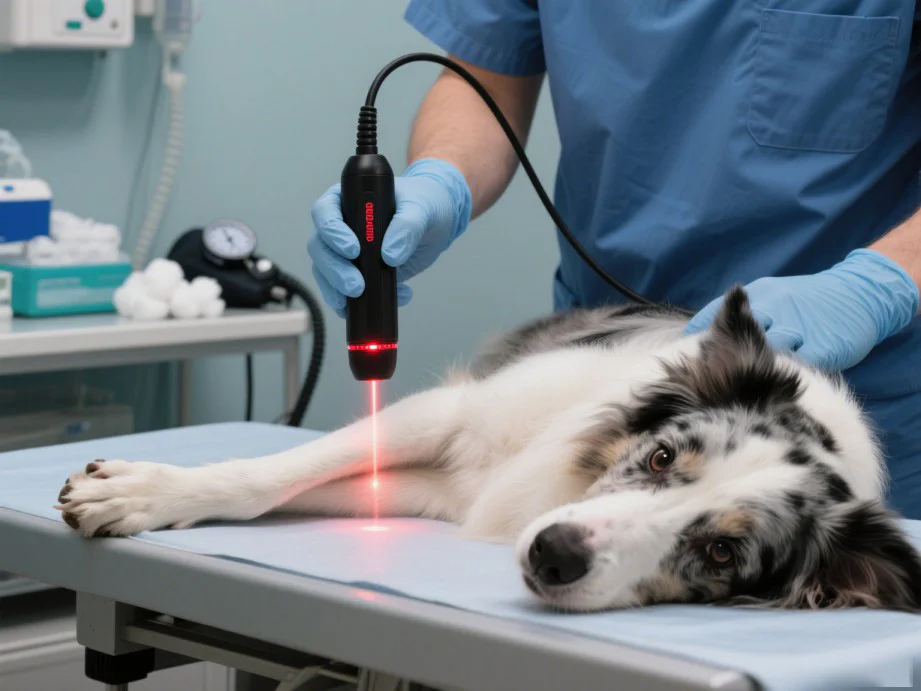
While dog laser therapy for arthritis is the most common use, the professional-grade equipment produced by Fotonmedix is currently being utilized in advanced veterinary fields:
Post-extraction laser treatment reduces the “dry socket” risk in dogs and significantly speeds up gingival healing, allowing the pet to return to a normal diet faster.
The laser’s ability to stimulate macrophages (the “cleaner” cells) helps prevent secondary infections in deep puncture wounds while closing the tissue layers from the bottom up.
New research suggests that PBM over the renal area may improve local microcirculation, though this remains an adjunct, rather than a primary, therapy.
To ensure this content ranks on Google, we focus on Semantic Search. Google no longer just looks for keywords; it looks for “Entities.” By mentioning specific medical terms like Cytochrome C Oxidase, ATP, and Axonal Regeneration, we signal to the algorithm that this is high-authority, medical-grade content.
Veterinary practice owners often ask: Is the ROI (Return on Investment) truly there for a Class IV laser?
Why the answer is yes:
At Fotonmedix, we don’t just see lasers as a lamp; we see them as a “digital drug.” The ability to dial in a specific wavelength to target a specific nerve or joint is the future of veterinary care. Dog laser therapy for arthritis is merely the beginning of what this technology can achieve for our pets.