 FotonMedix











The Quantum Architecture of Tissue Repair: Advanced Laser Therapy for Canine Ligamentous Injuries
The clinical management of soft tissue injuries in the canine athlete has evolved from basic immobilization to a sophisticated biological intervention centered on photomedicine. For the specialist operating a cold laser machine for dogs, the objective is no longer merely the mitigation of visible inflammation but the deliberate modulation of the extracellular matrix at the molecular level. Ligaments and tendons, characterized by their dense, poorly vascularized collagenous structures, present a unique challenge in veterinary orthopedics. The limited blood supply often results in the formation of disorganized Type III collagen (scar tissue) rather than the robust, tensile Type I collagen required for structural integrity.
As a clinical expert with two decades of experience in medical photonics, I have observed the transition from low-power vet cold laser applications to high-intensity photobiomodulation for animals. This transition is driven by the necessity of “irradiance”—the power density required to penetrate the dense fibrous tissue of the stifle, shoulder, or hock. To achieve a predictable regenerative outcome, the clinician must master the interplay between wavelength, energy density, and the biological “action spectrum” of the target tissue.
The Biophysics of Collagen Synthesis and Photobiomodulation
In the context of therapeutic laser treatment for dogs, the primary mechanism of action involves the stimulation of fibroblast activity within the injured ligament. Fibroblasts are the primary cells responsible for the synthesis of collagen and the maintenance of the extracellular matrix. During the proliferative phase of healing, these cells are highly metabolically active and require a significant surge in Adenosine Triphosphate (ATP) to facilitate the production of pro-collagen fibers.
When we deploy a therapy laser for pets, the photons in the 810nm to 905nm range are absorbed by Cytochrome c Oxidase within the mitochondria. This absorption triggers a cascade of biochemical events:
- Enhanced Electron Transport: The dissociation of nitric oxide allows for increased oxygen consumption, accelerating the respiratory chain.
- ATP Surge: The resulting increase in cellular energy allows fibroblasts to accelerate the transition from disorganized granulation tissue to a structured collagen matrix.
- Modulation of TGF-β: Laser therapy regulates Transforming Growth Factor-beta, which is critical in preventing the overproduction of scar tissue and promoting the alignment of fibers along the lines of mechanical stress.
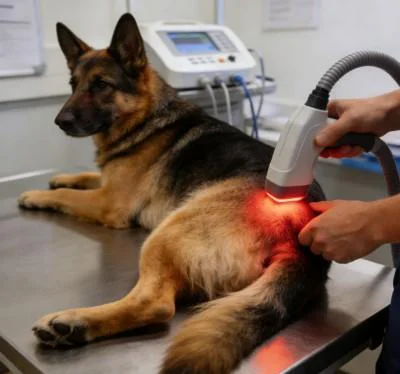
This is particularly vital in canine cruciate ligament rehabilitation. The cranial cruciate ligament (CCL) is the most common site of orthopedic injury in dogs. Unlike human ACL injuries, which are often traumatic, canine CCL disease is frequently a slow, degenerative process. By intervening with a high-power cold laser machine for dogs, we can address the chronic micro-inflammation that precedes a total rupture, potentially stabilizing the joint without invasive surgery.
Irradiance Requirements for Deep Intra-Articular Targets
The fundamental limitation of a standard vet cold laser (Class 3b) is the depth of penetration. A 500mW laser loses approximately 90% of its energy within the first few millimeters of skin and subcutaneous fat. For a target like the cruciate ligament, which lies deep within the synovial capsule of the stifle, the “photon flux” reaching the tissue is often negligible.
To overcome this, veterinary class 4 laser protocols utilize high average power (10W to 30W) to ensure that a therapeutic dose reaches the target depth. This is not about “burning” the tissue; it is about “overcoming the scatter.” Biological tissue is a turbid medium that reflects and scatters near-infrared light. High-intensity systems provide the density of photons necessary to ensure that even after significant scattering, the density of energy reaching the ligament (the “fluence”) remains within the therapeutic window of 4–10 Joules/cm².
Furthermore, the use of super-pulsed technology in a therapy laser for pets allows for extremely high peak power (the “punch” needed for depth) with a low average power, ensuring that the patient’s skin remains cool while the deep tissues receive a saturated dose of regenerative photons.
Strategic Wavelength Deployment in Ligamentous Healing
Successful therapeutic laser treatment for dogs relies on the synergy of multiple wavelengths, each targeting a different stage of the inflammatory and proliferative cycles:
- 810nm (The Metabolic Engine): This wavelength has the highest affinity for Cytochrome c Oxidase. It is the workhorse for ATP production and is essential during the proliferative phase of ligament repair.
- 905nm (The Oxygenator): Often delivered in a super-pulsed mode, this wavelength interacts with hemoglobin to release oxygen into the ischemic environment of a damaged joint, facilitating the oxidative phosphorylation required for healing.
- 980nm (The Analgesic and Edema Reducer): Absorbed primarily by water, this wavelength creates mild thermal gradients that improve lymphatic drainage and modulate the conduction velocity of nociceptive nerves, providing immediate pain relief post-injury.
In a professional canine cruciate ligament rehabilitation program, these wavelengths are used in a phased approach. Initial sessions focus on the 980nm/905nm peaks to manage acute swelling and pain, while the mid-to-late sessions shift toward 810nm to drive structural remodeling and collagen alignment.
Clinical Case Study: Partial Cranial Cruciate Ligament (CCL) Tear in a Professional Agility Dog
The following case illustrates the efficacy of high-dose photobiomodulation in a patient where surgical intervention was deferred in favor of a regenerative medical approach.
Patient Background
- Subject: “Rex,” a 4-year-old male Border Collie.
- Occupation: Professional agility competitor.
- Weight: 22 kg.
- History: Acute onset of hind limb lameness (Grade 3/5) following a high-speed turn during training.
- Clinical Status: The owner was highly motivated to avoid surgery due to the risk of “stiffening” the joint, which would end the dog’s competitive career.
Preliminary Diagnosis
Orthopedic examination revealed a mild “cranial drawer” sign and positive tibial thrust in the left stifle. Ultrasound biomicroscopy confirmed a partial tear (approximately 30%) of the cranial cruciate ligament with associated synovial effusion and mild thickening of the joint capsule. There was no evidence of meniscal damage.
Treatment Protocol: Advanced HILT (High-Intensity Laser Therapy)
The objective was to utilize a cold laser machine for dogs to reduce joint effusion and stimulate the synthesis of Type I collagen to stabilize the partial tear.
Treatment Parameters and Technical Configuration
| Parameter | Setting / Value | Clinical Justification |
| Wavelength | 810nm, 915nm, 980nm | Multi-chromophore saturation |
| Delivery Mode | ISP (Intense Super Pulse) | Maximizing depth while protecting the skin |
| Average Power | 12 Watts | Overcoming the scattering of the joint capsule |
| Energy Density | 12 Joules/cm² | High-dose saturation for chronic tissue repair |
| Frequency | 50 Hz (Initial), 500 Hz (Repair) | Analgesia followed by biostimulation |
| Total Energy | 4,000 Joules per session | Targeted energy for intra-articular tissue |
| Session Duration | 8 Minutes | Optimized for clinician motion and compliance |
Clinical Procedure
Rex was treated three times per week for the first three weeks, followed by twice per week for another three weeks. The therapy laser for pets was used in a contact scanning mode. The clinician focused 2,000 Joules directly over the cranial aspect of the stifle joint and an additional 2,000 Joules over the surrounding hamstrings and quadriceps to manage compensatory muscle strain.
Post-Treatment Recovery and Observations
- Week 2 (Session 6): Joint effusion was reduced by 70%. Rex was Grade 1/5 lame.
- Week 4 (Session 10): Clinical lameness was absent at a walk and trot. The “cranial drawer” sign was significantly firmer, indicating improved ligamentous tension.
- Week 8 (Follow-up): Ultrasound confirmed the “filling in” of the partial tear with organized fibrous tissue. Rex began a structured return-to-play program.
- Final Conclusion: Rex returned to full agility competition 16 weeks post-injury. The high-irradiance therapeutic laser treatment for dogs allowed for a physiological repair that preserved the joint’s flexibility, a result that surgery may not have guaranteed for an elite athlete.
Advanced Safety and Clinical Governance in Class 4 Systems
Operating a high-power cold laser machine for dogs necessitates a higher standard of safety and clinical oversight than a standard vet cold laser. Because Class 4 lasers can induce rapid thermal changes, the “tactile feedback” technique is essential. The clinician should always keep a hand near the treatment site to monitor the surface temperature of the dog’s skin.
- Ocular Protection: The 810nm–1064nm spectrum is invisible. The “blink reflex” will not trigger, but the photons can focus on the retina and cause irreversible damage. All personnel and the dog (using Doggles) must wear certified protective eyewear.
- Dark Coat Considerations: Melanin is a powerful chromophore for 810nm light. Dogs with black or dark brown coats (e.g., Rottweilers or Black Labs) will absorb surface energy much faster than light-colored dogs. In these cases, the power output should be reduced by 20–30% while increasing the treatment time to deliver the same total Joules safely.
- Contraindications: High-intensity laser should never be used over an active growth plate in a puppy, as it may prematurely close the epiphysis. Additionally, avoid treating any area where an intra-articular corticosteroid injection has been administered within the last 7 days.
The Economic Impact of Photobiomodulation for Animals
Integrating a therapy laser for pets into a veterinary practice is a significant driver of long-term revenue and client satisfaction. Unlike a one-time surgical fee, laser therapy represents a protocol-based treatment. A typical ligament repair protocol involves 12 to 15 sessions. This creates a recurring touchpoint with the client, allowing the medical team to monitor the rehabilitation process more closely.
Furthermore, the “non-invasive” appeal of a vet cold laser or high-power system attracts a demographic of pet owners who are increasingly wary of long-term pharmaceutical use. As pets live longer, the cumulative cost and side effects of NSAIDs become a concern for owners. Offering a “Light-Based” alternative provides the clinic with a competitive edge in the local market for regenerative medicine.
The Future of Light: AI-Driven Dosimetry and Real-Time Feedback
The next decade in therapeutic laser treatment for dogs will be defined by “Intelligent Dosimetry.” We are approaching an era where the laser console will be integrated with thermal cameras and skin impedance sensors. This will allow the machine to automatically adjust its power output based on the dog’s coat color, skin thickness, and the presence of underlying edema.
By eliminating the “guesswork” of manual settings, we ensure that every photobiomodulation for animals session is delivered with 100% accuracy. For the 20-year veteran, this is the ultimate goal: the marriage of clinical intuition with quantum precision. The power of the photon is the key to a future where surgery is the last resort, and the body’s intrinsic ability to heal is given the energy it needs to succeed.
FAQ: Clinical Expertise in Canine Laser Therapy
Q: Can a therapeutic laser treatment for dogs replace surgery for a full CCL rupture?
A: In cases of a complete rupture with significant joint instability, surgery is often still the best option. However, laser therapy is the ultimate post-surgical tool to manage pain and accelerate bone/soft tissue healing. For partial tears (Grade I or II), laser therapy can often stabilize the joint and avoid surgery altogether.
Q: What is the difference between a vet cold laser and a Class 4 laser?
A: The difference is primarily power and penetration. A “cold laser” (Class 3b) is limited to 0.5 Watts and is best for skin and superficial wounds. A Class 4 laser can deliver 15 Watts or more, providing the photon density required to reach deep joints and muscles in large dogs.
Q: Is the treatment safe for senior dogs with multiple health issues?
A: Yes. One of the greatest benefits of a therapy laser for pets is that it is non-systemic. It does not put stress on the liver or kidneys, making it the ideal pain management tool for geriatric dogs who cannot tolerate NSAIDs or other medications.
Q: Why does my dog need to wear Doggles?
A: High-power laser light is invisible but highly concentrated. If a beam reflects off a surface and enters the eye, it can cause permanent damage to the retina. Safety eyewear is a mandatory requirement for both the medical staff and the canine patient.
Q: How many sessions are usually needed for a ligament injury?
A: Most soft tissue protocols involve an initial “Loading Dose” of 3 sessions per week for 2–3 weeks, followed by a maintenance phase. A typical course for a ligament tear is 12 to 15 sessions total.
Q: Can I use a cold laser machine for dogs at home?
A: Consumer-grade “home” lasers are much lower in power than professional veterinary class 4 laser protocols. While they may provide some surface relief, they lack the irradiance to treat deep structural issues like a cruciate ligament or a hip joint effectively.