 FotonMedix











The Science of Photobiomodulation: A Comprehensive Clinical Guide to Red Light Therapy in Veterinary Orthopedics
The integration of advanced optical technology into veterinary medicine has transformed the management of chronic degenerative conditions. What was once considered a supplementary “alternative” treatment has now become a foundational pillar of modern rehabilitative care. When discussing red light therapy on dogs, we are not merely describing a soothing warmth; we are engaging with the profound science of photobiomodulation (PBM). As a clinical expert with two decades of experience navigating the complexities of medical lasers, I have witnessed the shift from skepticism to evidence-based adoption. This evolution is driven by our deepening understanding of mitochondrial bioenergetics and the specific biophysical interactions between photons and canine tissue.
The Biophysical Interaction: From Photons to Physiology
To understand the red light therapy benefits for dogs, one must first appreciate the “Optical Window” of biological tissue. Canine skin and fur present unique challenges that differ significantly from human medicine. Fur, particularly in dark-coated breeds, acts as a powerful filter, scattering and absorbing light energy before it can reach the deeper musculoskeletal structures. The efficacy of the treatment is therefore entirely dependent on the wavelength, power density, and the clinician’s ability to ensure a sufficient “photon flux” reaches the target mitochondria.
The primary mechanism of action involves the absorption of photons by chromophores within the cell, most notably cytochrome c oxidase (CCO) located in the inner mitochondrial membrane. When a dog is suffering from arthritis or acute injury, the oxidative phosphorylation process is hindered. Nitric oxide (NO) binds to the CCO enzyme, effectively “clogging” the cellular respiratory chain. This leads to a decrease in the production of adenosine triphosphate (ATP) and an increase in oxidative stress.
When we apply red light therapy on dogs at specific wavelengths—typically 630nm to 660nm for superficial tissue and 810nm to 980nm for deep tissue—we trigger a photochemical reaction. The photons dissociate the nitric oxide from the CCO enzyme, allowing oxygen to bind in its place. This restoration of mitochondrial bioenergetics leads to an immediate surge in ATP production, providing the cell with the metabolic “currency” required for repair and regeneration.
Canine Photobiomodulation (PBM) and the Inflammatory Cascade
The application of red light therapy for dogs with arthritis is specifically targeted at modulating the pro-inflammatory environment within the joint capsule. Chronic osteoarthritis in dogs is characterized by the presence of inflammatory cytokines, such as Interleukin-1 (IL-1) and Tumor Necrosis Factor-alpha (TNF-α), which contribute to the degradation of the extracellular matrix.
Advanced Canine photobiomodulation (PBM) works as a potent non-pharmacological anti-inflammatory agent. By dissociating nitric oxide, PBM also induces a temporary, localized vasodilation. This increase in microcirculation is vital for the delivery of oxygen and nutrients to the joint, while simultaneously facilitating the removal of metabolic waste products and inflammatory debris. Unlike systemic NSAIDs (Non-Steroidal Anti-Inflammatory Drugs), which can have adverse effects on renal and hepatic health in senior dogs, laser therapy provides a localized, site-specific treatment that targets the root cause of the metabolic stagnation.
Furthermore, the dissociation of nitric oxide leads to an increase in the production of reactive oxygen species (ROS) in controlled, low levels. These ROS act as secondary messengers, activating transcription factors that upregulate gene expression for tissue repair and cell survival. This is why the red light therapy benefits for dogs extend beyond simple pain masking; it actively shifts the joint from a state of chronic inflammation to a state of regenerative repair.
Overcoming the Fur Barrier: The Necessity of a Class IV Veterinary Laser
One of the most common pitfalls in veterinary laser medicine is under-dosing. A standard, low-power red light therapy device often lacks the irradiance necessary to overcome the scattering effect of the canine coat. In my 20 years of clinical practice, I have consistently found that a Class IV veterinary laser is required for effective orthopedic outcomes, particularly in large, double-coated breeds.
The distinction between a low-power LED device and a high-intensity laser is one of “Power Density” (W/cm²). While red light (650nm) is excellent for treating superficial wounds or lick granulomas, it has very little penetrative capacity beyond the first few millimeters of tissue. For treating the hips, elbows, or spine, we must utilize the near-infrared (NIR) spectrum. NIR light (810nm to 1064nm) experiences much less absorption by melanin and hemoglobin, allowing it to reach the joint space. However, because the photons are still subject to scattering, a high initial power output (Watts) is necessary to ensure that a therapeutic dose of Joules is delivered to the deep tissue in a reasonable timeframe.
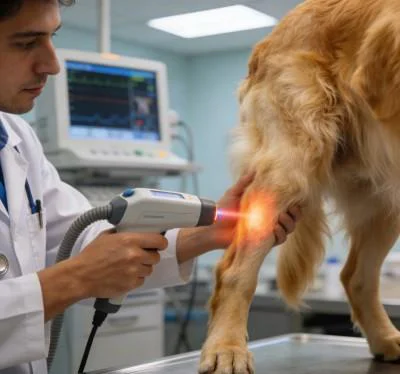
Wavelength Summation: Surface vs. Deep Joint Protocols
Effective red light therapy for dogs with arthritis utilizes “Wavelength Summation”—the simultaneous or sequential delivery of multiple wavelengths to address the various layers of pathology.
810nm: This wavelength has the highest affinity for cytochrome c oxidase. It is the primary engine for ATP production and is essential for deep-tissue regeneration in the chondrocytes (cartilage cells).
980nm: This wavelength targets the water in the interstitial fluid. By creating a controlled, localized thermal effect, it improves blood flow through vasodilation and provides an immediate analgesic effect via the gate-control theory of pain.
650nm: This red light wavelength targets the superficial nerve endings and the skin. While it does not reach the joint, it is vital for reducing compensatory muscle tension and improving the health of the surrounding dermis.
By combining these wavelengths, the clinician can treat the “injury chain”—from the superficial compensatory muscle guarding to the deep-seated arthritic lesion.
Hospital Clinical Case: Bilateral Elbow Dysplasia and Secondary Osteoarthritis
To illustrate the rigorous application of these principles, let us examine a detailed clinical case handled in a high-traffic veterinary rehabilitative center.
Patient Background:
The patient, “Gunner,” is an 8-year-old male neutered Rottweiler weighing 52kg. Gunner presented with a 2-year history of progressive thoracic limb lameness, which was significantly worse after exercise. He exhibited “head bobbing” lameness in the right forelimb and a stiff, shortened gait in the left.
Initial Diagnosis:
Physical examination revealed significant crepitus and decreased range of motion (ROM) in both elbows. Radiographic analysis confirmed Grade III Elbow Dysplasia with extensive osteophyte formation on the anconeal process and subchondral bone sclerosis. Gunner was already on a multimodal plan involving Gabapentin and a senior joint supplement, but his quality of life was declining.
Treatment Strategy:
The goal was to utilize a Class IV veterinary laser to deliver a high-energy dose to the elbow joint capsules and the surrounding triceps musculature. Given his dark, dense coat, the protocol required high irradiance to ensure photon penetration.
Clinical Treatment Parameters:
| Parameter | Setting / Value | Clinical Rationale |
| Wavelengths | 810nm + 980nm | ATP production and thermal vasodilation |
| Power Output | 15 Watts (Average) | Overcoming Rottweiler coat density |
| Duty Cycle | 50% (Pulsed) | Managing thermal relaxation time |
| Energy Density | 10 J/cm² | Targeted dose for deep joint structures |
| Total Energy | 4,000 Joules per elbow | Comprehensive dose for chronic OA |
| Frequency | 500 Hz (Phase 1) | Targeted at inflammatory modulation |
| Frequency | 10,000 Hz (Phase 2) | Targeted at immediate analgesia |
| Time per Session | 6-8 Minutes per joint | Sweeping motion to ensure even distribution |
Post-Treatment Recovery and Conclusion:
The protocol consisted of three sessions per week for two weeks (induction phase), followed by once-weekly sessions for four weeks (maintenance phase).
Week 2: Gunner’s owners reported he was “rising faster” and initiating play for the first time in months. His Pain Visual Analog Scale (VAS) score dropped from 8/10 to 5/10.
Week 6: Physical exam showed a 15-degree increase in flexion and extension ROM in both elbows. The crepitus was still present, but the associated pain response was significantly diminished.
Follow-up (3 Months): Gunner was able to resume 20-minute daily walks on soft surfaces. He was successfully tapered off Gabapentin, and his joint health is now managed through monthly “booster” laser sessions and therapeutic exercise. This case demonstrates that the answer to red light therapy for dogs with arthritis is not just “if” it works, but “how” it is dosed.
The Role of Mitochondrial Bioenergetics in Senior Pet Longevity
As our canine companions enter their geriatric years, their cellular “repair budget” decreases. This decline is often linked to mitochondrial senescence—the gradual loss of efficiency in the electron transport chain. When we perform red light therapy on dogs, we are essentially providing a “metabolic jumpstart.”
By consistently upregulating mitochondrial bioenergetics, we can mitigate the effects of chronic age-related inflammation, often referred to as “inflammaging.” This is one of the most significant red light therapy benefits for dogs that pet owners notice: a return of “mental brightness” and energy. This systemic effect occurs because the dissociated nitric oxide and the newly produced ATP enter the systemic circulation, providing a subtle but measurable benefit to the cardiovascular and neurological systems.
Practical Execution: Precision and Safety in Veterinary PBM
The success of any Canine photobiomodulation (PBM) session depends on the technique of the operator. Because we are using high-intensity Class IV lasers, safety and precision are paramount.
The Sweeping Motion: The clinician must always keep the laser head in motion. This ensures that the energy is distributed evenly across the joint capsule and prevents the accumulation of heat in the dark pigment of the fur or skin.
Tissue Compression: When treating deep joints like the hip or elbow, the clinician should use the laser handpiece to gently compress the tissue. This reduces the distance the photons must travel and “blanches” the superficial blood vessels, reducing the amount of light absorbed by hemoglobin before it can reach the joint.
Eye Protection: This is non-negotiable. Both the clinician and the patient (using specialized canine “Doggles”) must wear wavelength-specific safety goggles. NIR light is invisible, meaning the “blink reflex” will not protect the retina from accidental exposure.
Strategic Integration with Other Modalities
Red light therapy benefits for dogs are maximized when used as part of a multimodal rehabilitative program. In my experience, the synergy between laser therapy and hydrotherapy (underwater treadmill) is particularly effective. The laser is used prior to the treadmill session to reduce pain and increase blood flow, allowing the dog to perform more meaningful exercise without compensatory movement.
Similarly, combining laser therapy with targeted therapeutic exercises—such as “sit-to-stands” or cavaletti poles—ensures that the newly acquired ROM is supported by improved muscle strength. The laser provides the “biological window” of comfort, and the exercise provides the structural stability.
FAQ: Key Considerations for Pet Owners and Clinicians
- How do I know if my dog is receiving enough energy?In a professional setting, the dose is measured in Joules. For chronic arthritis in a medium to large dog, a dose of 2,000 to 5,000 Joules per joint is typically required. If your clinician is only using a “pointer” style laser for 60 seconds, it is highly likely the dose is sub-therapeutic for deep joint issues.
- Can red light therapy on dogs be used for cancer?Standard clinical practice is to avoid treating directly over a known malignant tumor, as the increased ATP could theoretically stimulate the growth of cancer cells. However, it can be used for palliative care in other areas of the body to improve the quality of life in oncology patients.
- Why is a Class IV laser better than a home LED device for arthritis?Depth. Arthritis is a deep-joint pathology. Home LED devices are great for skin health but lack the “collimated” beam and high power density required to penetrate the canine coat and reach the joint capsule. For chronic orthopedics, the veterinary-grade laser is the necessary tool.
- Are there any side effects to red light therapy for dogs with arthritis?When performed correctly, the side effects are virtually zero. Some dogs may experience a “rebound effect” where they are slightly more sore for 24 hours as the inflammatory debris is cleared, but this is usually followed by a significant improvement in mobility.
- How soon will I see results?While some dogs show immediate improvement due to endorphin release, structural healing and long-term inflammatory modulation usually require a “loading phase” of 6 to 8 sessions over three weeks.
The Future of Veterinary Medical Lasers
As we look toward the next decade, the focus of Canine photobiomodulation (PBM) will shift toward more personalized dosing. We are beginning to see the emergence of “smart” laser systems that can adjust their power output based on the specific tissue density and coat color of the patient. Furthermore, the integration of real-time thermal imaging will allow clinicians to visualize the “inflammatory map” of the dog during the treatment, ensuring that the energy is directed exactly where it is needed most.
The goal of our work at the intersection of optics and medicine remains the same: to provide a non-invasive, drug-free pathway to healing. By respecting the physics of light and the biology of the dog, we can ensure that every patient has the opportunity to age with dignity, mobility, and a high quality of life.
Clinical Conclusion
The efficacy of red light therapy on dogs is no longer a matter of debate; it is a matter of clinical precision. By understanding the intricacies of mitochondrial bioenergetics and utilizing high-power Class IV technology, we can achieve outcomes that were once thought impossible. Whether we are treating a young athlete with elbow dysplasia or a senior companion with spinal degeneration, the strategic application of light allows us to tap into the body’s innate capacity for repair. As clinicians, our responsibility is to move beyond the surface and deliver the photons exactly where they can do the most good.