 FotonMedix











Understanding the Financial and Clinical Landscape of Modern Laser Therapy
The evolution of medical laser technology has transitioned from high-cost experimental procedures to essential interventions in vascular and musculoskeletal medicine. For clinicians and healthcare administrators, understanding the cost-benefit ratio is not merely about the price of the equipment, but the long-term clinical outcomes and patient throughput enabled by specific wavelengths and delivery systems.
The Economic Architecture of Laser-Based Medical Interventions
When analyzing how much does laser therapy cost, it is imperative to distinguish between high-intensity surgical applications and low-level therapeutic modalities. The cost is a multifaceted equation involving equipment depreciation, specialized consumables (such as radial fibers), and the clinical expertise required for safe execution.
In the contemporary market, patients and providers are navigating a landscape where the initial investment in laser technology directly correlates with reduced recovery times and a decrease in post-operative complications. This economic efficiency is most evident in specialized fields like phlebology and podiatric medicine.
Primary Cost Drivers in Laser Medicine
- Wavelength Specificity: Advanced systems utilizing 1470nm or 1940nm wavelengths for vascular work often command higher procedure fees due to their targeted water-absorption characteristics, which minimize collateral thermal damage.
- Consumable Integration: The use of single-use sterile probes or specialized handpieces significantly impacts the per-procedure cost.
- Clinical Setting: Hospital-based procedures typically carry higher overhead costs compared to outpatient specialized clinics.
Navigating the Costs of Endovenous Laser Therapy (EVLT)
Endovenous laser therapy cost remains a focal point for patients suffering from chronic venous insufficiency (CVI). Unlike traditional vein stripping, EVLT is a minimally invasive procedure that uses thermal energy to collapse diseased veins.
From a clinical perspective, the cost is justified by the ablation rate and the prevention of deep vein thrombosis (DVT). The procedure typically ranges from $2,000 to $5,000 per leg, depending on the extent of the varicosities and the geographical location of the practice. However, when evaluating the “cost,” one must include the reduction in “lost workdays” which, for the working-age population, represents a significant indirect financial saving.
Comparative Efficacy and Value
While radiofrequency ablation (RFA) is a competitor, laser therapy offers a distinct advantage in treating smaller tributary veins and cases with complex venous anatomy. The precision of a fiber-optic delivery system allows for a more tailored approach, ensuring that the energy density ($J/cm^2$) is optimized for the specific vessel diameter.
Addressing Chronic Pain: Laser Therapy for Foot Pain
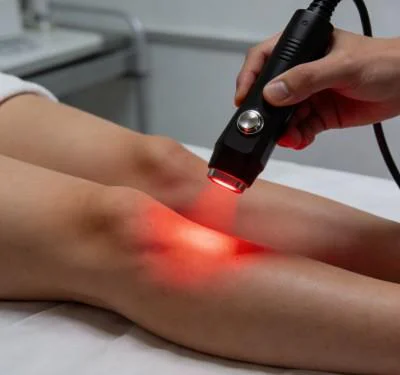
In the realm of physical medicine, laser therapy for foot pain has emerged as a gold-standard non-pharmacological intervention. Whether treating plantar fasciitis, Achilles tendonitis, or peripheral neuropathy, the goal is photobiomodulation (PBM).
PBM works by stimulating cytochrome c oxidase within the mitochondria, accelerating the production of Adenosine Triphosphate (ATP). This biochemical surge facilitates rapid tissue repair and inflammation reduction. For patients, the cost of a course of laser treatments (typically 6 to 12 sessions) is often weighed against the ongoing costs of orthotics, corticosteroid injections, or potential surgery.
Expanded Semantic Keywords for SEO
To provide a comprehensive view of the market, we must also address these high-traffic related areas:
- Class IV laser therapy benefits: High-power lasers that deliver higher dosages of energy to deep tissues in shorter timeframes.
- Medical laser reimbursement rates: The fluctuating landscape of insurance coverage for laser procedures.
- Photobiomodulation clinical protocols: The standardized settings used by clinicians to ensure repeatable therapeutic outcomes.
Clinical Case Study: Chronic Venous Insufficiency and Varicose Veins
To illustrate the practical application of high-end laser systems, we examine a case involving advanced vascular pathology.
Patient Background
- Age/Gender: 52-year-old Female.
- Occupation: Retail Manager (requires standing 8-10 hours daily).
- Chief Complaint: Severe bilateral lower extremity heaviness, nighttime cramping, and visible bulging veins (CEAP Classification: C3).
- Medical History: Two previous pregnancies, no history of DVT, BMI of 29.
Preliminary Diagnosis
Duplex Ultrasound (DUS) revealed significant reflux in the Great Saphenous Vein (GSV) originating from the saphenofemoral junction (SFJ). The vein diameter measured 9.2mm at the proximal thigh.
Treatment Parameters and Protocol
The surgical team opted for an endovenous laser ablation using a 1470nm diode system, known for its high absorption in the water component of the vessel wall, allowing for lower energy settings and less post-operative bruising.
| Parameter | Value |
| Wavelength | 1470 nm |
| Power Output | 7 Watts (Continuous Wave) |
| Energy Density (LEED) | 70 J/cm |
| Fiber Type | Radial Emission Fiber (360 degrees) |
| Anesthesia | Tumescent Local Anesthesia (TLA) |
Surgical Execution
Under ultrasound guidance, a 6F sheath was introduced into the GSV at the knee level. The radial fiber was positioned 2cm distal to the SFJ. Tumescent anesthesia was injected circumferentially to provide a heat sink and protect perivenous structures. The laser was activated, and the fiber was withdrawn at a steady rate to ensure uniform thermal delivery.
Post-Operative Recovery and Results
- Immediate Post-Op: Patient ambulated for 30 minutes immediately following the procedure. Compression stockings (20-30 mmHg) were prescribed for 14 days.
- 7-Day Follow-up: Ultrasound confirmed total occlusion of the GSV. No evidence of endovenous heat-induced thrombosis (EHIT).
- 30-Day Follow-up: Significant reduction in VCSS (Venous Clinical Severity Score). The patient reported a 90% reduction in pain and heaviness.
Clinical Conclusion
The use of 1470nm wavelength with a radial fiber significantly reduces the risk of vein wall perforation. This case demonstrates that while the initial endovenous laser therapy cost involves sophisticated equipment, the clinical outcome—minimal downtime and high success rate—represents the highest value for the patient.
Technical Analysis of Laser Parameters in Podiatry
When clinicians implement laser therapy for foot pain, the success of the treatment is dependent on the “Therapeutic Window.” Delivering too little energy results in no biological response, while too much can cause inhibitory effects or thermal injury.
Energy Delivery Calculation
The total energy delivered ($E$) is calculated as:
$E = P \times t$
(Where $P$ is power in Watts and $t$ is time in seconds).
For deep-seated conditions like plantar fasciitis, a Class IV laser is preferred because it can overcome the skin’s reflection and absorption in the melanin/hemoglobin layers to reach the plantar fascia at the calcaneal attachment.
Treatment Protocol for Plantar Fasciitis
- Wavelength: Dual-wave (810nm for oxygenation and 980nm for pain/biostimulation).
- Power: 10W-15W.
- Dose: 10-15 $J/cm^2$.
- Frequency: 2-3 sessions per week for 3 weeks.
Strategic FAQ
How does endovenous laser therapy cost compare to traditional surgery?
While the upfront cost of EVLT might be higher due to specialized laser fibers and equipment, the “total cost of care” is lower. Traditional surgery (stripping) requires general anesthesia, hospital stays, and weeks of recovery. EVLT is performed in an hour under local anesthesia with immediate return to work.
Does insurance typically cover laser therapy for foot pain?
Coverage varies. Most insurance providers cover EVLT for symptomatic varicose veins if medical necessity is proven via ultrasound. However, PBM or “Cold Laser” for foot pain is often an out-of-pocket expense, though it is increasingly being accepted as a legitimate alternative to long-term opioid use or surgery.
Is one laser wavelength better than others for pain management?
There is no “perfect” wavelength, but the 800nm to 1100nm range (the “Optical Window”) is generally considered best for deep tissue penetration.
What are the main Class IV laser therapy benefits?
The primary benefits include faster treatment times, deeper penetration into joints and muscles, and a more pronounced analgesic effect compared to lower-powered Class III lasers.