Introduction
The shift toward non-invasive, regenerative technologies in modern rehabilitation medicine has made knee laser therapy one of the fastest-growing interventions in orthopedics and sports medicine. Unlike medications or injections, which offer short-lived relief, photobiomodulation influences cellular biology, circulation, and tissue architecture, enabling long-term structural improvement.
This article explores how laser therapy for knee pain assists patients with degenerative, traumatic, and biomechanical disorders. It further analyzes why medical teams frequently combine knee treatment with laser therapy for feet to resolve kinetic-chain dysfunctions responsible for persistent pain.
Core Physiological Effects of Knee Laser Therapy
1. Modulation of Chronic Synovitis
Laser therapy reduces inflammatory synovial membrane volume, decreasing:
- Stiffness
- Joint effusion
- Mechanical pressure on subchondral bone
2. Cartilage Metabolic Enhancement
Although photobiomodulation does not regenerate full-thickness cartilage, it supports:
- Chondrocyte metabolic efficiency
- Anti-inflammatory cytokine balance
- Improved joint lubrication dynamics
3. Soft-Tissue Remodeling
Laser treatment accelerates healing of:
- MCL sprains
- Quadriceps tendon micro-tears
- Iliotibial band irritation
- Patellar tracking dysfunction
4. Edema and Pain Reduction
Laser energy reduces cytokines, stabilizes nerve membrane potential, and accelerates lymphatic drainage.
Conditions Commonly Treated With Laser Therapy for Knee Pain
Hospitals regularly use knee laser therapy to manage:
- Medial compartment osteoarthritis
- Lateral meniscus irritation
- Chronic patellofemoral pain
- Baker’s cyst inflammation
- Early degenerative joint disease in runners
- Post-surgical stiffness following ACL reconstruction
Many patients report improvements after several sessions, especially when integrated into structured physiotherapy plans.
The Role of Foot Function in Knee Disorders
Lower-extremity biomechanics dictate how forces travel from the ground up through the tibia into the knee joint. Foot pathologies often increase stress on knee joints.
Conditions That Worsen Knee Dysfunction
- Plantar fasciitis
- Collapsed arch
- Rigid high arch (cavus foot)
- Midfoot arthritis
- Achilles tendinopathy
- Morton’s neuroma
Why Laser Therapy for Feet Matters
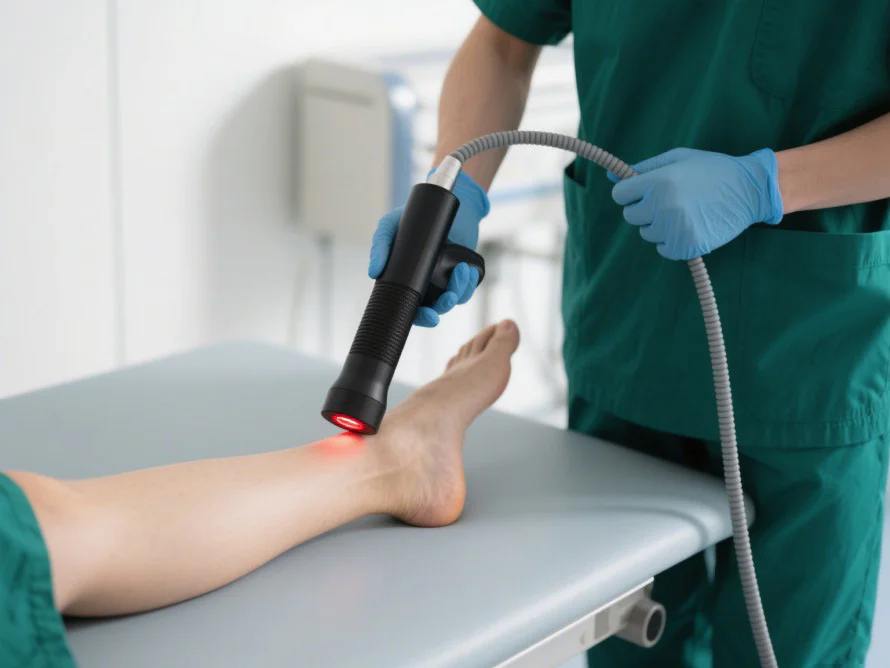
Treating the foot reduces compensatory joint loading, enabling knee tissues to heal properly. This is why clinicians frequently pair knee protocols with laser therapy for feet during rehabilitation.
Clinical Methodology in Hospitals
Evaluation
A typical assessment involves:
- MRI or ultrasound for deep tissue imaging
- Weight-bearing radiographs
- Functional tests (single-leg squat, step-down test)
- Gait cycle evaluation
Laser Therapy Protocols
Hospitals often employ:
- Class IV laser
- Multi-wavelength output (810/980 nm)
- 10–18 W power
- 10-minute scanning over joint line, soft-tissue insertions, and synovial border
For the feet:
- 6–10 minutes on plantar fascia, midfoot joints, or Achilles tendon depending on pathology
Rehabilitation Integration
Laser therapy is paired with:
- Neuromuscular conditioning
- Manual therapy
- Postural alignment correction
- Strength symmetry restoration
Hospital Case Study
Case Title:
“Chronic Post-Meniscectomy Knee Pain With Compensatory Forefoot Overload Successfully Managed Using Knee and Foot Laser Therapy”
Patient Profile
- Age: 57
- Sex: Female
- History: Partial lateral meniscectomy six years before; persistent lateral knee discomfort and swelling; forefoot pain developed due to altered gait
Diagnostic Findings
- MRI: Mild lateral compartment degeneration
- Ultrasound: IT band friction area inflamed
- Foot exam: Metatarsalgia with increased plantar pressure in 2nd/3rd MTP joints
- Functional assessment: Reduced push-off strength, Trendelenburg gait pattern
Treatment Protocol
- Knee laser therapy
- Class IV, 810/980 nm, 14 W, 12 minutes
- Target zones: lateral joint line, IT band insertion, lateral patellar retinaculum
- Laser therapy for feet
- Applied over MTP joints and forefoot plantar surface
- Aimed to reduce tissue overload and improve gait mechanics
- Combined with gluteal strengthening, hip mobility work, and forefoot loading correction.
Outcome After 9 Sessions
- Knee pain decreased from VAS 7 to VAS 2
- Forefoot metatarsal swelling significantly reduced
- Improved stride length and symmetrical push-off
- MRI follow-up showed reduction in IT band fluid accumulation
- Patient resumed hiking without lateral knee irritation
This case demonstrates how concurrent knee and foot laser therapy can resolve long-standing biomechanical complications following orthopedic surgery.
Conclusion
Laser technology gives clinicians a powerful tool for addressing chronic knee disorders at a biological and mechanical level. When delivered through structured medical protocols—and paired with corrective treatment to the feet—laser therapy for knee pain, knee laser therapy, and laser therapy for feet provide long-term recovery pathways that were historically difficult to achieve using traditional conservative methods.
 FotonMedix