 FotonMedix











news
Company News丨Industry News丨Products News
Search the whole station
Company News丨Industry News丨Products News
Knee pain remains one of the most common reasons for outpatient orthopedic visits among adults. Degenerative joint disease, traumatic soft-tissue injuries, chronic tendinopathy, and post-surgical inflammation continue to drive long-term disability. As patients and clinicians seek non-invasive, well-tolerated, and evidence-supported modalities, laser therapy for knee pain has shifted from an adjunctive technique into a widely recognized component of rehabilitation medicine. Its growing acceptance in hospital departments, sports injury clinics, and physiotherapy centers reflects both technological progress and measurable clinical outcomes.
This article examines the science, clinical indications, mechanisms of action, hospital-grade usage procedures, and a real case study demonstrating how knee laser therapy performs in actual medical practice. Additionally, it evaluates how lower-extremity pathology often overlaps—particularly regarding gait abnormalities—requiring clinicians to integrate laser therapy for feet when treating knee disorders influenced by biomechanical compensation.
Therapeutic laser devices deliver specific wavelengths—commonly Class IIIb and Class IV—designed to trigger photobiomodulation at cellular and tissue levels. In knee rehabilitation, several pathways are clinically relevant:
Laser irradiation stimulates endothelial nitric oxide release, encouraging vasodilation. Regions of the knee with compromised perfusion—such as degenerated cartilage or chronically inflamed synovium—display measurable increases in oxygenation post-therapy.
Photonic energy absorbed by cytochrome c oxidase influences ATP production. Increased energy availability accelerates synthesis of structural proteins involved in ligament and tendon remodeling.
Laser therapy interrupts nociceptive transmission by stabilizing neuronal membrane potential and reducing peripheral C-fiber sensitivity. This contributes to both immediate and long-term reductions in knee pain intensity.
Research demonstrates decreased expression of IL-1β, IL-6, and TNF-α in treated joints. This favors a restorative microenvironment conducive to cartilage and synovial health.
Hospitals and rehabilitation specialists increasingly adopt laser treatment due to several operational advantages:
Patients avoid risks associated with injections or surgical interventions.
Sessions typically last 5–15 minutes, with no downtime.
Laser therapy integrates smoothly with physiotherapy, aquatic therapy, joint mobilization, and orthopedic bracing.
Applications include:
Clinicians report that combining knee laser therapy with structured strength and alignment protocols leads to higher patient adherence and better long-term outcomes.
Orthopedists consistently observe that gait mechanics involving the subtalar joint, arch stability, and forefoot alignment influence knee loading patterns. For this reason, laser therapy for feet often becomes a necessary adjunct, especially in patients with:
Treating both anatomical regions reduces compensatory strain and supports symmetrical weight distribution during rehabilitation.
A standardized medical protocol generally includes:
Most hospitals use:
Improvement often emerges between sessions 3 and 6. Chronic degenerative cases may require 10–15 visits for stable benefits.
“Acute Fibrillation Synovitis With Secondary Patellar Tracking Disorder Managed Using Laser Therapy for Knee Pain”
The attending orthopedic specialist noted that combining knee laser therapy with foot correction created a synergistic recovery pattern that would not have been achieved through knee-only treatment.
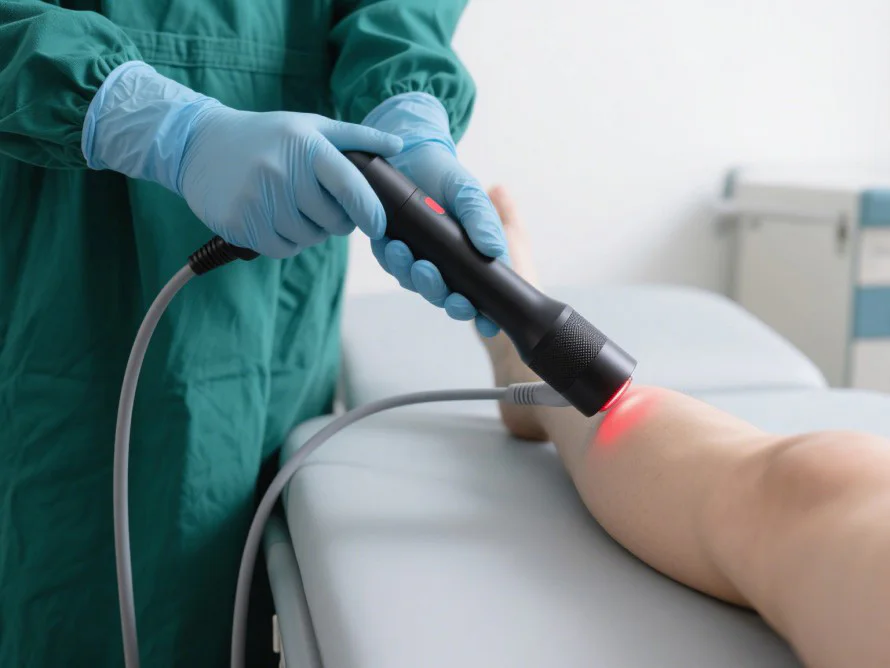
Laser-based photobiomodulation aligns with modern orthopedic priorities: non-invasive care, quantifiable tissue regeneration, safety, and compatibility with integrated rehabilitation programs. As more hospitals adopt Class IV technology, data consistently reinforces its value for knee osteoarthritis, soft-tissue injuries, synovitis, and biomechanical compensation disorders.