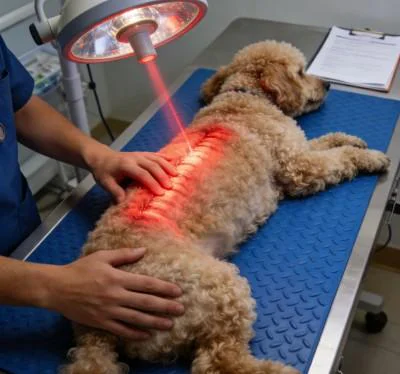
先进的生物光子学:重新定义兽医难治性伤口处理和皮肤缺血的临床标准
The modern veterinary clinician faces an increasingly complex demographic of patients: aging companions with multiple comorbidities, brachycephalic breeds with compromised healing, and high-performance athletes with focal soft tissue trauma. In this environment, the traditional reliance on “time and topical” wound management is being replaced by a more aggressive, biologically targeted approach. The utilization of 兽用激光器 has moved beyond a supplemental “wellness” service into a core component of regenerative medicine. Specifically, the application of 光生物调节 (PBM) to resolve dermal ischemia and refractory soft tissue injuries represents the pinnacle of modern light-based therapy.
When a practitioner evaluates the market for a 医生兽医治疗激光, they are essentially looking for a tool that can modulate the very foundations of cellular respiration. While pet owners often seek the 最适合狗狗的红光治疗仪 for home-use wellness, the professional reality is that chronic wounds and deep-seated 犬肌肉骨骼疼痛 require an irradiance and wavelength specificity that consumer-grade 红光治疗宠物 products simply cannot provide. This article examines the clinical physics of high-power PBM, the molecular mechanisms of dermal regeneration, and the strategic integration of a 四级 兽用激光器 into the critical care and dermatological workflow.
The Molecular Dynamics of Dermal Ischemia and the “Ischemic Stall”
Chronic wounds—such as decubital ulcers, non-healing surgical incisions, or ischemic skin flaps—are characterized by a state known as the “ischemic stall.” In these tissues, the microvasculature is compromised, leading to a localized hypoxic environment. Without sufficient oxygen, the mitochondrial respiratory chain becomes inefficient, leading to a depletion of Adenosine Triphosphate (ATP) and a buildup of Reactive Oxygen Species (ROS). This biochemical environment inhibits fibroblast proliferation and the synthesis of a healthy collagen matrix.
Photobiomodulation for animal pain management and wound repair addresses this deficit at the level of the cytochrome c oxidase (CCO) enzyme. When photons in the near-infrared (NIR) spectrum are absorbed by CCO, they trigger the dissociation of nitric oxide (NO). This is a critical clinical event. Nitric oxide, when bound to the mitochondria, acts as a “braking” mechanism for cellular respiration. By displacing NO, the laser allows oxygen to re-bind, essentially “unlocking” the cell’s ability to produce energy.
Furthermore, the displaced NO enters the surrounding interstitial space and microvessels, where it acts as a potent vasodilator. This immediate improvement in microcirculation facilitates the delivery of nutrient-rich blood to the ischemic zone and the removal of metabolic waste. For the patient, this transition from a chronic inflammatory M1 macrophage phenotype to a regenerative M2 phenotype is the hallmark of successful laser intervention.

Wavelength Synergy: The Multi-Layered Approach to Soft Tissue Repair
专业人员 医生兽医治疗激光 is defined by its ability to deliver energy to different depths of tissue simultaneously. This is achieved through the utilization of multiple wavelengths, each targeting a specific chromophore.
- 660 纳米(可见红): This wavelength is primarily absorbed by the superficial layers of the skin. It is essential for managing the bacterial biofilm on the wound surface and stimulating the initial stages of epithelialization.
- 810 纳米(近红外): Often considered the “gold standard” for ATP production, 810nm has a high absorption rate in CCO. It is the workhorse for driving the metabolic repair of fibroblasts and keratinocytes.
- 980 纳米(近红外): This wavelength has a high affinity for water and hemoglobin. Its primary role is the modulation of microcirculation and the reduction of localized edema. By improving fluid dynamics, it clears the path for photons from other wavelengths to penetrate deeper.
- 1064 纳米(近红外): Possessing the lowest scattering coefficient in mammalian tissue, 1064nm is critical for reaching deep 犬肌肉骨骼疼痛 and deep-seated ischemic pockets that shorter wavelengths cannot access.
The clinical advantage of a 4 级兽用激光器 lies in its high irradiance (power density). To reach the deep dermal layers through the scattering barrier of fur and thick epidermis, the laser must maintain a high “photon pressure.” While a low-power 红光治疗宠物 device may provide some superficial metabolic support, it lacks the power to overcome the optical density of compromised tissue, often failing to reach the therapeutic threshold of 6-10 J/cm² required for structural regeneration.
Managing the Biofilm and Immune Response in Refractory Wounds
One of the primary reasons wounds become “refractory” is the development of a bacterial biofilm. These protective matrices make bacteria up to 1,000 times more resistant to systemic antibiotics. High-intensity PBM has been shown to disrupt these biofilms, making the bacteria more susceptible to both the patient’s immune system and topical antimicrobials.
Moreover, the stimulatory effect of a 医生兽医治疗激光 extends to the local immune cells. PBM increases the phagocytic activity of macrophages and the motility of leukocytes. By enhancing the local “surveillance” of the immune system, 激光治疗 helps to resolve the low-grade, persistent infections that often keep a wound trapped in the inflammatory phase.
Clinical Case Study: Management of a Large, Ischemic Bite Wound in a Geriatric Canine
This case illustrates the transition from a failing conservative management protocol to a successful regenerative outcome utilizing high-power PBM.
患者背景
- 主题 “Gus,” a 12-year-old male neutered Greyhound.
- 重量 32 千克。.
- 历史 Gus presented with a massive, degloving bite wound on the lateral aspect of the right thigh. Due to his age and thin Greyhound skin, the wound had undergone significant edge necrosis. After three weeks of standard bandaging and systemic antibiotics, the wound was 12cm x 8cm, with 40% of the bed covered in necrotic slough and no evidence of granulation tissue.
- 合并症: Moderate osteoarthritis in the hocks, making movement painful and further delaying systemic circulation.
初步诊断
- Non-healing, Stage 4 Ischemic Wound.
- Localized Tissue Hypoxia and Biofilm formation.
- Secondary 犬肌肉骨骼疼痛 in the hindlimbs.
治疗参数和方案
目的是利用多波长 4 级兽用激光器 to disrupt the biofilm, stimulate angiogenesis, and drive the proliferative phase of healing.
| 治疗阶段 | 频率 | 波长 | 功率(瓦) | 模式 | 剂量(焦耳/平方厘米) | 总能量(焦耳) |
| Phase 1: Debridement | 每日(7 天) | 660nm + 980nm | 10W | 脉冲(100 赫兹) | 6 焦耳/平方厘米 | 2,000 J |
| 第 2 阶段:再生 | 每周 3 次 | 810nm + 1064nm | 15W | 化武 | 10 焦耳/平方厘米 | 5,000 J |
| 第 3 阶段:改建 | 每周 1 次 | 810 纳米 | 12W | 化武 | 8 焦耳/平方厘米 | 4,000 J |
临床应用详情
During the initial “Debridement” phase, the laser was used in a non-contact mode to prevent contamination. The 660nm and 980nm wavelengths were prioritized to stimulate superficial immune response and reduce the massive localized edema. By the end of Week 1, the necrotic slough had loosened significantly, allowing for a clean mechanical debridement.
In Phase 2, the protocol shifted to high-power Continuous Wave (CW) therapy. The 1064nm wavelength was used to treat the deep muscle layers beneath the wound to improve the vascular bed from the “inside out.” A contact technique was used on the wound margins to stimulate fibroblast migration.
术后恢复和效果
- 第二周 The wound bed showed 100% healthy, beefy red granulation tissue. The first “islands” of epithelialization appeared at the margins.
- 第四周 The wound size had reduced by 60%. Gus’s lameness had improved, as the 激光治疗 on the thigh also addressed the underlying muscle tension.
- 第八周 Complete wound closure was achieved. The new skin was supple and showed good integration with the surrounding tissue, with minimal scar contraction.
- 结论 高辐照度的 医生兽医治疗激光 provided the bio-energetic stimulus necessary to overcome the “ischemic stall.” By addressing both the superficial biofilm and the deep vascular deficit, the laser facilitated a recovery that was previously static under standard care.
Strategic Implementation: Choosing Your Veterinary Laser for Success
对于诊所所有者来说,获得 4 级兽用激光器 is a significant driver of both clinical outcomes and practice revenue. When searching for a 兽用激光器出售, clinicians must look beyond the wattage and evaluate the “Clinical Intelligence” of the system. A high-quality device should offer:
- Dose Mapping: Software that calculates the exact Joules required based on the species, coat color, and the specific pathology being treated.
- 手机多功能性 The ability to switch between large massage heads for 犬肌肉骨骼疼痛 and fine-point, non-contact tips for delicate wound care.
- Thermal Safety Sensors: Advanced systems now include real-time thermal monitoring to ensure that the patient’s skin temperature remains within the therapeutic range, particularly in dark-coated patients where melanin absorption is higher.
The investment in professional-grade 激光治疗设备 pays for itself not only through session revenue but through the reduction in “unbilled” complications. A wound that heals 40% faster with no dehiscence represents a massive saving in technician time, bandage changes, and client frustration.
常见问题
How does laser therapy help with “old” or chronic wounds?
Chronic wounds are often stuck in the inflammatory phase of healing. The 医生兽医治疗激光 provides the cellular energy (ATP) needed for the tissue to finally progress into the proliferative phase. It restarts the “biological clock” of the wound by improving microcirculation and reducing oxidative stress.
Can laser therapy replace antibiotics for skin infections?
No, but it is a powerful adjunct. By disrupting biofilms and stimulating the local immune response, laser therapy makes antibiotics much more effective. In some minor cases, it may allow for a shorter course of medication, but it should be part of a multimodal plan.
Is the best red light therapy device for dogs at home the same as a vet’s laser?
Not even close. At-home devices are usually Class 1 or 2 (low power) and non-coherent. They are fine for general wellness, but they lack the irradiance (power) to reach the deep dermal or musculoskeletal layers where real pathology resides. A professional 4 级兽用激光器 provides up to 100 times more power density.
Is it painful for the dog?
Actually, most dogs find it extremely soothing. The laser creates a gentle, deep warmth. Because it also triggers the release of endorphins, many dogs will relax or even fall asleep during the treatment. It is a “fear-free” modality.
How many sessions will my dog need for a wound?
While every wound is different, a typical protocol for a chronic wound involves a “loading” phase of 3-5 sessions in the first week, followed by 2-3 sessions per week until closure. Most clinicians see a visible improvement in the wound bed within 2-3 sessions.
The Future of Veterinary Care: A Photon-Integrated Standard
As we look toward the future, the role of 兽用激光器 in standard practice is only going to expand. We are moving away from the era of “waiting for healing” to an era of “driving regeneration.” By mastering the physics of light and the biology of the cell, we can provide our patients with a level of care that was once reserved for human elite athletics.
"(《世界人权宣言》) 医生兽医治疗激光 is the centerpiece of this transition. It allows us to treat the “untreatable” wounds, resolve the chronic pain of our geriatric patients, and ensure that every surgical incision has the best possible start. In the hands of a skilled practitioner, the photon is the ultimate tool for clinical excellence—providing a drug-free, non-invasive, and highly effective pathway to health for the companions we serve.
FotonMedix