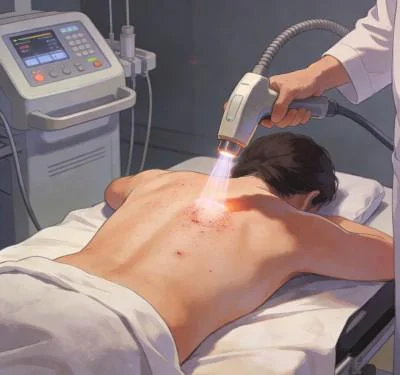
临床前沿:通过先进的 4 级激光光生物调制加速组织再生
The landscape of non-invasive rehabilitation has undergone a seismic shift with the integration of high-irradiance light therapy. As clinical practitioners, the focus has moved from mere symptomatic pain management to the biological orchestration of tissue repair. Central to this evolution is the Class 4 laser, a tool that transcends the limitations of traditional low-level light therapy by delivering therapeutic dosages to deep-seated anatomical structures. This article explores the physiological mechanisms, dosimetric precision, and clinical outcomes associated with modern 激光治疗仪, grounded in 20 years of clinical observation and biophotonic research.
The Biological Imperative: Photobiomodulation at the Cellular Level
Photobiomodulation (PBM) therapy is not a thermal intervention; it is a photochemical one. While Class 4 lasers possess the power to generate heat, their primary therapeutic value lies in the interaction between photons and specific cellular chromophores. The primary target is Cytochrome c oxidase (CCO), the terminal enzyme in the mitochondrial electron transport chain.
当 激光治疗仪 delivers photons in the near-infrared (NIR) spectrum—typically between 800nm and 1100nm—these photons displace inhibitory nitric oxide (NO) from the CCO binding site. This displacement restores oxygen consumption and accelerates the production of Adenosine Triphosphate (ATP). The resulting “bioenergetic surge” provides the metabolic fuel necessary for cellular repair, protein synthesis, and the modulation of oxidative stress.
Beyond ATP, PBM influences cellular signaling pathways. It triggers the release of reactive oxygen species (ROS) in controlled, physiological amounts, which act as secondary messengers to activate transcription factors like NF-kB and AP-1. These factors govern the expression of genes involved in cell proliferation, migration, and the synthesis of anti-inflammatory cytokines. In the context of musculoskeletal rehabilitation, this means faster recruitment of fibroblasts and satellite cells, leading to structural integrity rather than just temporary analgesia.
Class 4 Laser Technology: Overcoming the Depth-Dose Paradox
For decades, clinicians struggled with the “Depth-Dose Paradox”: the fact that the skin and subcutaneous fat absorb and scatter the majority of incident light. Low-power lasers (Class 3b) often fail to deliver a sufficient “Joules per square centimeter” ($J/cm^2$) dosage to target tissues like the lumbar facets or the hip capsule.
A 4 级激光治疗机 solves this through high power density. By delivering power outputs exceeding 0.5 Watts (and often up to 30 Watts in modern clinical units), these devices create a photon density high enough to overcome the scattering coefficient of biological tissue.

权力与时间的关系
In clinical SEO and medical practice, the “Power-Time” relationship is critical. A 15-Watt Class 4 laser can deliver a 3,000-Joule treatment to a large muscle group in 4 minutes, whereas a 500mW laser would require 100 minutes to achieve the same total energy delivery. This efficiency is not just about throughput; it is about reaching the biological threshold required to trigger the systemic and local regenerative responses.
多波长同步
The most effective Class 4 systems do not rely on a single wavelength. Instead, they utilize a strategic blend:
- 810 纳米: Optimal for CCO absorption and deep tissue penetration.
- 980 纳米: Targeted at water and hemoglobin, improving local circulation and modulating nerve conduction velocity for immediate pain relief.
- 1064 纳米: Offers the deepest penetration with minimal melanin absorption, ideal for dense structures like ligaments and tendons.
High Intensity Laser Therapy (HILT) in Musculoskeletal Rehabilitation
High Intensity Laser Therapy (HILT) has emerged as a cornerstone in the treatment of chronic degenerative conditions. Unlike standard physical therapy modalities that may only address mechanical dysfunction, HILT addresses the underlying metabolic stagnation of chronic injuries.
In conditions such as calcific tendinopathy or high-grade muscle strains, the tissue is often in a state of hypoxia. The high irradiance of a Class 4 laser promotes significant vasodilation through the release of nitric oxide. This “angiogenic stimulus” increases the delivery of oxygen and nutrients while facilitating the removal of metabolic waste products like lactic acid and bradykinin.
Furthermore, PBM therapy exerts a profound effect on the peripheral nervous system. It increases the threshold of nociceptors and reduces the conduction of C-fibers, which are responsible for slow, chronic pain signals. This neurophysiological modulation allows patients to engage in active rehabilitation exercises sooner, breaking the cycle of pain and disuse atrophy.
Clinical Case Study: Regenerative Protocol for Chronic Calcific Rotator Cuff Tendinopathy
To illustrate the clinical efficacy of Class 4 laser therapy, we examine a case from a specialized orthopedic rehabilitation center. This case highlights the necessity of precise parameter setting and the predictable trajectory of recovery when PBM is applied correctly.
患者背景
- 主题 54-year-old male, recreational tennis player.
- 历史 14-month history of right shoulder pain (dominant side). Pain rated 8/10 during overhead activity. Failed conservative treatments including NSAIDs, corticosteroid injections (two rounds), and standard physical therapy.
- 诊断 Confirmed via Diagnostic Ultrasound and MRI as Chronic Calcific Tendinopathy of the Supraspinatus tendon with a 0.8cm calcium deposit and associated subacromial bursitis.
最初的临床表现
The patient exhibited limited range of motion (ROM) in abduction (85 degrees) and internal rotation. Visible muscle wasting was noted in the infraspinatus fossa. The goal was to eliminate the need for surgical debridement by using Class 4 laser therapy to induce resorption of the calcification and stimulate collagen remodeling.
治疗参数和方案
The treatment was administered using a multi-wavelength Class 4 laser therapy machine. A total of 12 sessions were conducted over 6 weeks (twice weekly).
| 参数 | Phase 1 (Weeks 1-2): Pain & Edema | Phase 2 (Weeks 3-6): Regeneration |
| 主波长 | 980nm (60%),810nm (40%) | 810nm (70%)、1064nm (30%) |
| 输出功率 | 10 瓦(脉冲) | 15 瓦(连续波) |
| 频率 | 20Hz (for analgesic effect) | 1000Hz (to stimulate fibroblasts) |
| 能量密度 | 8 焦耳/平方厘米 | 12 焦耳/平方厘米 |
| 每次会议的总能量 | 4,000 焦耳 | 6 500 焦耳 |
| 持续时间 | 8 分钟 | 10 分钟 |
治疗后恢复过程
- 第 1-3 节 The patient reported a “warming sensation” during treatment. Immediate post-treatment pain reduction was noted (from 8/10 to 4/10), likely due to the temporary inhibition of A-delta and C-fiber transmission.
- 第 4-8 节 Range of motion increased significantly. Abduction improved to 140 degrees. Follow-up ultrasound at week 4 showed the borders of the calcific deposit becoming “fuzzy,” indicating active resorption by macrophages.
- 第 9-12 节 Pain during daily activities was eliminated (0/10). The patient began eccentric loading exercises without discomfort.
最终结论
At the 3-month follow-up, a repeat MRI showed complete resolution of the calcific deposit and a significant increase in the organized collagen density of the supraspinatus tendon. The patient returned to competitive tennis. This case demonstrates that the high energy delivery of a Class 4 laser is capable of triggering biological processes—such as macrophage-led resorption—that are simply not possible with lower-power devices.
The Role of Cellular Signaling Pathways in Long-term Outcomes
The success of the aforementioned case is not merely an “acute” reaction. The long-term stability of the tissue is due to the activation of specific cellular signaling pathways. Specifically, PBM therapy upregulates the production of Transforming Growth Factor-beta (TGF-beta) and Vascular Endothelial Growth Factor (VEGF).
TGF-beta is a critical regulator of the extracellular matrix (ECM). By stimulating fibroblast activity, it ensures that the “new” collagen laid down in the tendon is primarily Type I (strong and elastic) rather than Type III (scar tissue). Meanwhile, VEGF promotes neovascularization, ensuring that the previously bradytrophic (low blood supply) tendon tissue receives a permanent increase in microcirculation. This shift from a degenerative state to a regenerative one is the hallmark of professional-grade laser therapy.
Safety, Dosimetry, and Precision in Laser Therapy Machines
Operating a Class 4 laser requires a sophisticated understanding of dosimetry. Because these machines deliver high power, the risk of thermal injury is present if the applicator remains stationary. Clinical experts utilize a “scanning technique,” moving the handpiece in a slow, grid-like pattern to ensure homogeneous light distribution without creating “hot spots.”
Modern Class 4 devices often include “Smart Protocols” that calculate energy delivery based on the patient’s skin phototype (Fitzpatrick Scale), the depth of the target tissue, and the chronicity of the condition. Precision is further enhanced by the use of different handpiece attachments:
- Contact Zoom: For deep myofascial trigger points where compression is needed to displace superficial blood and allow deeper photon travel.
- Non-Contact Large Beam: For broad areas like the lumbar spine or quadriceps, ensuring a large spot size and uniform energy density.
Integrating Class 4 Laser into a Multimodal Clinical Framework
While a Class 4 laser is a powerful stand-alone tool, its SEO value and clinical utility are maximized when integrated into a comprehensive care plan. In the modern clinic, laser therapy serves as a “primer.” By applying PBM therapy 之前 manual therapy or exercise, the clinician reduces the patient’s pain threshold and increases tissue extensibility. This synergy leads to higher patient compliance and faster discharge times.
The data is clear: clinics that adopt high-irradiance laser machines see a reduction in the number of required sessions per patient by 30-50% compared to traditional modalities. This efficiency is a compelling argument for both patient outcomes and clinic profitability.
常见问题(FAQ)
Is Class 4 laser therapy safe for patients with metal implants?
Yes. Unlike diathermy or ultrasound, which can heat metal implants and cause internal burns, laser light is not reflected or absorbed by surgical stainless steel or titanium in a way that causes dangerous temperature spikes. This makes it an ideal choice for post-surgical rehabilitation after joint replacement.
通常需要进行多少次疗程才能看到效果?
虽然有些患者会因为神经末梢的镇痛作用而立即缓解疼痛,但组织结构的变化通常需要 “累积剂量”。对于急性损伤,4-6 次治疗可能就足够了。对于慢性退行性疾病,通常建议进行 10-15 次治疗,以完成再生周期。.
4 级激光器和 “冷激光器 ”有什么区别?
“冷激光 ”是 3b 级激光(0.5 瓦以下)的通用术语。虽然它们可以刺激表层组织,但往往缺乏足够的功率,无法在实际治疗时间内达到深层结构。4 级激光器的功率更高,穿透更深,治疗时间也大大缩短,但需要主动移动手机来控制热效应。.
PBM 治疗是否有禁忌症?
主要禁忌症包括直接在已知的原发性或继发性癌症上进行治疗、在孕妇腹部进行治疗或在甲状腺上进行治疗。此外,在进行高强度治疗前,应仔细评估服用光敏药物的患者。.
结论:无创医学的未来
从 “控制 ”疼痛到 “治疗 ”病理,是医学界的新标准。 医用激光器 科学随着我们对细胞信号通路和生物光子相互作用认识的加深,4 级激光治疗机仍然是临床医生武器库中最有力的工具。通过利用 光生物调节疗法, 现在,我们可以为患者提供一条快速、非侵入性、以生物学为基础的康复之路。的时代 高强度激光疗法 这不仅仅是力量的问题,而是如何精确运用光来释放人体与生俱来的再生潜能。.
FotonMedix