搜索整个车站

行业新闻

关节炎解决方案:用第 4 级激光疗法控制慢性关节退化

Osteoarthritis (OA) is the most common form of arthritis, affecting millions worldwide. It’s characterized by the progressive breakdown of cartilage, leading to pain, stiffness, swelling, and decreased mobility. For years, management has centered on pain medications, corticosteroid injections, and eventually, joint replacement surgery. However, a new, regenerative approach is changing the narrative: 4 级激光治疗. This non-invasive modality offers hope by not just masking pain but by actively combating the underlying degenerative processes within the joint.

This article delves into the pathophysiology of osteoarthritis and explains how 深层组织激光疗法 intervenes to slow degeneration and promote a healing environment. We will also analyze the key features that make a 4 级激光治疗 machine ideal for managing chronic joint conditions and present a detailed case study demonstrating significant improvement in a patient with severe knee OA.

Understanding Osteoarthritis: More Than Just “Wear and Tear”

Osteoarthritis was once simplistically viewed as the result of mechanical “wear and tear.” Modern medicine now understands it as a complex inflammatory and metabolic disease of the entire joint organ, including cartilage, bone, synovium, and ligaments.

The key pathological processes include:

  1. Cartilage Breakdown: Chondrocytes (cartilage cells) become dysfunctional, producing less of the essential compounds (collagen and proteoglycans) that give cartilage its structure and shock-absorbing properties. Enzymes like matrix metalloproteinases (MMPs) break down the cartilage matrix.
  2. Synovial Inflammation: The synovium (joint lining) becomes chronically inflamed, a condition called synovitis. This inflamed tissue releases a flood of pro-inflammatory cytokines (e.g., IL-1β, TNF-α) that accelerate cartilage destruction.
  3. Subchondral Bone Changes: The bone beneath the cartilage (subchondral bone) remodels, becoming harder and developing lesions, which further compromises joint mechanics and pain signaling.
  4. Weakened Musculature: Pain leads to disuse, which causes muscle atrophy around the joint. This loss of muscular support places even more stress on the joint, creating a vicious cycle of degeneration.

How Laser Treatment Therapy Targets the Root Causes of OA

4 级激光治疗 addresses each of these pathological pillars through photobiomodulation:

  • Modulating Inflammation: The laser light is absorbed by the inflamed synovium and immune cells within the joint. This absorption dramatically reduces the production and release of destructive cytokines like TNF-α and IL-1β, effectively “cooling down” the inflammatory environment that drives cartilage breakdown.
  • Stimulating Chondrocyte Activity: The primary photonic effect is a boost in mitochondrial ATP production within chondrocytes. With more cellular energy, these cells can become more active, increasing the synthesis of collagen and proteoglycans to repair and maintain the cartilage matrix.
  • Inhibiting Pain Pathways: Laser therapy decreases the sensitivity of pain-transmitting nerves (nociceptors) in and around the joint. It also stimulates the release of endorphins and reduces the production of pain-mediating compounds like prostaglandins and bradykinin.
  • Improving Circulation and Reducing Stiffness: The therapy promotes vasodilation, improving blood flow to the periarticular muscles and joint capsule. This enhances oxygen delivery, reduces stagnant fluid, and improves flexibility.

Case Study: Overcoming Severe Knee Osteoarthritis and Avoiding Surgery

患者简介

  • 姓名缩写: D.W.
  • 年龄 68
  • 性别 男
  • 职业 Retired teacher
  • 症状 Severe bilateral knee osteoarthritis, right worse than left. Diagnosed 10 years prior.

现病史:
D.W. reported constant, deep aching pain in both knees, rated 7/10 on average, worsening to 9/10 with walking or standing for more than 10 minutes. He experienced significant morning stiffness lasting over an hour and nightly pain that disrupted his sleep. He had undergone 6 corticosteroid injections over the years, each providing diminishing returns. His orthopedist had recommended total knee arthroplasty (replacement). D.W. sought a non-surgical alternative.

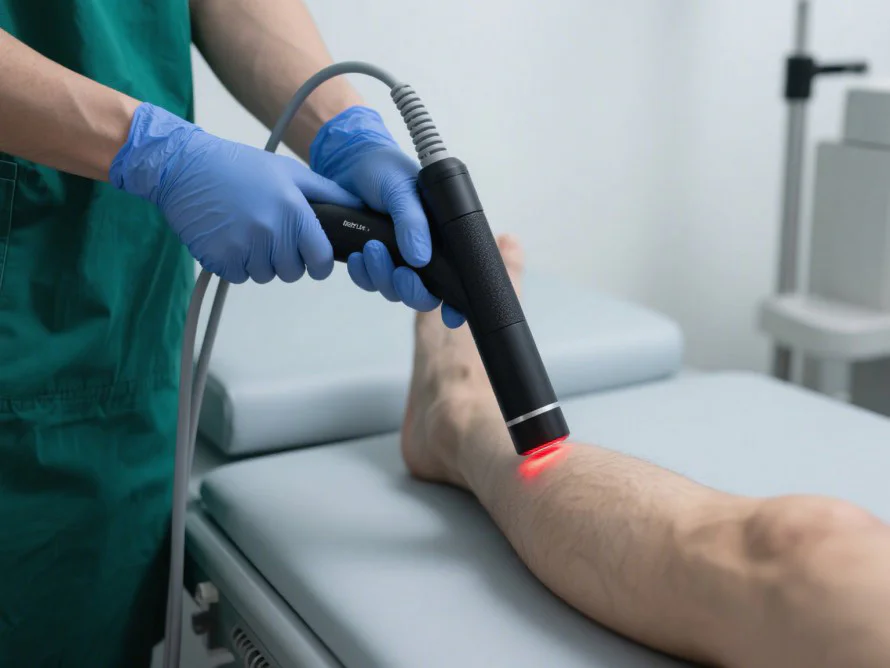
<trp-post-container data-trp-post-id='7037'>The Arthritis Solution: Managing Chronic Joint Degeneration with Class 4 Laser Therapy</trp-post-container> - knee pain(images 1)

客观调查结果:

  • 观察: Antalgic (painful) gait, noticeable quadriceps atrophy in the right leg.
  • 触诊 Significant tenderness along the joint line, crepitus (grinding) with movement, and small effusion.
  • Range of Motion: Active knee flexion was limited to 110° on the right (normal ~135°), with painful extension.
  • 功能限制: Unable to climb stairs without use of a railing and severe pain. Difficulty rising from a chair without use of arms.
  • Radiographic Evidence: Weight-bearing X-rays showed severe joint space narrowing, large osteophytes (bone spurs), and subchondral sclerosis, confirming Grade 4 (severe) OA.

治疗计划:
课程 深层组织激光疗法 was initiated on the right knee.

  • 设备: An FDA-cleared 4 级激光治疗 machine (15W, 810nm).
  • 频率 3 treatments per week for 8 weeks.
  • 协议: The laser was applied to the medial, lateral, and anterior aspects of the knee, as well as the surrounding quadriceps and hamstring tendons. A dosage of 10-12 J/cm² was used per area.
  • 辅助疗法: The patient was prescribed simple, non-weight-bearing isometric strengthening exercises for the quadriceps and gentle range-of-motion exercises to perform daily.

结果与成果:

  • After 4 treatments (1.5 weeks): D.W. reported a 30% reduction in resting pain and noted a significant decrease in morning stiffness, down to 30 minutes.
  • 治疗 12 次后(4 周): His resting pain was rated 2/10. He could walk for 20 minutes with only mild discomfort (3/10). He was sleeping through the night. His quadriceps strength showed measurable improvement.
  • After 24 treatments (8 weeks): D.W. achieved full, pain-free knee extension and flexion to 125°. He could climb stairs foot-over-foot with minimal pain and rise from a chair without using his arms. He rated his overall improvement at 80%.
  • 3 个月随访: The patient maintained his improvements and had joined a aquatic therapy class to continue strengthening. He successfully postponed his knee replacement surgery indefinitely. His outcome scores (WOMAC and VAS) showed dramatic and clinically significant improvement.

结论 这一案例表明 4 级激光治疗 is a powerful, evidence-based modality for managing severe osteoarthritis. By targeting the disease’s inflammatory and metabolic components, it can significantly reduce pain, improve function, and enhance quality of life, providing a viable non-surgical option for many patients.

上一页 下一个

放心提交。您的数据将根据我们的隐私政策受到保护。
查看更多隐私政策

我知道