新闻
公司新闻丨行业新闻丨产品新闻
搜索整个车站
公司新闻丨行业新闻丨产品新闻
In the evolving landscape of veterinary rehabilitation and pain management, few modalities have shifted clinical protocols as significantly as high-power therapeutic lasers. Canine osteoarthritis (OA), a pervasive, progressive, and debilitating condition affecting a substantial portion of the geriatric dog population, requires a multimodal approach that transcends simple symptom masking. 四级激光治疗, scientifically referred to as Photobiomodulation (PBM), has emerged not merely as an adjunctive pain reliever but as a fundamental tool capable of altering the inflammatory microenvironment of the diseased joint.
To truly leverage the capabilities of 四级 激光治疗, clinicians must move beyond the rudimentary understanding of “shining light on a painful spot.” Effective utilization requires a profound grasp of cellular bioenergetics, the optical properties of canine tissue, and the precise dosimetry required to overcome the unique barriers presented by fur and pigmentation.
A persistent misconception in veterinary medicine is equating therapeutic lasers with simple heating devices. While a comforting thermal effect is often present with high-power systems, the primary therapeutic action is photochemical, not photothermal. The efficacy of laser for dogs arthritis lies in its ability to influence cellular metabolism at the mitochondrial level.
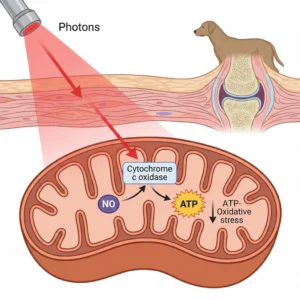
The central protagonist in this cellular narrative is Cytochrome c Oxidase (CcO), the terminal enzyme in the mitochondrial electron transport chain. CcO acts as a photoacceptor or chromophore, specifically absorbing photons within the near-infrared (NIR) spectrum, typically between 800nm and 980nm.
In states of chronic inflammation or cellular stress—conditions endemic to an arthritic joint—mitochondrial function is suppressed. Nitric oxide (NO) binds competitively to the oxygen-binding site of CcO, effectively throttling cellular respiration and halting the production of Adenosine Triphosphate (ATP), the cell’s primary energy currency.
When sufficient photon density from a Class IV laser reaches the distressed tissue, these photons are absorbed by CcO. This absorption destabilizes and displaces the inhibitory NO molecule. This event, known as photodissociation, immediately restores the enzyme’s capacity to utilize oxygen. The immediate consequence is a significant upregulation in ATP synthesis.
This surge in cellular energy is not abstract; it is the fuel required for the energy-intensive processes of tissue repair, synthesis of collagen, and re-establishment of homeostasis. Furthermore, the displacement of NO allows it to act as a vasodilator in the local microcirculation, improving oxygenation to previously ischemic tissues.

Beyond ATP, PBM has a direct impact on inflammatory mediators. Clinical studies suggest that appropriate laser dosages can inhibit cyclooxygenase-2 (COX-2) expression, similar to the mechanism of action of NSAIDs, but without the associated gastrointestinal or renal side effects. Furthermore, PBM has been shown to reduce levels of pro-inflammatory prostaglandins (like PGE2) while stimulating the release of anti-inflammatory cytokines.
For the arthritic patient, this means we are addressing the “inflammatory soup” bathing the joint capsule, reducing the chemical signals that perpetuate pain and degradation.
The classification of lasers is based on their potential hazard to the eye and skin, directly related to their power output. A Class IV laser is categorized as any device exceeding 500 milliwatts (0.5 Watts) of continuous power. In the realm of veterinary rehabilitation, however, the distinction is practical: power equals penetration and treatment speed.
Historically, lower-power Class IIIb lasers (under 500mW) were used for superficial conditions. While effective for wounds or shallow tendonitis, they lack the photon density required to treat deep musculoskeletal structures in anything but the smallest patients. The “therapeutic window” relates to the number of photons that must reach the target tissue (the joint capsule, periosteal nerve endings, and surrounding muscle) to trigger the PBM response.
In a large breed dog with hip osteoarthritis, the target tissue may be several centimeters deep, shielded by skin, subcutaneous fat, and significant muscle mass. As laser light enters tissue, it scatters and is absorbed. To deliver a therapeutic dose to a deep hip joint, a high surface dose is necessary. Class IV lasers, often ranging from 10 to 30 Watts, provide the necessary power to deliver these photons efficiently within a reasonable treatment time. Trying to treat a Great Dane’s hip with a 200mW laser is clinically futile; the photons simply will not reach the target in sufficient numbers to initiate a biological change.
The clinical success of 激光治疗狗关节炎 depends heavily on utilizing the correct wavelengths that fall within the optical window of tissue transparency (roughly 600nm to 1100nm). Not all wavelengths behave identically.
A superior clinical protocol often involves a multi-wavelength approach to address different aspects of the pathology simultaneously: deep cellular stimulation, superficial circulation enhancement, and pain receptor modulation.
The most critical element of successful 四级激光治疗 is dosimetry. Dosing follows the Arndt-Schulz Law, which suggests a “sweet spot” for biological stimulation. Too little energy provides no benefit; too much energy can be inhibitory.
Dosage is measured in Joules per square centimeter (J/cm²), representing energy density. For deep-seated osteoarthritis, veterinary consensus suggests a target dose at the tissue surface of 8 to 12 J/cm² to ensure adequate energy reaches the joint.
Veterinary medicine presents a unique challenge absent in human therapy: fur and dense pigmentation. Melanin is a potent absorber of light. A black Labrador will absorb significantly more laser energy superficially than a yellow Labrador. If not accounted for, this superficial absorption can lead to uncomfortable heating of the skin without adequate energy reaching the deep joint.
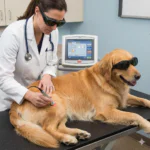
To mitigate this, clinicians must use a contact technique. By firmly pressing the laser emitter head against the skin and parting the fur, the clinician achieves two goals:
To illustrate the practical application of these principles, we will examine the management of a chronic, complex osteoarthritis case.
A comprehensive orthopedic examination revealed severely restricted range of motion in both coxo-femoral (hip) joints with palpable crepitus. Marked atrophy was present in the gluteal and quadriceps muscle groups. Radiographs confirmed bilateral end-stage osteoarthritis, characterized by femoral head flattening, severe osteophyte formation on the acetabular rim, and subchondral bone sclerosis.
Jasper was currently being managed with maximum tolerated doses of Gabapentin and a COX-2 selective NSAID. Despite this, his Quality of Life (QoL) score was assessed as poor due to chronic pain breaking through the pharmacological barrier.
The goal was to introduce Class IV PBM as a powerful anti-inflammatory and analgesic agent to lower the baseline pain threshold, allowing for improved mobility and subsequent muscle re-building. A dual-wavelength, high-power protocol was selected to ensure deep penetration into the hip joint capsule.
| 参数 | 设置/值 | 理由 |
| 波长 | 810nm and 980nm blend | 810nm for peak CcO stimulation; 980nm for analgesic thermal gradient. |
| 电源 | 15 瓦(平均值) | High power needed for deep penetration in a 34kg dog. |
| 模式 | Continuous Wave (CW) & Multi-Frequency | CW for maximal energy delivery; mixed frequencies (e.g., 20Hz, 500Hz, 5000Hz) to target different tissue types and pain receptors. |
| Target Dose | 12 焦耳/平方厘米 | High end of dosing range due to severity and depth of pathology. |
| 治疗区 | approx. 400 cm² per hip | Covering the joint capsule, gluteals, hamstring origin, and lumbosacral area. |
| 总能源 | 4,800 Joules per hip | Total energy required to achieve target fluence over the large area. |
| 技术 | Direct Contact, Scanning | Firm pressure to bypass fur and blanch skin. |
The induction phase consisted of three treatments per week for the first two weeks, tapering down based on clinical response.
Weeks 1-2 (Induction Phase): Following the initial session, Jasper appeared more comfortable resting but showed no significant change in mobility. By the fourth session (end of week 1), the owner reported Jasper spontaneously climbed two porch stairs, an action he hadn’t attempted in months. The “shuffling” gait began to show signs of increased stride length.
Weeks 3-4 (Transition Phase): Frequency was reduced to twice weekly. Jasper’s ability to rise from a down position improved markedly. The palpable heat and effusion over the hip joints decreased. Crucially, under veterinary supervision, his NSAID dosage was reduced by 25% without a return of breakthrough pain symptoms.
Weeks 5-8 (Maintenance Phase): Treatment frequency was reduced to once weekly, then once every two weeks. Jasper began engaging in short, slow walks without immediately tiring. Muscle tone in the hindquarters showed palpable improvement due to increased use.

After eight weeks, Jasper was maintained on a monthly Class IV laser therapy session and a 50% reduced dose of his original NSAID regimen. While the radiographic pathology remained unchanged—laser does not regenerate lost cartilage—the functional outcome was transformative. By effectively managing the chronic inflammation and neuropathic pain, 四级激光治疗 broke the cycle of pain-inactivity-atrophy, restoring a respectable quality of life for a geriatric patient.
While PBM is remarkably safe with few side effects, the high power of Class IV devices demands strict adherence to safety protocols.
整合 laser for dogs arthritis represents a shift from a reactive, drug-based model of pain management to a proactive, multi-modal strategy. By addressing the cellular roots of inflammation and pain, Class IV laser therapy provides a crucial window of opportunity. It lowers the pain barrier sufficiently to allow patients to engage in therapeutic exercise, which is the ultimate key to long-term geriatric mobility.
As our understanding of photobiology deepens, protocols will become even more refined, moving away from generic “pain settings” toward customizable treatments based on tissue type, chronicity, and individual patient physiology. For the modern veterinary clinician, Master Class IV laser technology is no longer a luxury; it is an essential component of comprehensive orthopedic care.
Q: Is Class IV laser therapy painful for the dog during treatment? A: No, the treatment is painless. The high power of Class IV lasers creates a gentle, soothing warmth in the tissue, which most dogs find very relaxing. Many patients, including those with chronic pain, will lean into the probe or fall asleep during the session due to the immediate relief and release of endorphins.
Q: How quickly can I expect to see results in my dog’s arthritis? A: Response times vary depending on the severity and chronicity of the arthritis. Some owners report seeing an improvement in comfort immediately after the first session. However, PBM is cumulative. Typically, significant, lasting improvements in mobility and a reduction in pain behaviors are observed after the third to sixth treatment in the induction phase.
Q: Can laser therapy replace my dog’s current pain medication? A: Laser therapy is a powerful tool that often allows veterinarians to significantly reduce the dosage of NSAIDs or other pain medications, thereby lowering the risk of long-term side effects on the liver or kidneys. In some mild to moderate cases, it can eventually replace pharmaceuticals entirely, but this decision must always be made under direct veterinary supervision based on the dog’s response.
Q: Are the effects of laser therapy permanent? A: Osteoarthritis is a progressive, degenerative disease with no cure. Therefore, laser therapy is a management tool, not a permanent fix. Once the initial pain and inflammation are brought under control during the induction phase, most chronic arthritis patients require maintenance treatments—ranging from every two to six weeks—to sustain their improved quality of life and prevent a relapse of severe symptoms.
Q: Is there any risk of burning my dog with a high-power laser? A: When operated by a trained veterinary professional using proper technique (continuously moving the handpiece or using a large contact head), the risk of thermal injury is extremely low. Modern Class IV medical devices are also equipped with sophisticated software and safety protocols to manage energy delivery and prevent tissue overheating.
放心提交。您的数据将根据我们的隐私政策受到保护。
查看更多隐私政策