搜索整个车站

行业新闻

神经学优势:利用激光疗法治疗神经疼痛和神经病变

Chronic nerve pain, such as that seen in peripheral neuropathy, sciatica, or carpal tunnel syndrome, represents one of the most challenging areas in pain management. Traditional approaches often rely on medications like gabapentin or steroids, which can have significant systemic side effects and do little to repair the damaged nerves themselves. Enter 4 级激光治疗—a modality that is gaining recognition for its unique ability to not just manage but potentially heal damaged neurological tissue.

This article explores the cutting-edge application of 激光治疗 for neurological conditions. We will break down the complex neurobiology of how light energy interacts with nervous tissue, outline the key features of a 激光治疗仪 suited for this task, and present a compelling case study that illustrates its profound impact on a patient’s life.

The Science of Light on Nerves: Beyond Masking Symptoms

The action of 深层组织激光疗法 on nerves, or neurophotobiomodulation, is multifaceted and targets the entire functional unit of the nerve cell (neuron).

  1. Mitochondrial Respiration and Axonal Transport: The mitochondria within the neuron’s cell body and along the axon are primary targets. The absorption of laser light energy supercharges ATP production. This abundant energy is crucial for powering axonal transport—the essential process of moving proteins, neurotransmitters, and organelles from the cell body down the long axon to the nerve terminal. Compromised axonal transport is a hallmark of many neuropathies.
  2. Reduction of Wallerian Degeneration: After nerve injury, the segment of the axon separated from the cell body undergoes a process of breakdown called Wallerian degeneration. Studies suggest that 激光治疗 can slow this process, preserving more of the nerve’s structure and facilitating faster regeneration.
  3. Myelin Sheath Repair: The myelin sheath, the fatty insulation that allows for rapid nerve signal conduction, can be damaged by compression or disease (e.g., diabetic neuropathy). Laser energy stimulates Schwann cells (which produce myelin in the peripheral nervous system) to proliferate and remyelinate axons, restoring proper nerve conduction velocity.
  4. Modulation of Neuroinflammation: Laser therapy significantly reduces the release of pro-inflammatory cytokines (e.g., TNF-α, IL-1β) around the nerve, which are known to contribute to neuropathic pain and sensitization.
  5. Sensory Nerve Calibration: For hypersensitive nerves, laser therapy can help decrease the hyperexcitability of nociceptors (pain-sensing nerves) by modulating ion channels and reducing the expression of pain-related neurotransmitters like Substance P.

This comprehensive biological approach is what sets 4 级激光治疗 apart from purely symptomatic treatments.

Selecting the Best Laser Therapy Device for Neurological Applications

Treating nerves requires precision. The 最佳激光治疗仪 for neuropathic conditions must possess specific characteristics:

  • Effective Penetration Depth: The wavelength must be in the near-infrared spectrum (800-900nm) to penetrate deeply enough to reach major nerve trunks, such as the sciatic nerve or the median nerve at the wrist.
  • Adequate Power: A 4 级激光治疗 machine, with power output above 0.5W, is necessary to deliver a sufficient dose of energy to these deep structures without requiring prohibitively long treatment times.
  • Precision Applicators: Devices should come with focused handpieces or probes that allow the clinician to accurately target specific anatomical locations, like the carpal tunnel or tarsal tunnel.

Real-World Evidence: A Case Study on Severe Carpal Tunnel Syndrome

患者简介

  • 姓名缩写: R.B.
  • 年龄 48
  • 性别 女性
  • 职业 Data entry specialist
  • 症状 Severe, bilateral carpal tunnel syndrome (CTS), worse in the dominant right hand. Symptoms for 3 years.

现病史:
R.B. reported constant numbness and tingling (paresthesia) in her thumb, index, and middle fingers, severe enough to wake her 4-5 times per night. She experienced significant weakness, frequently dropping objects, and a burning pain that radiated up her forearm. She had tried wrist splints and two corticosteroid injections, which provided relief for only a few months each. Her physician had recommended surgical intervention (carpal tunnel release), which she wished to avoid.

客观调查结果:

  • Physical Exam: Positive Tinel’s sign (tapping over carpal tunnel reproduced tingling), Positive Phalen’s test (holding wrists in flexion for 30 seconds reproduced symptoms). Thenar muscle wasting was noted on the right hand.
  • Nerve Conduction Study (NCS)/Electromyography (EMG): Confirmed severe CTS. The study showed significantly slowed sensory and motor nerve conduction velocities across the right wrist and moderate slowing on the left.
  • 功能限制: Difficulty with typing, gripping a steering wheel, and performing fine motor tasks like buttoning a shirt.

治疗计划:
A conservative trial of 深层组织激光疗法 was initiated on the right wrist.

  • 设备: A 12W 4 级激光治疗 machine with a 905nm pulsed laser and an 810nm continuous wave laser.
  • 频率 3 times per week for 4 weeks, then 2 times per week for 3 weeks.
  • 协议: The laser was applied using a contact technique directly over the carpal tunnel and along the path of the median nerve in the forearm. A dosage of 8-10 J/cm² was used.
  • 辅助疗法: The patient was educated on ergonomic modifications and performed nerve gliding exercises.
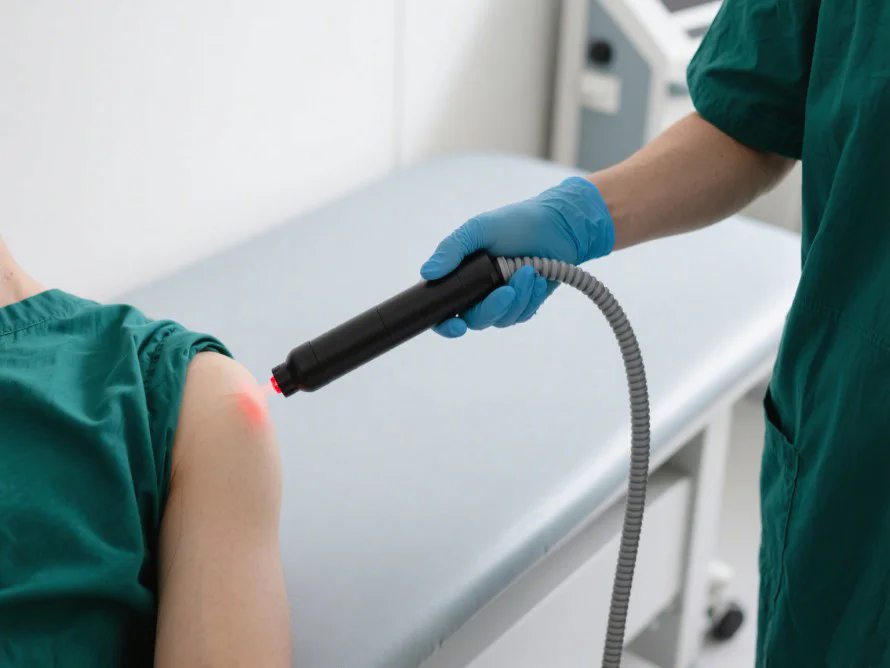
<trp-post-container data-trp-post-id='7031'>The Neurological Edge: Using Laser Treatment Therapy to Target Nerve Pain and Neuropathy</trp-post-container> - neurophotobiomodulation(images 1)

结果与成果:

  • 6 次治疗后 R.B. reported a 50% reduction in nighttime waking and a noticeable decrease in daytime tingling.
  • After 12 treatments: She could sleep through the night without interruption. Her grip strength, measured by a dynamometer, had improved by 25%. The burning pain had resolved.
  • After 7 weeks (17 treatments): All numbness and tingling had resolved. Muscle wasting had visibly improved with targeted strengthening. A follow-up NCS/EMG showed marked improvement, with nerve conduction velocities moving into the mild/moderate range.
  • 6 个月随访: The patient remained completely asymptomatic and had returned to all normal activities, including her job, without limitations. Surgery was deemed unnecessary.

结论 这一案例表明 4 级激光治疗 can be a potent non-surgical intervention for compressive neuropathies like CTS. By targeting the underlying pathophysiology—inflammation, impaired energy production, and demyelination—it facilitates true biological repair, offering a viable alternative to surgery for many patients.

上一页 下一个

放心提交。您的数据将根据我们的隐私政策受到保护。
查看更多隐私政策

我知道