
搜索整个车站

行业新闻

深层组织激光疗法的实际成本始于治疗效率

能量控制、波长灵活性、治疗速度、可量化的临床工作流程

如果一台激光仪覆盖目标区域所需时间过长、会产生令人不适的表面热量,或者由于无法精确控制能量输出而迫使治疗师采用保守的参数设置,那么即使诊所购置了性能强大的激光仪,每项治疗仍可能造成亏损。.

这就是患者在询问时很少能看到的那一部分,, 冷激光疗法是否有效?

这也是诊所业主在询问时应该重点考察的部分, 深层组织激光疗法的成本.

真正的经济问题不仅仅在于一次激光治疗的费用是多少。.

关键在于设备能否在合理的治疗时间内,向目标组织输送临床适宜的能量,同时让治疗师能够控制热量、波长、功率和治疗区域。.

对于康复科而言,这彻底改变了采购方面的讨论。.

低输出设备的采购价格可能较低,但治疗时间较长。高输出4类平台的初期成本可能较高,但能提供显著更高的能量输出能力,且治疗灵活性更强。当每天需要治疗多名患者时,这一差异就显得尤为重要。.

这就是 激光治疗设备 应将其视为临床基础设施,而非另一件物理治疗设备。.

当治疗部位较深时,冷激光疗法有效吗?

答案取决于“冷激光”的具体含义。”

该术语通常用于指代低强度激光疗法和光生物调节系统,这些系统输出功率相对较低,旨在产生生物学效应,同时不会导致组织显著升温。.

有科学文献表明,光生物调节是一种涉及光-组织相互作用、线粒体信号传导、炎症调节和细胞反应的生物机制。.

但一个实际的临床问题则有所不同。.

治疗师可能正在治疗位于皮肤下方几厘米处的组织。.

光线必须先穿过皮肤、皮下组织及其他解剖层。.

有些光子被散射了。.

有些被吸收了。.

剩余的光能随深度增加而减小。.

因此,某款设备是否适用于某种特定病症,取决于波长、输出能量、治疗区域、组织特性以及治疗方案。.

“激光疗法有效”这一说法过于笼统。.

更好的问题是:

对于该靶组织而言,这种波长、剂量和治疗方案是否合理?

这是专业诊所在购置设备前应当考虑的问题。.

为什么深层组织治疗会改变对设备的要求
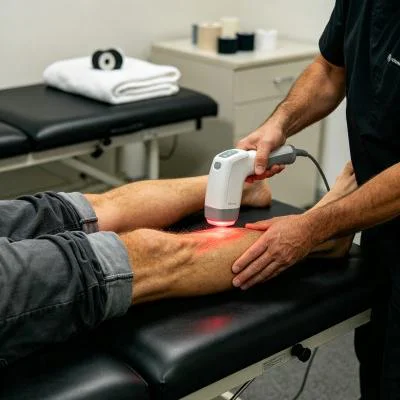
Laser light therapy126

表层治疗相对来说比较简单。.

只需相对较低的能量,即可对较小的治疗区域进行照射。.

深度处理会带来另一个问题。.

临床医生需要在体表提供足够的能量,以补偿靶区上方组织造成的能量衰减。.

但表层组织最先接收入射的能量。.

这在深度与热舒适性之间取得了平衡。.

试想一下,正在为一名患者治疗腰部旁脊柱肌。.

目标不是皮肤。.

治疗师可能需要针对更深层的肌肉和结缔组织进行治疗。.

如果输出值过低,治疗时间可能会很长。.

如果输出功率增加得过快,表面温度可能会让人感到不适。.

此时,临床医生必须降低功率或放慢移动速度,以确保患者感到舒适。.

这就是高强度激光系统之所以有用的一大原因。.

它们能提供更多的可用能量,但同时也需要更好的控制。.

激光能量在组织内部会发生什么

激光能量不会像直的电线那样穿过生物组织。.

其中有两种主要相互作用尤为重要。.

吸收

发色团和水会吸收部分入射的光能。.

吸收量在很大程度上取决于波长。.

散射

组织结构会改变光子的传播方向。.

这意味着随着光线向更深处传播,治疗区域会发生变化。.

结果是一条渐进衰减曲线。.

能量密度随深度的增加而降低,但具体曲线会因组织成分和波长而异。.

因此,假设一个在皮肤表面输出20 W的设备也能向皮肤下几厘米处的组织输出20 W,这种假设是不准确的。.

不是。.

表面输出是起点。.

在特定深度下具有临床意义的照射剂量取决于治疗头与靶区之间发生的情况。.

为什么810 nm波长对更深层的靶点具有吸引力

在810 nm左右,与1470 nm等较长波长相比,水的吸收相对较低。.

这使得更大比例的近红外光能在被吸收之前穿透更深的组织。.

这并不意味着810 nm的波长能够无损地穿过组织。.

散射仍然很重要。.

血液和其他组织中的发色团仍然会影响光学场。.

但相对较好的吸光特性,正是810 nm左右波长长期以来在光生物调节和深层组织应用领域受到关注的原因之一。.

对于康复诊所而言,这意味着波长的选择比单纯选择功率最高的设备更为重要。.

为什么980 nm能带来不同的治疗体验

980 nm 与水的相互作用比 810 nm 更强。.

它还会被血液中的发色团产生相应的吸收。.

因此,该波长范围内的能量会产生更明显的热响应。.

这未必是件坏事。.

在某些治疗策略中,控制性升温可能是有益的。.

当加热成为限制因素时,问题便开始了。.

如果患者在达到预定治疗能量之前就感到皮肤不适,进一步提高功率并不能解决这一临床问题。.

治疗师还需要另一个控制变量。.

该变量可以是脉冲结构。.

占空比会改变热分布

假设一台高功率激光器的峰值输出功率为 20 W。.

这并不一定意味着该组织会持续承受20瓦的功率。.

如果激光器以25%占空比的脉冲模式工作,则发射仅在该周期的一部分时间内处于活跃状态。.

在活跃期间,峰值输出始终保持在较高水平。.

整个循环中的平均功率较低。.

这使治疗师能够在限制持续热量积聚的同时,采用更高的瞬时输出进行治疗。.

具体的治疗反应仍取决于脉冲持续时间、频率、治疗区域、组织特性以及总能量。.

因此,占空比并不是一种“万能”的安全设置。.

这是一个控制变量。.

在评估时,这一区别至关重要 激光治疗设备 用于严肃的临床应用。.

一个模拟康复案例

以下案例是一个模拟的临床情景,旨在说明如何综合考虑设备性能、治疗参数和临床经济性。该案例并非真实的患者病历,也不应被视为通用的治疗方案。.

案例识别

临床参数模拟记录
部门物理医学与康复
模拟案例编号PMR-HILT-2026-0831
病人68岁女性
诊断伴有慢性关节周围疼痛的膝关节骨关节炎
病理分级凯尔格伦-劳伦斯分级法 III 级
治疗方面右膝
症状持续时间4 年
基线NPRS7/10
基线WOMAC67/96
基线主动屈曲98°
基线定时起立行走测试14.7秒
主要临床问题下楼梯和长时间站立时的疼痛
激光平台LaserMedix-MAX
主要波长810 纳米
次级波长915 纳米和 940 纳米
受控热组件980 纳米
初始峰值功率10 W
最大峰值功耗24 W
初始频率15 Hz
后期频率20 赫兹
初始占空比25%
后期占空比30%
第1节 能源800 J
第2节 能源1,000 J
第3节 能源1,200 J
第4节 能源1,400焦耳
第5节 能源1,550焦耳
第6节 能源1,650焦耳
第7节 能源1,750焦耳
第8节 能源1,850焦耳
治疗频率每周三次
辅助康复股四头肌强化与活动度训练
第1周 NPRS6/10
第2周 NPRS5/10
第3周 NPRS4/10
第4周 NPRS2–3/10
第4周 WOMAC43/96
第4周 主动屈曲116°
第4周 “起身行走”计时测试11.1秒
热响应温和的暖感,不会引起持续的皮肤刺激
治疗方案调整缩短了膝关节内侧的停留时间,并保持了脉冲照射量

为什么治疗师没有从24 W开始?

该平台的产量有望大幅提高。该平台可实现显著更高的产量。.

但这并不意味着24 W就是正确的起点。.

该患者患有慢性退行性关节病。.

治疗靶区位于皮肤深处。.

治疗师需要确定患者对光负荷和热负荷的反应。.

因此,首次测试采用10 W功率,占空比为25%。.

治疗头在持续移动。.

总能量限制为800焦耳。.

患者表示感到温暖,但没有灼热感或锐痛。.

这为后续工作奠定了基础。.

接下来,可以根据患者的实际反应来调整后续治疗 session,而不是采用任意的最大功率设置。.

这就是拥有高性能机器与懂得如何使用它之间最重要的区别之一。.

治疗进展

第二次实验将总能量提高到1,000焦耳。.

第三个达到了1,200焦耳。.

到第四次治疗时,治疗师在更深层的治疗过程中使用了更高的峰值输出功率,并将总能量提高到1,400 J。.

第五和第六次交易分别达到1,550焦耳和1,650焦耳。.

在第六次治疗期间,关节内侧区域的温度高于周围组织。.

治疗师并未缩减整个治疗方案。.

相反,在该区域增加了涂抹器的移动幅度。.

第七届会议共交付1,750 J。.

第八个释放了1,850焦耳的能量。.

四周结束时,模拟患者报告称,在下楼梯和转移到椅子上的过程中,疼痛感明显减轻。.

关键不在于具体的焦耳数值。.

这就是发展。.

根据耐受性、临床反应和功能目标对治疗方案进行了调整。.

在计算深层组织激光疗法费用时,这为何重要

患者可能会看到某次治疗的费用标注为$100或$200,并询问这是否很贵。.

一位诊所老板的盘算却有所不同。.

该诊所需要考虑:

  • 设备购置成本
  • 治疗时间
  • 治疗师的劳动
  • 患者吞吐量
  • 维护
  • 培训
  • 消耗品
  • 空间利用率
  • 治疗频率
  • 患者留存率
  • 本地报销或自费支付模式

"(《世界人权宣言》) 深层组织激光疗法的成本 因此有两面性。.

这是患者的治疗费用。.

此外还有诊所的运营成本。.

这两个数字并不一样。.

一家每次收费$150的诊所,其利润未必能达到$150。.

同样,购置成本更高的机器,其回报也不一定就更差。.

关键在于利用率。.

一个简单的诊所经济模型

假设有一家诊所,每次深层组织激光治疗的收费为$120。.

如果该诊所每天接诊5名患者,每周接诊5天,那么每周的治疗次数就是25次。.

按48个运营周计算,即每年约1,200个场次。.

按每次$120计算,扣除人工、租金、维护、税费、市场营销及其他运营成本前,与这些疗程相关的治疗总收入约为$144,000。.

现在更改治疗体积。.

如果该设备能使诊所每天接诊八名患者,而不是五名,那么其年接诊量将发生显著变化。.

这就是为什么治疗速度很重要。.

"(《世界人权宣言》) 深层组织激光疗法的成本 应根据可用的临床接诊能力进行评估,而不仅仅依据采购发票。.

为什么治疗时间可能比购买价格更重要

假设一台机器完成某项处理需要20分钟。.

另一套高效率系统使治疗师能够在10分钟内完成相同的治疗流程,同时保持适当的临床控制。.

第二台机器的价格可能更高。.

But the therapist has potentially freed ten minutes of appointment capacity.

Across several patients per day, that difference becomes significant.

A clinic owner should therefore ask:

How many minutes does a typical treatment require?

How much therapist involvement is required?

Can the therapist treat another patient while the laser is operating?

How quickly can the treatment area be covered?

Can one device serve multiple indications?

These questions often provide more useful financial information than comparing purchase prices alone.

What FotonMedix Laser Therapy Equipment Brings to the Calculation

LaserMedix-MAX is specified with five wavelengths:

650 nm, 810 nm, 915 nm, 940 nm and 980 nm.

Its maximum output configuration is 30 W.

The system is designed for non-invasive high-energy treatment and includes temperature indication and dual hot-and-cold treatment functions.

For a clinic, the practical attraction is the combination of energy capacity and wavelength flexibility.

One patient may require a deeper near-infrared strategy.

Another may need a different wavelength balance.

A third patient may require a more conservative pulsed treatment because of thermal sensitivity.

The equipment can therefore be integrated into different treatment workflows rather than being restricted to one narrow protocol.

Does More Expensive Equipment Mean Better Treatment?

Not automatically.

A more expensive machine is only valuable if the additional capability is actually used.

For example, a clinic that treats only small superficial areas may not benefit enough from a high-output multi-wavelength system to justify the investment.

A busy rehabilitation department treating chronic joint pain, sports injuries, large muscle groups and postoperative patients may have a stronger use case.

This is why the best 激光治疗设备 depends on the clinic’s patient population.

The right purchasing question is not:

“Which machine is the best?”

它是:

“Which machine gives our therapists the control and throughput required by our actual patient mix?”

Why Five Wavelengths Can Change Workflow Flexibility

A single wavelength forces the clinician to work within one optical profile.

五波长系统为临床医生提供了更多选择。.

The LaserMedix-MAX configuration includes:

650 纳米

Useful when a more superficial optical component is desired.

810 纳米

Relevant to deeper near-infrared treatment strategies because of relatively low water absorption.

915 纳米

Provides another near-infrared option within the treatment platform.

940 纳米

Adds another wavelength choice for tissue interaction and treatment planning.

980 纳米

Provides stronger water interaction and a more noticeable thermal component.

The goal is not to use every wavelength in every session.

The value comes from having choices.

Why 1470 nm Belongs in a Different Clinical Conversation

A buyer researching 激光治疗设备 may also encounter 1470 nm systems.

1470 nm has strong absorption by water.

That makes it particularly useful in surgical applications where controlled tissue interaction is required.

FotonMedix’s SurgMedix-MAX uses 1470 nm and 980 nm, with an additional 635 nm component, for applications including incision, excision, coagulation and evaporation.

That is a different clinical purpose from non-invasive physical therapy.

这一区别很重要。.

A wavelength with strong water absorption can be excellent for precise surgical tissue interaction while being a poor choice if the objective is to transmit optical energy deeply through intact tissue.

There is no universal best wavelength.

There is a wavelength appropriate to a particular clinical task.

Why Patients Ask Whether Cold Laser Therapy Works

From the patient’s perspective, the question is understandable.

They have pain.

They may have already tried medication, exercise, manual therapy or other physical modalities.

They want to know whether putting light over the painful area will actually do anything.

The answer should not be an exaggerated promise.

Photobiomodulation has biological mechanisms that have been investigated in laboratory and clinical research.

The proposed effects include changes in mitochondrial signaling, ATP-related cellular activity, inflammatory signaling and tissue repair responses.

But clinical results vary.

The condition matters.

治疗参数很重要。.

The wavelength matters.

剂量很重要。.

The treatment schedule matters.

The quality of the underlying clinical diagnosis matters.

So 冷激光疗法是否有效?

For some clinical applications, research supports therapeutic effects from appropriately dosed photobiomodulation.

But that does not mean every cold laser device, every wavelength and every protocol will produce the same outcome.

Cold Laser and Class 4 Treatment Are Not the Same Thing

The term “cold laser” generally emphasizes low thermal effect.

Class 4 laser therapy systems can operate at substantially higher output levels.

The difference is not merely terminology.

Higher output provides more energy-delivery capacity.

That can reduce treatment time and make larger treatment areas more practical.

But higher output also creates greater responsibility for thermal management.

The therapist needs to understand:

  • 峰值功率
  • 平均功率
  • 工作周期
  • 频率
  • 总能量
  • 治疗区
  • 移动速度
  • 组织深度
  • 患者的感受

This is why high-intensity laser treatment should not simply be described as a stronger version of cold laser treatment.

They can overlap in photobiomodulation principles while using very different delivery strategies.

Why “Cold” Does Not Mean “Weak”

A cold laser is not necessarily ineffective because it does not produce strong heat.

The biological response of light is not determined only by temperature.

Photobiomodulation involves interactions between light and cellular systems.

That is why low-level treatments can have biological effects even when the patient feels almost nothing.

However, the absence of heat also means that patient sensation cannot be used as a direct measure of dose.

A patient feeling nothing does not prove that the treatment has no biological effect.

A patient feeling warmth does not prove that the deeper target received the correct dose.

Objective treatment parameters remain important.

Why High-Intensity Treatment Needs More Clinical Discipline

The higher the available output, the more important treatment control becomes.

A therapist using a high-output device should not simply park the applicator over one point and wait.

Treatment movement, dwell time and energy distribution matter.

If the treatment area is small, excessive local energy can accumulate quickly.

If the treatment area is large, insufficient movement may create uneven exposure.

If the target is deep, the therapist needs to consider attenuation through the superficial tissue.

This is why high-output 激光治疗设备 should be accompanied by proper clinical training.

What the Patient Experience Looked Like in the Simulated Case

The patient initially expected a strong heating sensation.

Instead, the first treatment felt like moderate warmth.

The therapist explained that stronger sensation was not the objective.

The goal was controlled energy delivery.

By the third treatment, the patient reported that the knee felt less stiff when standing after prolonged sitting.

By the fifth treatment, stair descent became easier.

By the eighth treatment, the patient reported less pain during daily activities.

The treatment was still combined with exercise.

This is important because the laser was not presented as a replacement for active rehabilitation.

It was integrated into it.

Comparing Laser With Traditional Physical Therapy

Laser treatment does not need to compete with conventional therapy.

Exercise remains fundamental for strength, mobility and functional recovery.

Manual therapy can address mechanical restrictions.

Education can change movement behavior.

Weight management can reduce joint loading where appropriate.

Medication can sometimes provide symptom control.

Surgery may be appropriate for certain structural conditions.

The value of laser is that it can become another tool within this system.

Its non-invasive nature may allow it to be used without adding a wound, injection or prolonged recovery period.

For patients who have difficulty tolerating aggressive manual techniques during painful phases, a well-controlled laser session may be easier to tolerate.

But the final clinical decision still belongs to the treating professional.

The Economic Question Is Also About Patient Compliance

There is another factor hidden inside 深层组织激光疗法的成本.

Patients are more likely to complete a treatment plan when appointments are tolerable and convenient.

A treatment that requires a long appointment every time can become difficult for patients who work full-time.

A treatment that causes excessive discomfort can reduce compliance.

A treatment that fits naturally into a rehabilitation session can be easier to integrate.

That can affect the real-world value of the equipment.

A clinic should therefore consider not only treatment price but also treatment practicality.

A Better Way to Calculate Equipment ROI

A useful purchasing calculation can begin with five numbers.

Equipment Investment

The complete acquisition cost of the system, accessories and initial training.

Average Revenue Per Session

The actual local price charged to patients or reimbursed by the payer.

Daily Treatment Volume

The realistic number of treatments the clinic can perform.

Therapist Time

How much staff time is required for each treatment.

Annual Utilization

How many operating days the equipment will realistically be used.

From there, the clinic can estimate gross treatment capacity and compare it with total ownership costs.

The calculation should also include service, maintenance and downtime.

A machine that cannot be serviced quickly can create a hidden financial cost even if the initial purchase price looks attractive.

What International Buyers Should Ask a Supplier

When purchasing from an overseas 激光设备供应商, the buyer should request more than a quotation.

Ask for the complete technical specification.

Ask for treatment modes.

Ask about wavelength configuration.

Ask about output control.

Ask about pulse control.

Ask about thermal monitoring.

Ask for regulatory documents applicable to the target market.

Ask about warranty terms.

Ask about service response.

Ask about spare parts.

Ask about operator training.

Ask about packaging and shipping.

Ask about electrical compatibility.

Ask about distributor support.

These details often determine the real cost of ownership.

Why the Cheapest Laser Is Not Always the Cheapest Option

Imagine two machines.

Machine A costs less but has one wavelength, limited output control and a longer average treatment time.

Machine B costs more but provides five wavelengths, higher output capacity, pulse control and a broader clinical application range.

If the clinic uses only one treatment indication, Machine A may be perfectly reasonable.

If the clinic treats multiple conditions every day, Machine B may create greater clinical and operational value.

The purchase decision therefore needs to be connected to patient volume.

The question is not simply “How much does the machine cost?”

It is “How much useful clinical work can the machine perform over its service life?”

The Difference Between Treatment Price and Treatment Value

A patient paying $120 for a session is not necessarily buying 120 dollars of laser energy.

They are paying for the entire clinical service.

That includes:

Assessment.

Professional judgment.

Treatment planning.

Equipment.

Therapist time.

Facility costs.

Follow-up.

Documentation.

The machine is one component.

This is why clinics should avoid competing purely on price.

A high-quality rehabilitation service is built around clinical outcomes and patient experience.

Laser can support that service when it is used appropriately.

What the Simulated Case Teaches

The 68-year-old patient in this scenario had Grade III knee osteoarthritis and significant functional limitations.

The therapist did not start with maximum power.

The treatment was progressively increased.

The primary wavelength strategy favored deeper exposure.

Thermal response was monitored.

Duty cycle was used as part of energy management.

Treatment was combined with exercise.

Pain and function were measured.

By week four, the simulated patient had improved across pain, mobility and functional testing.

The case demonstrates a principle that is often missed in equipment marketing.

The value of high-output laser therapy is not simply the amount of power available. It is the amount of controllable clinical energy that can be delivered efficiently and reproducibly.

What to Look for in Laser Therapy Equipment

For a rehabilitation clinic, a practical system should provide enough flexibility to adapt to real patients.

That means considering:

多种波长

Different wavelengths create different absorption and scattering profiles.

Adequate Output

Higher output can make large-area and deep-treatment workflows more practical.

脉冲控制

Duty cycle and frequency provide another level of treatment control.

热反馈

Temperature indication can help the therapist monitor the patient’s treatment experience.

Practical Applicators

The device needs to be comfortable and efficient for repeated clinical use.

Treatment Documentation

Reproducible parameters support consistent clinical workflows.

Service Support

Equipment downtime can directly affect clinic capacity.

Regulatory Documentation

International buyers need clear market-specific compliance information.

These factors are more useful than simply searching for the machine with the largest wattage.

The Real Answer to Does Cold Laser Therapy Work

Yes, there is a legitimate scientific basis for photobiomodulation, and clinical research has investigated its effects across a range of musculoskeletal and rehabilitation applications.

But that answer needs an important qualification.

The result depends on the treatment.

A poorly matched wavelength, insufficient dose, inappropriate treatment area or poorly controlled protocol can produce a very different outcome from a carefully designed treatment.

This is why the question should move from:

“Does cold laser therapy work?”

to:

“Does this specific treatment protocol provide an appropriate optical dose for this patient and target tissue?”

That is a much more useful clinical question.

The Real Answer to Deep Tissue Laser Therapy Cost

There is no universal price.

Treatment prices vary by country, clinic, anatomical region, equipment class, treatment duration, practitioner expertise and the number of sessions.

The previously published FotonMedix pricing discussions describe broad examples of approximately $80–$250 per session, depending on the treatment setting and equipment, with multi-session programs varying substantially. These figures should be treated as market examples rather than a fixed global price.

For a clinic owner, the more important calculation is total treatment economics.

A device that reduces treatment time, supports multiple indications and allows high patient throughput may have a different economic profile from a lower-cost device that requires longer sessions.

The purchase price is only the beginning.

The Final Lesson for Clinics

The real challenge in deep tissue treatment is not simply delivering more light.

It is controlling where, when and how that energy is delivered.

The surface receives the energy first.

The target lies deeper.

Wavelength determines how strongly tissue components interact with the light.

810 nm provides a different optical profile from 980 nm.

1470 nm behaves differently again because of its much stronger water absorption.

Pulse frequency and duty cycle change the temporal distribution of energy.

Treatment movement affects local energy accumulation.

Total joules describe cumulative exposure.

Patient feedback and functional testing provide the clinical context.

When all of these factors are considered together, 激光治疗设备 becomes more than a high-powered light source.

It becomes a controllable treatment platform.

For clinics evaluating a new system, the smartest purchase is rarely the cheapest machine or the machine with the biggest wattage number.

It is the system that matches the clinic’s patients, treatment areas, workflow, staff capability and regulatory requirements.

For patients, the same principle applies.

The question should not be whether laser sounds modern.

The question is whether the treatment is appropriate for the diagnosis, whether the clinician can control the dose, and whether progress is being measured.

That is the practical difference between selling a machine and building a useful laser treatment service.

上一页 下一个