搜索整个车站

行业新闻

脊柱专家的秘密:椎间盘源性疼痛和根性疼痛的激光治疗疗法

Chronic low back pain is the leading cause of disability worldwide, and a significant portion of cases originate from the intervertebral discs and associated nerve compression. Traditional management often cycles through medication, physical therapy, epidural injections, and surgery. 4 级激光治疗 is emerging as a powerful, non-invasive intervention that can break this cycle by directly targeting the inflamed disc and irritated nerve root—structures that were once thought to be beyond the reach of conservative care.

This article provides an in-depth look at the pathophysiology of discogenic and radicular pain. We will explain the mechanisms by which 深层组织激光疗法 achieves unprecedented penetration to influence disc metabolism and calm nerve inflammation. Furthermore, we will outline the clinical protocols and present a detailed case study of a patient with debilitating sciatica who found relief through this advanced 激光治疗.

The Complex Anatomy of Back Pain: Discs and Nerves

To understand how laser therapy works, one must first understand the source of the pain:

  • The Diseased Disc (Discogenic Pain): The intervertebral disc is an avascular structure, meaning it has no direct blood supply. It relies on diffusion from the vertebral endplates for nutrients. With injury, age, or degeneration, this diffusion is impaired. The nucleus pulposus (the disc’s gel center) loses hydration and proteoglycans, leading to disc height loss and microtears in the annulus fibrosus (the disc’s tough outer wall). These tears allow inflammatory proteins from the nucleus to leak out, irritating the pain-sensitive nerve fibers in the outer annulus and surrounding ligaments.
  • Nerve Compression (Radicular Pain/”Sciatica”): A bulging or herniated disc can physically compress the spinal nerve root exiting the spine. This compression, combined with the chemical irritation from the leaked inflammatory proteins, causes radiculopathy—pain, numbness, tingling, and weakness that radiates down the path of the nerve (e.g., down the leg for sciatica).

Penetrating the Depth: How Laser Therapy Reaches the Spine

The profound effectiveness of 4 级激光治疗 for spinal conditions lies in its unique ability to deliver therapeutic energy to these deep structures.

  1. Reducing Disc Inflammation: The near-infrared light from a high-powered 激光治疗仪 penetrates through layers of muscle and fascia to reach the disc and vertebral junction. This energy is absorbed by cells in the endplate and the disc itself, leading to:
    • Enhanced Cellular Metabolism: Increased ATP production improves the function of disc cells (chondrocytes), potentially slowing degeneration.
    • Modulation of Inflammatory Mediators: The laser energy significantly reduces the concentration of key inflammatory cytokines (e.g., IL-1, IL-6, TNF-α, PGE2) in and around the disc. This reduction in the “chemical soup” irritating the nerves is a primary driver of pain relief.
  2. Healing the Irritated Nerve: As detailed in previous articles, laser therapy promotes nerve healing (neuroregeneration) by:
    • Reducing edema and inflammation around the nerve root.
    • Increasing ATP production within the nerve cell for repair.
    • Encouraging remyelination of the damaged nerve sheath.
    • Decreasing the hypersensitivity of the nerve, normalizing pain signaling.

Case Study: Resolving Chronic Lumbar Radiculopathy Without Surgery

患者简介

  • 姓名缩写: T.M.
  • 年龄 41
  • 性别 男
  • 职业 Truck driver
  • 症状 Chronic left-sided low back pain with radiating sciatica down the posterior thigh and calf into the foot (L5/S1 distribution). Symptoms for 8 months.

现病史:
T.M. reported a constant, deep ache in his lower back and a sharp, burning pain that radiated down his left leg. Prolonged sitting, his primary work activity, exacerbated his symptoms to 9/10. He experienced numbness on the top of his left foot and weakness in his left ankle (difficulty walking on his heels). A course of physical therapy and two epidural steroid injections provided only temporary relief for a few weeks. An MRI confirmed a large left paracentral disc protrusion at the L5-S1 level, compressing the traversing S1 nerve root. Surgery (microdiscectomy) was recommended.

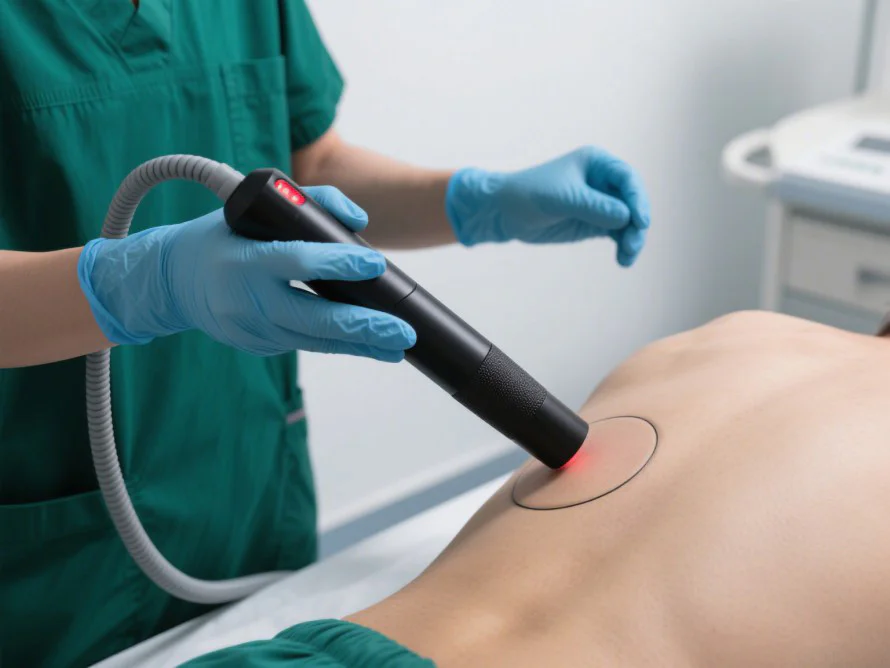
<trp-post-container data-trp-post-id='7045'>The Spine Specialist’s Secret: Laser Treatment Therapy for Discogenic and Radicular Pain</trp-post-container> - back pain(images 1)

客观调查结果:

  • Posture: Antalgic lean away from the painful side.
  • Range of Motion: Limited forward flexion and left lateral flexion due to leg pain.
  • Motor Strength: 4/5 strength in left ankle plantar flexion and great toe extension.
  • Sensation: Diminished light touch sensation in the lateral left foot (S1 dermatome).
  • Reflexes: Diminished left Achilles reflex.
  • 特殊测试: Positive Straight Leg Raise test on the left at 45 degrees, reproducing leg pain.

治疗计划:
A targeted 深层组织激光疗法 protocol was designed to address both the disc pathology and nerve inflammation.

  • 设备: A 25W 4 级激光治疗 machine with a 810nm laser for deep penetration.
  • 频率 3 times per week for the first 6 weeks, then 2 times per week for 4 weeks.
  • 协议:
    • Primary Target: The L5-S1 interspace and left paravertebral muscles, using a high dose (12-15 J/cm²) to reach the disc and nerve root.
    • Secondary Target: The path of the sciatic nerve down the posterior thigh and calf, using a scanning technique.
  • 辅助疗法: Core stabilization exercises and nerve flossing maneuvers were introduced as pain decreased.

结果与成果:

  • 6 个疗程(2 周)后 T.M. reported a 40% reduction in his radiating leg pain. The constant burning sensation was replaced with intermittent tingling.
  • 治疗 12 次后(4 周): His resting back pain was rated 2/10. He could sit for over an hour with minimal discomfort. The numbness in his foot had resolved. Motor strength improved to 4+/5.
  • After 20 treatments (10 weeks): T.M. was pain-free at rest and reported only mild ache after a long day of driving. He had full, pain-free range of motion and normal motor strength. All neurological findings (sensation, reflex) were normal.
  • 后续行动: The patient returned to full-duty work. A 6-month follow-up MRI showed a significant reduction in the size of the disc protrusion and resolution of the nerve root compression. He successfully avoided surgery.

结论 这一案例表明 4 级激光治疗 is not merely a superficial modality. Its ability to deliver biostimulatory energy to deep spinal structures makes it a first-line, non-invasive treatment for disc herniations and radiculopathy, capable of producing both profound symptomatic relief and meaningful anatomical improvement.

上一页 下一个

放心提交。您的数据将根据我们的隐私政策受到保护。
查看更多隐私政策

我知道