搜索整个车站

案例分享

Vetmedix Case Sharing丨Application Case of class 4 laser therapy for Knee Joint Injury + Postoperative Care for Bladder Stones

导言

Canine knee joint injuries are often caused by congenital structural defects (such as patellar luxation), improper exercise, or obesity. Manifestations include lameness, joint swelling, limited mobility, and evasive reactions due to pain when touching the affected area. In severe cases, normal weight-bearing walking is impossible, directly impacting daily motor function. Postoperative care for bladder stones often faces challenges such as wound inflammation, difficulty urinating, and slow tissue healing. Improper care may lead to secondary infections, prolong the recovery period, and even cause long-term effects on bladder function, reducing the dog’s quality of life.
Vetmedix (VETMEDIX) high-energy laser therapy, as an advanced treatment modality in the veterinary clinical field for such issues, has become an ideal choice due to its advantages of being safe, non-invasive, and providing precise repair. For knee joint injuries, its specific wavelength of high-energy laser can penetrate deep joint tissues, inhibit the activity of inflammatory factors, quickly reduce joint swelling and pain, while also improving blood circulation around the joint, reducing pain, and aiding in the recovery of joint range of motion. For postoperative care of bladder stones, the laser can gently act on the surgical area, reduce wound inflammation, alleviate postoperative pain, accelerate wound tissue healing, and reduce the risk of secondary infection.
This report fully documents the entire application process of using the Vetmedix (VETMEDIX) veterinary laser device in the treatment of canine knee joint injury and postoperative care for bladder stones. Let’s see how high-energy laser therapy helps dogs suffering from joint pain and those needing postoperative rehabilitation dispel discomfort, accelerate functional recovery, and reactivate limb vitality.

01 案例介绍

品种: 柯基犬
急性/慢性:急性期
既往病史:无
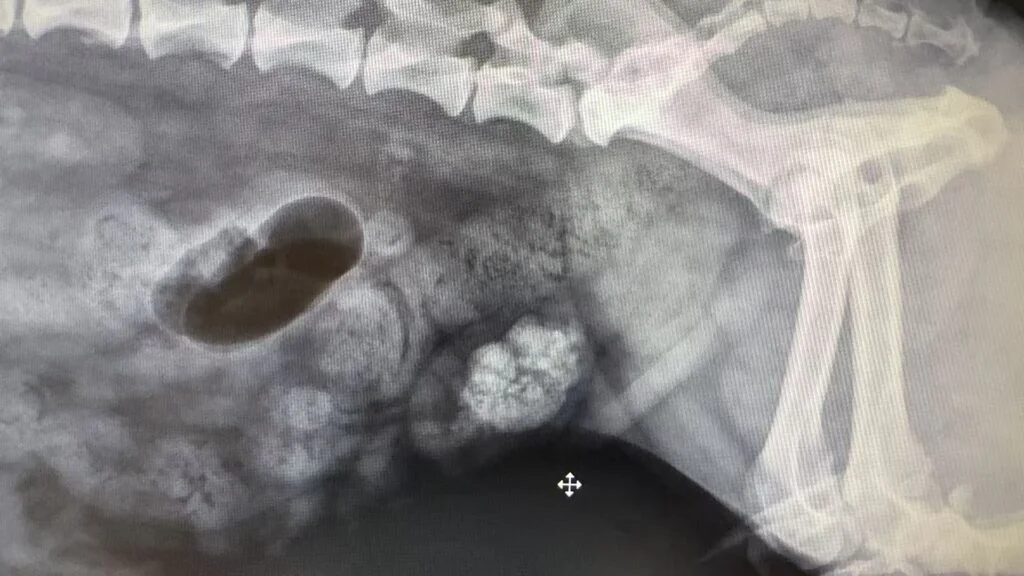
Chief Complaint: Right leg knee joint injury and bladder stones

02 Diagnosis Results

<trp-post-container data-trp-post-id='7439'>Vetmedix Case Sharing丨Application Case of High-Energy Laser Therapy for Knee Joint Injury + Postoperative Care for Bladder Stones</trp-post-container>(images 1)

Diagnosis Result – Knee Joint Injury and Diagnosis Result – Bladder Stones

03 Vetmedix class 4 laser therapy Treatment Plan

Treatment Date: 2025.8.11-2025.8.14
Course of Treatment: Twice daily laser physiotherapy for 4 consecutive days
治疗模式:
Knee Joint Injury: Combined with block therapy, in Program Mode: Dog – Chronic – Musculoskeletal – Light Color – 1-14kg
Postoperative Care for Bladder Stones: In Program Mode: Dog – Acute – Skin – 25cm²
Technique for Affected Areas:
Knee Joint: Use the standard treatment head to circumferentially and vertically irradiate the knee joint. Focus on key areas such as the surrounding pain points (edges of the patella, attachment points of medial and lateral collateral ligaments), Zusanli (ST36) acupoint, Yanglingquan (GB34) acupoint, etc. Irradiation time 3-5 minutes.

Bladder Area: Use the standard treatment head to vertically irradiate the surgical incision and the affected area around the incision. Irradiate for 1-2 minutes, ensuring uniform energy distribution.

Using Vetmedix 4 级激光治疗 During Treatment

04 治疗结果

After Using Vetmedix High-Energy Laser Therapy

05 案例摘要

短期恢复:
The pet presented with long-term lameness. Examination confirmed a right leg knee joint injury accompanied by bladder stones. The veterinary team at Xinjiang Agricultural University First Animal Hospital developed a comprehensive treatment plan for the dual conditions: using Vetmedix high-energy laser for conservative treatment of the knee joint, while simultaneously performing bladder stone surgery, followed by postoperative rehabilitation physiotherapy using high-energy laser. After 4 days of laser physiotherapy, knee joint swelling subsided, and the pet could walk slowly; the postoperative wound sutures were completely removed with no signs of infection.
长期跟踪:
The pet underwent a comprehensive re-examination at the hospital after discharge. The knee joint injury, through conservative treatment and laser care, showed significant recovery of right leg strength, restored normal activity, and even the ability to dig; there were no signs of bladder stone recurrence. Currently, appetite and mental state are stable, recovery is good, with no abnormal reactions.

结论

This case strongly demonstrates the significant dual value of Vetmedix (VETMEDIX) small animal high-energy laser rehabilitation therapy in the repair of Corgi knee joint injury and postoperative care for bladder stones. At the level of knee joint injury repair, the laser, through a photobiomodulation (PBM) mechanism, acts precisely on the damaged joint area in a non-invasive manner. It can quickly inhibit the activity of local inflammatory factors, reduce joint swelling and pain, while also improving microcirculation around the joint, delivering nutrients to damaged cartilage and ligaments, and simultaneously activating tissue repair pathways, promoting cartilage regeneration and ligament healing, effectively alleviating lameness and restoring joint mobility. At the level of postoperative care for bladder stones, the laser can assist in improving local blood circulation in the surgical area, accelerate wound healing, reduce the risk of postoperative infection, significantly shorten the recovery process from the postoperative period to independent movement, and help the pet return to a healthy life state more quickly.

06 Attending Physician

<trp-post-container data-trp-post-id='7439'>Vetmedix Case Sharing丨Application Case of High-Energy Laser Therapy for Knee Joint Injury + Postoperative Care for Bladder Stones</trp-post-container>(images 2)

Li Jianlong
Xinjiang Agricultural University
First Animal Hospital

Physician Introduction:
Member of the Communist Party of China, Ph.D. (Clinical Veterinary Medicine direction), Senior Member of the Chinese Association of Animal Science and Veterinary Medicine, Member of the Chinese Veterinary Medical Association, Member of the UCVO Specialized Committee, National Licensed Veterinarian. Research focuses on the prevention and treatment of common clinical diseases in veterinary medicine, involving equines, ruminants, companion animals, wildlife, etc., covering surgical diseases, obstetric diseases, internal medicine diseases, infectious diseases, and parasitic diseases, with a main focus on surgical diseases and operative techniques. Has published over 40 teaching and research articles as first author or participant, including 6 SCI papers. Participated in obtaining 6 national patents and 1 software copyright. Awarded one first-class and two third-class university-level teaching achievement awards. Excellent Instructor for the “Eagle Cup” in 2019, 2020, and 2022. Excellent Instructor for the National College Student Professional Skills Competition in 2020. National Outstanding Young Veterinarian Award in 2021. National Outstanding Young Veterinarian Award in 2025. Outstanding New Rising Veterinarian at the 6th Asian Small Animal Specialists Congress.

医院简介:
Xinjiang Agricultural University First Animal Hospital’s business scope includes: routine outpatient services, specialty services, grooming and styling design, boarding services, traditional Chinese veterinary medicine rehabilitation physiotherapy, pet cloning, pet photography, pet microchip implantation, etc. Facilities include: Imaging Center (Sinovision 64-slice spiral CT, digital radiography X-ray machine, Feynman color ultrasound), Clinical Laboratory (imported Abbott five-part hematology analyzer and biochemistry analyzer, IDEXX biochemistry analyzer, Jilin full set of laboratory equipment), Clinical Testing Center (drug sensitivity, bacterial and fungal isolation and identification, pathological diagnosis, etc.), ICU and Critical Care Center (hyperbaric oxygen chamber, ventilator, imported Italian hemodialysis machine), Surgical Center (argon-helium knife, VET-RF radiofrequency ablation, anesthesia machine, dental workstation, etc.), Endoscopy Center (nasal endoscope, gastroscope, colonoscope, bronchoscope), Ophthalmology Center (iCare animal-specific rebound tonometer, kowa Sl-17 slit lamp microscope, Neitz binocular indirect ophthalmoscope, ClearView fundus camera, etc.), Rehabilitation and Physiotherapy Center (ultrasound physiotherapy apparatus, laser therapy apparatus, acupuncture, massage, underwater treadmill, etc.).

<trp-post-container data-trp-post-id='7439'>Vetmedix Case Sharing丨Application Case of High-Energy Laser Therapy for Knee Joint Injury + Postoperative Care for Bladder Stones</trp-post-container>(images 3)
上一页 下一个

放心提交。您的数据将根据我们的隐私政策受到保护。
查看更多隐私政策

我知道