 FotonMedix












Erweiterte thermische Kinetik und biomodulatorische Schwellenwerte bei chronischen myofaszialen und neuropathischen Schmerzen
Die klinische Wirksamkeit von Lasertherapie zur Schmerzbehandlung in einem B2B-Krankenhaus beruht auf der präzisen Zufuhr von Photonen mit hoher Strahlungsintensität, um die “optische Barriere” der Dermis zu überwinden und sicherzustellen, dass die metabolische Hochregulierung der Cytochrom c-Oxidase in den tiefliegenden Nozizeptoren der myofaszialen Kette stattfindet.
Die Physik der Tiefengewebsbestrahlung und die “entzündungshemmende Kaskade”
Für den orthopädischen Chirurgen oder den Rehabilitationsleiter ist die “Black Box” der Lasertherapie Schmerz Protokolle ist oft die molekulare Umsetzung von Licht in funktionelle Mobilität. Um eine therapeutische Wirkung bei einer tief sitzenden Pathologie wie einem Piriformis-Syndrom oder einer chronischen Entzündung des Lendenwirbelgelenks zu erzielen, muss das Gerät eine spezifische Leistungsdichte ($W/cm^2$) aufrechterhalten, die dem Arndt-Schulz-Gesetz entspricht - es muss also einen ausreichenden Stimulus bieten, um die Heilung auszulösen, ohne die Hemmschwelle für thermische Schäden zu erreichen.
Der LaserMedix 3000U5 nutzt einen Multi-Wellenlängen-Ansatz (810nm/915nm/980nm), um den Kompromiss zwischen Absorption und Streuung“ zu erreichen. Die 810nm-Wellenlänge ist der primäre Treiber der ATP-Synthese, während die 980nm-Komponente einen kontrollierten Wärmegradienten erzeugt, der den ”Gate Control“-Mechanismus der Analgesie erleichtert.
Die Temperaturverteilung innerhalb des myofaszialen Gewebes während einer hochintensiven Sitzung kann durch die Pennes-Bioheat-Gleichung modelliert werden:
$$\rho c \frac{\partial T}{\partial t} = \nabla \cdot (k \nabla T) + \omega_b c_b (T_a - T) + Q_{laser}$$
Wo:
- $\rho, c, k$ sind die Dichte, die spezifische Wärme und die Wärmeleitfähigkeit des Gewebes.
- $\omega_b c_b (T_a - T)$ steht für die kühlende Wirkung der Blutperfusion.
- $Q_{laser}$ ist die volumetrische Wärmequelle, definiert als $\mu_a \cdot \Phi(r,z)$.
Für einen B2B-Beschaffungsmanager macht diese Gleichung deutlich, warum Systeme der Klasse 4 überlegen sind: Die $Q_{laser}$ muss hoch genug sein, um den “Wärmesenken”-Effekt der Blutperfusion im vaskularisierten Muskel zu überwinden. Ist die einfallende Leistung zu niedrig (wie bei Klasse 3b), wird die Energie vom Kreislaufsystem abgeleitet, bevor sie die angestrebte $O_2$-Dissoziationsschwelle erreichen kann, wodurch die Behandlung eher palliativ als regenerativ wirkt.
Klinische Spezialisierung: Behandlung komplexer regionaler Fuß- und Sprunggelenkspathologien
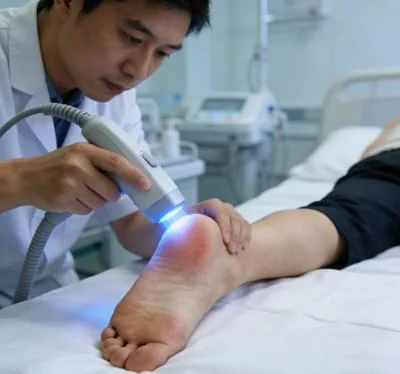
In spezialisierten podiatrischen Zentren, Lasertherapie bei Fußschmerzen hat sich von einem sekundären “Wellness”-Angebot zu einem primären Eingriff bei Tarsaltunnelsyndrom und Morton-Neurom entwickelt. Die Herausforderung am Fuß liegt in der hohen Dichte der kleinen Knochen und dem Fehlen von isolierenden Muskeln, was das Management des “thermischen Gradienten” entscheidend macht.
Durch die Nutzung von Photobiomodulationstherapie mit hoher Spitzenleistung, aber mit gepulstem Tastverhältnis (ISP-Modus), kann der Arzt hohe Energie an den tiefen Tibianerv oder die Plantarnerven abgeben, ohne eine Verbrennung des Periosts zu riskieren. Die Wellenlänge von 915 nm ist hier besonders wirksam, da sie auf dem Höhepunkt der Sauerstoff-Hämoglobin-Dissoziationskurve liegt und die Freisetzung von Sauerstoff in das ischämische, komprimierte Nervengewebe des Fußes erzwingt.
Vergleichende Leistung: Konventionelle Modalitäten vs. Hochintensitäts-Lasertherapie (HILT)
Für Krankenhausadministratoren liegt der ROI der SurgMedix- und LaserMedix-Plattformen in der Verringerung der “fehlgeschlagenen” konservativen Fälle und der Beseitigung der chirurgischen Ausfallzeiten.
| Klinische Metrik | Ultraschall / TENS | Low-Level-Laser (LLLT) | Fotonmedix Klasse 4 HILT |
| Eindringtiefe | < 2cm (Akustischer Abklingvorgang) | < 1cm (Streuverlust) | 8cm - 12cm (hohe Bestrahlungsstärke) |
| Behandlung Zeit | 20 - 30 Minuten | 15 - 20 Minuten | 5 - 10 Minuten |
| Wirkung auf Entzündungen | Passiv | Geringfügig aktiv | Aggressiv (Zytokinhemmung) |
| Neuro-Regeneration | Keine | Begrenzt | Signifikant (Schwann-Zell-Stimulation) |
| Patientenkapazität | 2 / Stunde | 3 / Stunde | 6 - 8 / Stunde |
Klinische Fallstudie: Komplexes Morton-Neurom und Bursitis intermetatarsalis
Patientenprofil und diagnostische Bewertung
- Thema: 42-jährige Frau, professionelle Gesellschaftstänzerin.
- Die Diagnose: Morton-Neurom am 3. und 4. Mittelfußknochen mit begleitender chronischer Bursitis.
- Die Symptome: “Stromschlag”-Empfindungen und Taubheitsgefühl in der 3. und 4. Zehe. Positives Mulder-Zeichen. VAS-Schmerzwert: 8/10. Der Patient war nicht in der Lage, normales Schuhwerk zu tragen oder zu arbeiten.
Technische Intervention und Maschinenkonfiguration
Ziel war es, mit dem LaserMedix 3000U5 das neurale Ödem zu reduzieren und die sensibilisierten Nozizeptoren im Mittelfußraum zu modulieren.
| Parameter Kategorie | Technische Konfiguration | Klinische Logik |
| Auswahl der Wellenlänge | 810nm + 980nm (Dual) | ATP-Synthese + thermische Analgesie |
| Wellenform | Intensiver Superimpuls (ISP) | Hohe Spitzenleistung/geringe thermische Streuung |
| Durchschnittliche Leistung | 15 Watt | Gezielter Einsatz in der Nervenscheide |
| Handstück | 25mm Orthopädischer Abstandhalter | Gezielte Energieverteilung |
| Energie der Sitzung insgesamt | 1.800 Joule | Konzentriert auf den Vorfuß |
| Dauer | 10 Sitzungen (3x/Woche) | Kumulative neuronale Stabilisierung |
Ergebnis der Nachbehandlung und Schlussfolgerung
- Sitzung 4: Der VAS-Wert sank auf 3/10. Die “elektrischen” Empfindungen lösten sich in ein leichtes Kribbeln auf.
- Sitzung 10: Mulder's Zeichen negativ. Der Patient kehrte zum Turniertanz zurück, ohne Schmerzen und ohne Gefühlsverlust.
- Schlussfolgerung: Die hohe Strahlungsdichte Lasertherapie bei Fußschmerzen eine “photochemische Neurektomie” - die Stabilisierung der Nervenmembran ohne das dauerhafte Taubheitsgefühl oder das chirurgische Narbengewebe, das mit der traditionellen Neurektomie verbunden ist. Dieser Fall unterstreicht den B2B-Wert des Angebots von “chirurgischen Alternativen” in einer Privatklinik.
Risikominderung: Technische Exzellenz und Einhaltung der B2B-Sicherheitsvorschriften
Bei der Verwaltung von 30 W Laserenergie muss die Variable “menschliches Versagen” durch fortschrittliches Hardwaredesign minimiert werden. Fotonmedix hält sich an die strengsten medizinischen Fertigungsstandards, um die langfristige Stabilität und Sicherheit der Geräte zu gewährleisten.
Thermische Rückkopplung und Diodenintegrität
Unsere Diodenmodule werden aus hochwertigen Halbleiterwafern mit integriertem thermoelektrischen Kühler (TEC) hergestellt.
- Rotverschiebung verhindern: Wenn sich Dioden erwärmen, kann sich ihre Wellenlänge verändern. Unsere “Intelligent Cooling”-Schleife hält die Diode auf einem konstanten Wert von $22^circ C$, so dass die 810nm Photonen bleiben genau auf den Cytochrom c-Absorptionspeak.
- Kalibrierung der Leistung: Wir empfehlen B2B-Kunden eine jährliche Kalibrierung mit einem digitalen Thermosensor, um zu überprüfen, ob die “Ausgangsleistung” auf der 10-Zoll-Benutzeroberfläche die aus dem Handstück austretenden Photonen genau wiedergibt.
Einhaltung der Vorschriften zur Augen- und Raumsicherheit
Laser der Klasse 4 stellen ein hohes Risiko für die Augen dar.
- Sicherheits-Fußpedal: Jedes Fotonmedix-System verfügt über einen abgeschirmten Fußschalter. Wenn der Bediener den Fuß hebt, wird der Strahl in weniger als 5 Millisekunden unterbrochen.
- Wellenlängenspezifische Schutzbrillen: Wir bieten OD 6+ Schutzbrillen an, die ergonomisch für Brillenträger konzipiert sind und die Einhaltung der 100%-Vorschriften während der Behandlung gewährleisten. Lasertherapie zur Schmerzbehandlung Sitzungen.
Strategische Marktpositionierung: Der ROI von “Sofortigen Ergebnissen”
Auf dem B2B-Medizinmarkt ist der schnellste Weg zum Wachstum einer Klinik das “patientengenerierte Marketing”. Die Fähigkeit einer Lasertherapie der Klasse 4 Schmerzen System eine 50%-Reduktion der Schmerzen nach der erste Sitzung ist ein starker Wachstumsmotor.
Für regionale Händler bietet die Fotonmedix-Serie eine “zukunftssichere” Plattform. Mit einem modularen Design, das sowohl Rehabilitationshandstücke als auch chirurgische Fasern (für die 1470nm-Ablation) unterstützt, investieren Ihre Kunden in eine abteilungsübergreifende Anlage und nicht in ein Einweggerät. Indem Sie die Epidemie der “chronischen Schmerzen” mit hocheffizienter Klasse-4-Technologie bekämpfen, können Ihre B2B-Partner einen erstklassigen, kostenpflichtigen Service anbieten, der klinische Spitzenleistungen und einen schnellen ROI ermöglicht.
FAQ: Professionelle technische Einblicke
1. Kann die Lasertherapie über chirurgischem Material (Schrauben/Platten) eingesetzt werden?
Ja. Im Gegensatz zum Ultraschall, der von Metall reflektiert wird und eine schmerzhafte Erwärmung der Knochenhaut verursachen kann, werden die Laserphotonen vom Metall reflektiert, aber von der Umgebung absorbiert. Weichteilgewebe. Es ist sicher und hochwirksam für die postoperative Schmerzbehandlung im Bereich der Hardware, sofern das Handstück ständig in Bewegung gehalten wird.
2. Wie entsteht durch die Wellenlänge von 980 nm ein “Analgesie-Tor”?
Die Wellenlänge von 980 nm hat eine höhere Absorption in Wasser, was eine lokalisierte thermische Wirkung auf die A-Delta- und C-Schmerzfasern erzeugt. Dieser Reiz gelangt schneller zum dorsalen Horn des Rückenmarks als das “Schmerzsignal”, wodurch das “Tor geschlossen” wird und eine sofortige Linderung eintritt, während die 810-nm-Wellenlänge eine langfristige Reparatur bewirkt.
3. Was ist der Unterschied zwischen “Continuous Wave” und “Pulsed Mode” bei Fußschmerzen?
Die kontinuierliche Welle wird für die hochenergetische “Sättigung” großer Muskelgruppen verwendet. Am Fuß (geringe Masse) verwenden wir den “gepulsten Modus”, um eine thermische Entspannung zu ermöglichen. Dadurch wird verhindert, dass der Patient ein unangenehmes “Brennen” verspürt, während gleichzeitig eine hohe Gesamtzahl an Joule an die Faszien abgegeben wird.