 FotonMedix



Deep Annular Ligament Constriction Defeats Weak Lasers
Synchronized high-power dual-wavelength photon emission decompresses palmar annular entrapment while preventing microvascular thermal spikes via strict pulse gating.
Ambulatory equine practitioners regularly face the frustrating challenge of chronic palmar annular ligament desmitis and digital flexor tendon sheath tenosynovitis in elite sport horses. The daily scene across show barns is exhausting: a grand prix show jumper stands in a grooming stall, flexing its fetlock uneasily while presenting windpuffs the size of baseballs and a dense, thickened transverse band choking the palmar aspect of the joint. Grooms spend half their day wrapping legs with sweat bandages, rubbing DMSO mixtures under standing wraps, and waving a compact cold laser therapy device for horses over the thickened fibrous constriction, hoping for soft tissue decompression that never comes. When performance stable trainers calculate the overall value of laser therapy horses protocols against lost competition seasons, ongoing diagnostic ultrasounds, and repetitive shockwave bills, underpowered devices show their limitations. Equine doctors evaluating the top equine laser therapy devices for ambulatory veterinarians quickly recognize that a heavy, scarred ligament wrapped around deep flexor tendons requires substantial photon saturation that lightweight wands simply cannot generate. Choosing the best cold laser therapy device for horses requires looking past superficial marketing claims to find equipment capable of driving real restorative energy into dense fetlock structures.
Annular Ring Scattering Strangles Low Power Photons
Treating palmar annular ligament constriction requires overcoming the formidable optical density of the distal equine limb. The palmar annular ligament forms a rigid, inelastic fibrous sling that binds the superficial and deep digital flexor tendons against the proximal sesamoid bones inside the digital flexor tendon sheath.
Photons moving through this anatomical cross-section encounter severe structural attenuation and scattering barriers. In optical physics models formulated by Farrell and Patterson for turbid biological media, light distribution within dense collagenous boundaries decays rapidly as scattering coefficients overpower weak energy flux. The thick equine skin, fibrous sub-fascial planes, and dense parallel collagen fibers of the annular ligament scatter incoming light before it can reach intra-thecal structures.
When low-level units are applied, their low photon output degrades into useless surface scatter within the first few millimeters of subcutaneous tissue. The target tenocytes within the compressed flexor tendons, the thickened synovial lining, and the ischemic core of the annular ligament receive zero biostimulatory energy. Cellular mitochondrial activity stays dormant, adenosine triphosphate production fails to accelerate, and chronic mechanical constriction continues to strangulate tendon gliding with every stride.
Dual Wave Target Precision Through Inflamed Synovial Sheaths
Breaking the cycle of chronic annular constriction demands two complementary wavelengths that target the dual pathological components of this injury: severe synovial fluid distension and localized fibrous ischemia.
The 1470nm wavelength targets free and interstitial water molecules concentrated within the distended digital flexor tendon sheath. In chronic tenosynovitis, inflammatory fluid pools under high pressure behind the constricted annular band, creating painful mechanical friction. Water exhibits an exceptionally sharp absorption peak at 1470nm. When high-power photons engage this fluid barrier, localized acoustic vibrational energy breaks up protein-heavy effusion, stimulates synovial lymphatic clearance, and rapidly lowers intra-thecal pressure on compressed digital nerves.
Simultaneously, the 980nm wavelength matches the absorption profile of oxygenated and deoxygenated hemoglobin. The constricted annular band creates a chronic ischemic zone where pinched micro-capillaries cannot supply reparative oxygen to stressed collagen fibers. High-density 980nm photons penetrate deeply into these compressed vascular beds, stimulating endothelial cells and prompting the release of nitric oxide. This surge in local perfusion reoxygenates ischemic ligament fibers, accelerates metabolic waste removal, and provides the biochemical support needed to remodel dense scar tissue into pliable collagen.
Combining high-energy water absorption at 1470nm with hemoglobin excitation at 980nm decompresses synovial effusion while feeding deep cellular repair pathways where single-band devices fail.
Thermal Gating via Calibrated Pulse Duty Cycles
Targeting lesions located deep behind the fetlock joint with high-wattage Class IV therapy requires precise management of surface heat buildup. The skin overlying the palmar annular ligament is thin, highly sensitive, and situated right over dense bone and fibrous bands. Continuous-wave laser energy accumulates heat faster than cutaneous capillary networks can carry it away, causing rapid thermal spikes that agitate the horse and force the operator to pull the handpiece away before deep tissue saturation occurs.
Thermal damage is eliminated through microsecond pulse duty cycles. By dividing laser emission into microsecond energy bursts separated by dark resting intervals, surface tissues shed thermal energy while deep internal structures retain cumulative therapeutic photon density.
Operating at 28 watts of peak power with an engineered 40 percent duty cycle (such as 40 milliseconds of active emission followed by 60 milliseconds of dark interval at 10 Hz) drives intense photon penetration during the pulse. During the 60-millisecond resting phase, the superficial vascular network dissipates heat away from the skin. The deeper, fibrous annular ligament and synovial membranes, which have slower thermal dissipation profiles, retain therapeutic photon absorption. This enables veterinarians to deliver thousands of restorative joules directly into the constricted fetlock canal without exceeding the critical 42-degree Celsius threshold on the skin.
High Intensity Class IV Platforms Versus Basic Mobile Laser Units
Ambulatory equine practitioners must understand the performance differences between low-level light therapy wands and high-power multi-wavelength Class IV medical systems. This operational contrast determines whether annular ligament injuries heal or require invasive surgical transection.
| Clinical Parameter | Class IV High-Power Deep System | Conventional Cold Laser Unit |
| Peak Optical Output | 25W to 30W multi-wavelength pulsed/continuous | 200mW to 1W total diode output |
| Effective Working Depth | 5 cm to 8 cm through dense ligament and sheath | 0.5 cm to 1.5 cm maximum tissue entry |
| Zone Treatment Time | 6 to 8 minutes per fetlock | 40 to 75 minutes per joint |
| Cellular Saturation | Exceeds the mitochondrial biostimulation threshold | Drops below cellular activation depth |
| Thermal Protection | Calibrated microsecond pulse duty cycles | Continuous wave or rough millisecond pulse |
| Clinical Timeline | Measured thickness reduction in 3 to 5 weeks | Protracted months with high recurrence rate |
Attempting to treat chronic palmar annular desmitis with an underpowered cold laser therapy device for horses leaves mobile clinicians at a severe practical disadvantage. Delivering six thousand joules across a thickened annular ring with a 500-milliwatt wand requires over two hours of steady application, which is completely impossible with a fidgeting performance horse. In contrast, an advanced high-power multi-wavelength medical platform delivers that dosage in under seven minutes, sweeping the palmar contours and collateral recesses smoothly.
Investing in high-power technology among the top equine laser therapy devices for ambulatory veterinarians transforms field practice economics. Ambulatory vets save hours on farm calls, manage more appointments per day, and provide definitive non-surgical options for stubborn lameness cases. Field practitioners looking for the best cold laser therapy device for horses must look beyond low-wattage devices and focus on true Class IV deep-penetrating power. Applying modern clinical laser therapy horses protocols with high-intensity equipment delivers consistent soft tissue remodeling where low-power devices stall.
Clinical Case Protocol: Chronic Palmar Annular Ligament Desmitis and Tenosynovitis
Documented clinical metrics confirm the structural and functional changes induced by high-power multi-wavelength photobiomodulation in severe fetlock constriction injuries.
Case History and Pathological Staging
A 10-year-old Selle Français gelding competing in 1.45m show jumping classes presented with chronic left forelimb lameness (Grade 3/5 on the AAEP scale) and marked swelling over the palmar aspect of the fetlock. The horse showed pain on fetlock flexion and carried severe digital flexor tendon sheath distension with a visible indentation notch across the palmar annular ligament. Diagnostic low palmar nerve blocks abolished the lameness, localizing the pain to the palmar fetlock canal.
High-resolution diagnostic ultrasound confirmed chronic palmar annular ligament desmitis. The annular ligament was thickened to 3.8 millimeters (normal baseline is under 2.0 millimeters), showing hypoechoic fiber separation, loss of linear architecture, and moderate adhesions to the superficial digital flexor tendon. The surrounding digital sheath carried severe synovial effusion with synovial plica thickening.
Previous treatments consisting of intra-thecal corticosteroid and hyaluronic acid injections, combined with three months of shockwave therapy and stall confinement, provided temporary relief followed by an immediate flare-up once light trot work resumed. Surgical desmotomy had been recommended. A high-power multi-wavelength Class IV laser protocol was instituted as a non-surgical alternative.
Laser Intervention Dosimetry and Operational Matrix
The gelding underwent a five-week therapeutic protocol utilizing synchronized 980nm and 1470nm wavelengths. Treatments combined non-contact circumferential scanning around the proximal and distal sheath pouches with deep contact massage across the palmar transverse fibers using a high-density quartz handpiece.
| Case Identifier | Patient Profile | Diagnosis and Lesion Extent | Operating Parameters | Dosimetric Delivery | Clinical Horizon |
| EQ-PAL-2026-1312 | 10yo Selle Français Gelding (590 kg) | Palmar Annular Ligament Desmitis (3.8mm thick) with Tenosynovitis | 980nm (16W) + 1470nm (12W); 28W Peak; 40% Duty Cycle | 15 Hz, 8,400 J per session (7.5 min); 15 sessions across 5 weeks | Week 2: Sheath circumference down 26%; Week 5: Ligament thickness down to 1.9mm, zero lameness at trot |
Measured Recovery Trajectory
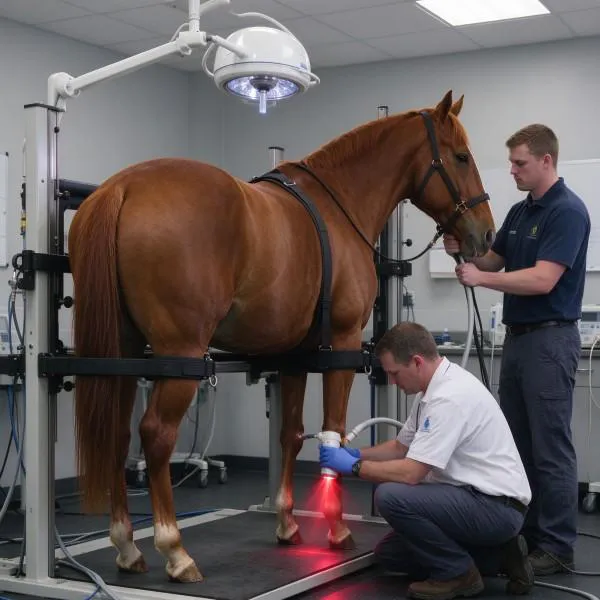
Sessions one through five focused on clearing synovial distension and softening the dense, constricted transverse ligament. The 1470nm wavelength ran at 60 percent of total output using a 40 Hz pulse frequency with a 30 percent duty cycle. Laser energy was directed along the proximal and distal recesses of the tendon sheath. After the fourth session, digital caliper measurements showed a 26 percent reduction in fetlock sheath circumference, and the horse stopped flinching during passive fetlock flexion tests.
Sessions six through fifteen shifted to stimulating cellular remodeling within the thickened annular collagen fibers and releasing intra-thecal adhesions. The 980nm wavelength was increased to maximum output at a lower pulse rate of 15 Hz with a 40 percent duty cycle, delivering deep photon saturation into the dense ligamentous tissue.
Follow-up ultrasound at the end of week five confirmed marked structural repair: palmar annular ligament thickness decreased from 3.8 millimeters to 1.9 millimeters, the normal parallel fibrillar pattern returned, and intra-thecal effusion resolved completely. The horse showed zero lameness during hard-surface lunging, flexed freely without pain, and initiated progressive conditioning without swelling recurrence.
Non Invasive Photobiological Remodeling Versus Surgical Desmotomy
High-intensity multi-wavelength laser therapy provides equine sports practices with substantial advantages over invasive surgical desmotomy and repeated intra-thecal injections.
Surgical transection of the palmar annular ligament involves significant risks, including wound dehiscence, long recovery timelines, and the formation of extensive post-operative scar tissue that can bind the deep flexor tendon permanently. Injections of corticosteroids inside the tendon sheath temporarily quiet inflammation, but repeated use degrades tendon elasticity, promotes intra-thecal adhesions, and elevates the danger of tendon rupture under hard competitive landings. High-power photobiomodulation resolves tissue entrapment through biological stimulation rather than surgical cutting or pharmaceutical suppression.
By delivering high photon density into the mitochondrial respiratory chains of tenocytes and synoviocytes, deep-tissue laser therapy surges cellular ATP production, ramps up fibroblast metabolism, and accelerates the synthesis of organized type-I collagen fibers. Simultaneously, rapid evacuation of inflammatory fluid via water-targeted acoustic mobilization relieves painful mechanical pressure inside the fetlock canal, allowing flexor tendons to glide freely without friction.
Where standard conservative approaches fail and surgery carries career-ending risks, high-power Class IV multi-wavelength laser technology resolves the structural pathology non-invasively. Veterinary practices protect their competitive equine patients, streamline treatment protocols, and deliver lasting soundness through verified optical physics.