 FotonMedix



Impacted Caliceal Stones Dust Without Retropulsion
Super-narrow optical kerf minimizes stone displacement while fourfold water absorption and high-frequency pulse gating suppress intra-renal heat buildup.
Endourologists dread the twenty-millimeter lower pole calcium oxalate monohydrate calculus lodged tightly inside an acute infundibular-pelvic angle. The flexible ureteroscope reaches the calyx at maximum deflection, but advancing a standard holmium optical fiber instantly stiffens the scope, dropping irrigation flow to a trickle and blinding the camera in red-tinged fluid. High pulse energy from traditional flashlamp-pumped systems triggers violent retropulsion, blasting dense stone fragments backward into inaccessible caliceal recesses or tearing delicate papillary margins. Meanwhile, prolonged continuous lithotripsy in a low-flow lower pole risks thermal injury to the urothelium and pyelovenous backflow, transforming a routine outpatient procedure into an emergency urosepsis admission.
Surgical teams face an unyielding hydrodynamic and optical compromise during retrograde intrarenal surgery. Dense stones demand high total energy for disintegration, yet standard solid-state holmium delivery produces irregular, jagged fragments larger than two millimeters that demand tedious basket retrieval, lengthening anesthesia time and multiplying ureteral shearing risks. When operating through tightly curved scopes, surgeons need a coherent light source that maintains high energy output through micro-thin fibers, vaporizing dense mineral matrices into microscopic gravel without kicking the stone away or overheating the renal pelvis.
Optical Absorption Dynamics and Water Resonant Peaks
Achieving microscopic stone dusting without collateral urothelial laceration requires matching optical output to the absorption peaks of liquid water embedded within the urinary tract and stone micropores. Liquid water exhibits an intense infrared absorption peak around 1940nm, situated directly within the emission envelope of thulium laser technology.
The absorption coefficient of liquid water at 1940nm reaches roughly 120 to 140 inverse centimeters, exceeding the absorption coefficient of conventional holmium systems operating at 2100nm by a factor of four. Photons emitted at this resonant wavelength deposit their energy within a penetration depth of less than 0.2 millimeters in hydrated tissue and urinary calculi. Rapid energy confinement inside the interstitial water pockets of the stone generates localized micro-explosions through superheated vapor expansion, pulverizing the crystalline lattice into a fine powder rather than fracturing it into coarse boulders.
Because the optical energy absorbs within a fraction of a millimeter, the laser thulium interaction creates an exceptionally narrow cutting kerf during soft tissue incision, such as infundibulotomy or bladder neck resection. The super-shallow extinction boundary shields underlying deep muscular sheaths from collateral photothermal coagulation, preventing chronic post-operative strictures that plague conventional mechanical or electrocautery interventions.
Spatial Beam Uniformity in Thulium Fiber Laser Systems
Spatial beam quality dictates how cleanly optical power transfers from the console into delicate endoscopes. Solid-state holmium lasers rely on bulky flashlamps and crystal rods that produce multimode, Gaussian-degraded beams requiring thick core fibers between 272 and 365 micrometers. These heavy fibers severely restrict endoscope deflection and strangle the irrigation channel, leading to poor visual fields and high intra-renal pressures.
Integrating a thulium fiber laser system completely changes this physical equation. Using single-mode active silica fibers doped with thulium ions, optical excitation occurs across a core diameter measured in tens of micrometers. The resulting beam profile possesses near-diffraction-limited optical quality, enabling high coupling efficiency into ultra-flexible 150 to 200-micrometer core delivery fibers.
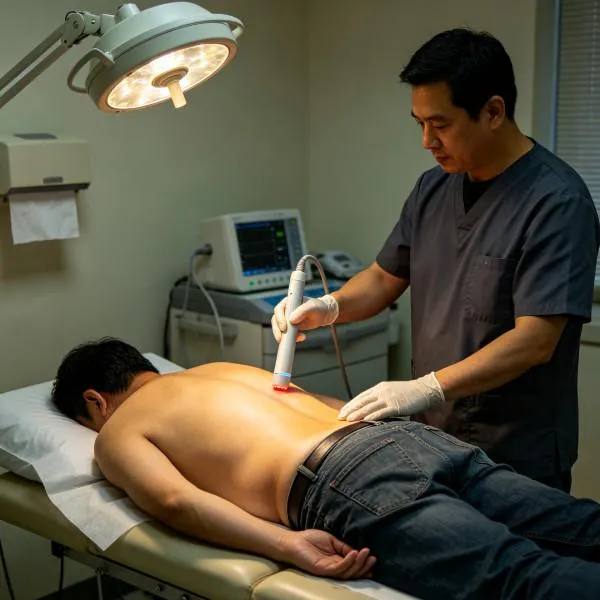
When passed through a fully deflected flexible ureteroscope, a thin thulium fibre laser delivery fiber preserves over 95% of instrument deflection angles while leaving ample clearance within the three-French working channel for continuous saline flush. The continuous, uniform beam prevents hot spots, avoiding catastrophic fiber tip burn-back that shatters endoscope working channels and costs hospital departments thousands of dollars in instrument repairs.
+-----------------------------------------------------------------------------+
| Laser Medium & Fiber  | Water Absorption Peak  | Operational Mechanical Effect|
+=======================+========================+============================+
| Flashlamp Holmium Rod | 2100nm (Moderate)      | Retropulsion, Coarse Chips |
+-----------------------+------------------------+----------------------------+
| Single-Mode Fiber     | 1940nm (Extreme Peak)  | Micron Dust, Zero Recoil   |
+-----------------------+------------------------+----------------------------+
| Thin Optical Core     | 150um Deflection Safe  | Unrestricted Saline Flush  |
+-----------------------+------------------------+----------------------------+
| Target Calculus Pores | Fast Superheating      | True Interstitial Vapor    |
+-----------------------+------------------------+----------------------------+
Thermal Dissipation Control via High-Frequency Pulse Gating
Delivering multi-watt continuous laser power inside an enclosed renal calyx presents a dangerous thermodynamic risk. Irrigant fluid within a restricted calyx warms rapidly if thermal accumulation outpaces convective saline exchange. Research published in the Journal of Endourology demonstrates that intrapelvic temperatures exceeding 43 degrees Celsius cause cellular apoptosis in renal tubular epithelium, while temperatures above 50 degrees Celsius produce irreversible thermal necrosis and stricture formation within seconds.
Mitigating thermal hazard relies on fine pulse-width modulation and high repetition frequency. Rather than firing high-energy pulses that release violent shockwaves, the system splits power delivery into ultra-low pulse energies—ranging from 0.05 to 0.4 Joules—delivered at extreme frequencies between 100 Hz and 2,000 Hz.
Each micro-pulse deposits just enough photonic energy to vaporize surface stone layers, followed by an immediate off-time that respects the thermal relaxation duration of adjacent fluid. The minute energy packets minimize kinetic cavitation bubbles, eradicating stone retropulsion entirely. The stone rests completely motionless against the caliceal wall while the fiber tip skims the surface like an eraser, converting the calculus into sub-millimeter silt that flushes out spontaneously during natural micturition.
Endourology Clinical Case Record
The following surgical protocol and postoperative recovery progression took place at the University Endourology & Minimally Invasive Stone Treatment Pavilion.
Case Identifier: URO-RIRS-2026-0389
Subject: 58-year-old Male, Corporate Director
Clinical Diagnosis: Obstructive Right Lower Pole Caliceal Calculus, 21mm x 14mm, dense Calcium Oxalate Monohydrate (Hounsfield Unit density: 1,380 HU), severe infundibular-pelvic acute angle (38 degrees) with secondary focal caliceal ectasia
Baseline Metrics: Recurrent flank pain, persistent microscopic hematuria, failed prior extracorporeal shockwave lithotripsy; pre-operative CT confirmed dense stone impaction in the lower pole posterior calyx with an infundibular width of only 3.5mm
| Operative Phase | Step Objective | Wavelength Setting | Pulse Energy (J) | Frequency (Hz) | Total Power (W) | Fiber Diameter | Cumulative Energy |
| Phase 1: Access | Infundibular Vaporization | 1940nm Thulium | 0.8 J | 15 Hz | 12 W | 200 µm | 1,800 Joules |
| Phase 2: Surface | Outer Shell Dusting | 1940nm Thulium | 0.15 J | 120 Hz | 18 W | 200 µm | 4,200 Joules |
| Phase 3: Core | Dense Core Vaporization | 1940nm Thulium | 0.25 J | 100 Hz | 25 W | 200 µm | 8,500 Joules |
| Phase 4: Calyx | Caliceal Border Clean-up | 1940nm Thulium | 0.05 J | 200 Hz | 10 W | 200 µm | 1,500 Joules |
Total surgical time was 42 minutes, with a laser emission time of 16.5 minutes. Intraoperative pyeloscopy confirmed complete dusting of the calculus into dust particles under 0.5mm without any stone retropulsion or mechanical basket extraction required. Postoperative unenhanced CT at four weeks confirmed a 100% stone-free rate with normal infundibular drainage and zero ureteral or infundibular stricture.
Precise Photonic Dusting Replaces Obsolete Ballistic Modalities
Traditional stone management methods place heavy mechanical and physical burdens on surgical patients and hospital infrastructure. Extracorporeal shockwave lithotripsy repeatedly pummels healthy renal parenchyma, leading to acute subcapsular hematomas, permanent renal tubular scarring, and hypertension while failing completely against dense monohydrate stones. Percutaneous nephrolithotomy demands large-caliber parenchymal punctures that carry notorious risks of major vascular hemorrhage, organ perforation, and lengthy hospital stays. When surgeons attempt retrograde intrarenal surgery using standard flashlamp holmium systems, the violent kinetic kick of high-energy pulses repeatedly knocks fragments away, leading to prolonged operative times, frequent stone migration, and costly scope repairs caused by fiber stress.
Embracing high-frequency thulium photonics transforms endourology into a gentle, highly controlled ambulatory discipline. Operating through ultra-flexible micro-fibers, the surgeon navigates tortuous lower pole anatomy without compromising scope articulation or irrigation rates. True dusting mechanics pulverize dense crystal structures into microscopic slurry, eliminating the time-consuming basket retrieval of sharp stone chunks and avoiding the ureteral abrasions associated with repeated access sheath passes. Hospital departments benefit from drastically reduced operative times, zero consumable basket costs, and lowered readmission rates, while patients enjoy painless stone clearance, rapid discharge, and a smooth, uncompromised return to professional and personal life.